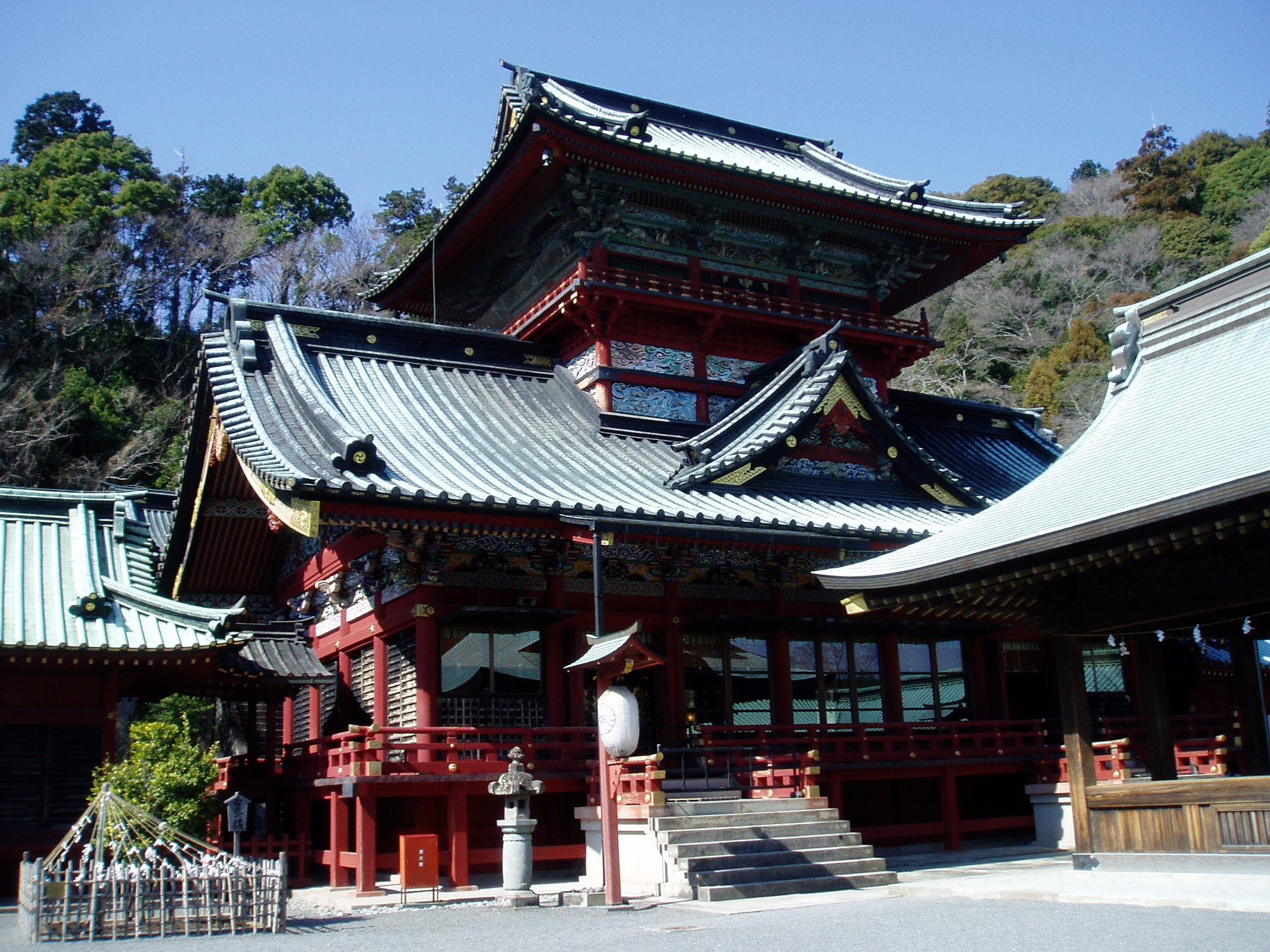
Shizuoka Sengen Shrine
One hundred thousand gold ryo. That was the price the Tokugawa shogunate paid to rebuild a shrine complex that fire had consumed in a single night in 1804. The reconstruction took sixty years, employed the most skilled artisans in Japan, and produced buildings so extravagant in their lacquer, gold leaf, and carved wood that they rivaled anything in Nikko. Shizuoka Sengen Shrine is not one shrine but three, fused into a single sacred precinct at the foot of Mount Shizuhata, where burial mounds from the Kofun period prove that people have recognized this ground as special for well over a thousand years. Among the deities enshrined here is Konohanasakuya-hime, the goddess of Mount Fuji herself, watching over her mountain from across the Shizuoka plain.
Three Gods, One Mountain
The complex comprises three distinct shrines, each with its own identity and divine patron. Kanbe Jinja, the oldest, venerates Ohnamuchi-no-Mikoto, regarded as the mythical founding deity of the ancient Suruga Province. Sengen Jinja, established in 901 as a branch of the great Fujisan Hongu Sengen Taisha, houses Konohanasakuya-hime, the kami of Mount Fuji whose name means 'the princess who makes the blossoms of the trees bloom.' Otoshimioya Jinja honors a deity who appears in the Kojiki as a protector of markets and commerce, a fitting guardian for a region that thrived on Tokaido trade. Together, these three shrines form the Soja, the paramount shrine of Suruga Province, a designation recorded in the Engishiki, the tenth-century compendium of Shinto ritual law. The mountain behind them, Shizuhata, holds a Kofun-period burial mound that has been excavated on its slopes, evidence that sacred activity here predates any written record.
The Shogun's Shrine
Every powerful clan that controlled the Suruga region left its mark on these shrines. The Minamoto, the Hojo, the Imagawa, the Takeda, and ultimately the Tokugawa all served as patrons. But it was Tokugawa Ieyasu, the first shogun, who elevated Shizuoka Sengen to national prominence. After retiring to nearby Sumpu Castle, Ieyasu sponsored a major rebuilding of the complex, and subsequent shoguns continued the tradition of worship here. The third shogun, Tokugawa Iemitsu, granted the shrines revenue-producing lands assessed at 2,313 koku, a substantial endowment. For the Tokugawa dynasty, Shizuoka Sengen was not merely a place of devotion but a political statement, a visible expression of legitimacy connecting the ruling house to the ancient gods of the land they governed.
Rising from the Ashes
On a night in 1804, fire swept through the shrine complex and reduced it to ruin. The shogunate's response was extraordinary: a sixty-year rebuilding campaign in the flamboyant Momoyama style, a deliberate choice of the architectural vocabulary associated with the grandeur of Toyotomi Hideyoshi's era. Artisans covered surfaces in lacquer and gold leaf, carved intricate reliefs into wooden panels, and created structures that were as much works of art as places of worship. The cost exceeded 100,000 gold ryo, an enormous sum even for the shogunate. The result was one of the most visually spectacular shrine complexes in Japan. Today, 26 structures in the compound are protected as Important Cultural Properties by the national government, making Shizuoka Sengen one of the largest concentrations of protected Shinto architecture in the country.
Layers Upon Layers
Beyond the three main shrines, four subsidiary shrines occupy the grounds. Hayama Jinja, founded in 1878, honors the mountain deity Oyamatsumi-no-Mikoto and the legendary warrior prince Yamato Takeru. Yachiho Jinja, created in 1873, is an amalgamation of 18 small shrines and 13 chapels that were once scattered across the surrounding area, gathered into one place during the Meiji reorganization of Shinto. Sukunahiko Jinja has a particularly revealing history: it was formerly the Yakushi-do, a Buddhist hall within Kanbe Jinja, forcibly converted into a Shinto shrine when the Meiji government mandated the separation of Buddhism and Shinto. The shrine museum displays artifacts from the Shizuhatayama Kofun archaeological site, relics connected to Tokugawa Ieyasu, a Muromachi-period tachi sword, and 17 diagrams showing the shrine complex before its catastrophic fire. Each layer of the complex tells a different chapter of Japanese spiritual and political history, stacked like geological strata on this ancient mountainside.
From the Air
Shizuoka Sengen Shrine is located at 34.984N, 138.375E at the base of Mount Shizuhata in Aoi-ku, Shizuoka city. From the air, the shrine complex sits in a forested area at the western edge of the Shizuoka urban center, with Mount Shizuhata rising behind it. Sumpu Castle park is approximately 1 km to the southeast. Shizuoka Airport (RJNS) lies about 20 km to the southwest. On clear days, Mount Fuji is the dominant landmark to the north-northeast. Best appreciated from 2,000-4,000 feet where the shrine's wooded precinct contrasts with the surrounding urban grid.