Shockley Semiconductor Laboratory
William Shockley was convinced someone was trying to injure him. When a secretary cut her finger at his semiconductor laboratory in Mountain View, he ordered lie detector tests for every employee. This was not an isolated incident but a pattern -- the Nobel Prize-winning co-inventor of the transistor had become so paranoid and erratic that the eight most talented scientists in his company were plotting their escape. In 1957, they left. Shockley called them the "traitorous eight" and predicted they would fail. Instead, they founded Fairchild Semiconductor, and from that single act of defection grew an industry. Over twenty years, 65 companies traced their origins to Shockley Semiconductor. By 2014, analysts estimated that over 2,000 companies and 92 publicly traded firms worth $2.1 trillion could be traced back to those eight co-founders.
The Nobel Laureate's Folly
Shockley founded his laboratory in 1955, funded by Beckman Instruments. It was the first high-technology company in what would become Silicon Valley to work on silicon-based semiconductor devices -- a distinction that earned the site an IEEE milestone plaque marking it as the "Birthplace of Silicon Valley." Shockley recruited brilliant physicists from across the country, but his management style was catastrophic. He became obsessed with a four-layer diode of his own design, keeping the project secret even from his own employees while vacillating between priorities. He would demand immediate production of basic transistors one week and redirect the entire team to his experimental diode the next. Mini-rebellions became commonplace.
The Eight Who Changed Everything
The youngest and most talented employees -- Julius Blank, Victor Grinich, Jean Hoerni, Eugene Kleiner, Jay Last, Gordon Moore, Robert Noyce, and Sheldon Roberts -- went over Shockley's head to Arnold Beckman, demanding that Shockley be replaced as manager. Beckman initially seemed to agree but ultimately backed Shockley. The eight broke ranks entirely, securing backing from Fairchild Camera and Instrument, an East Coast company with military contracts. Fairchild Semiconductor began making silicon transistors in 1957. Among the eight, Moore would co-found Intel and formulate Moore's Law, Noyce would co-invent the integrated circuit, and Kleiner would co-found Kleiner Perkins, the venture capital firm. The chain reaction from that single departure is the founding mythology of Silicon Valley.
From Lab to Landmark
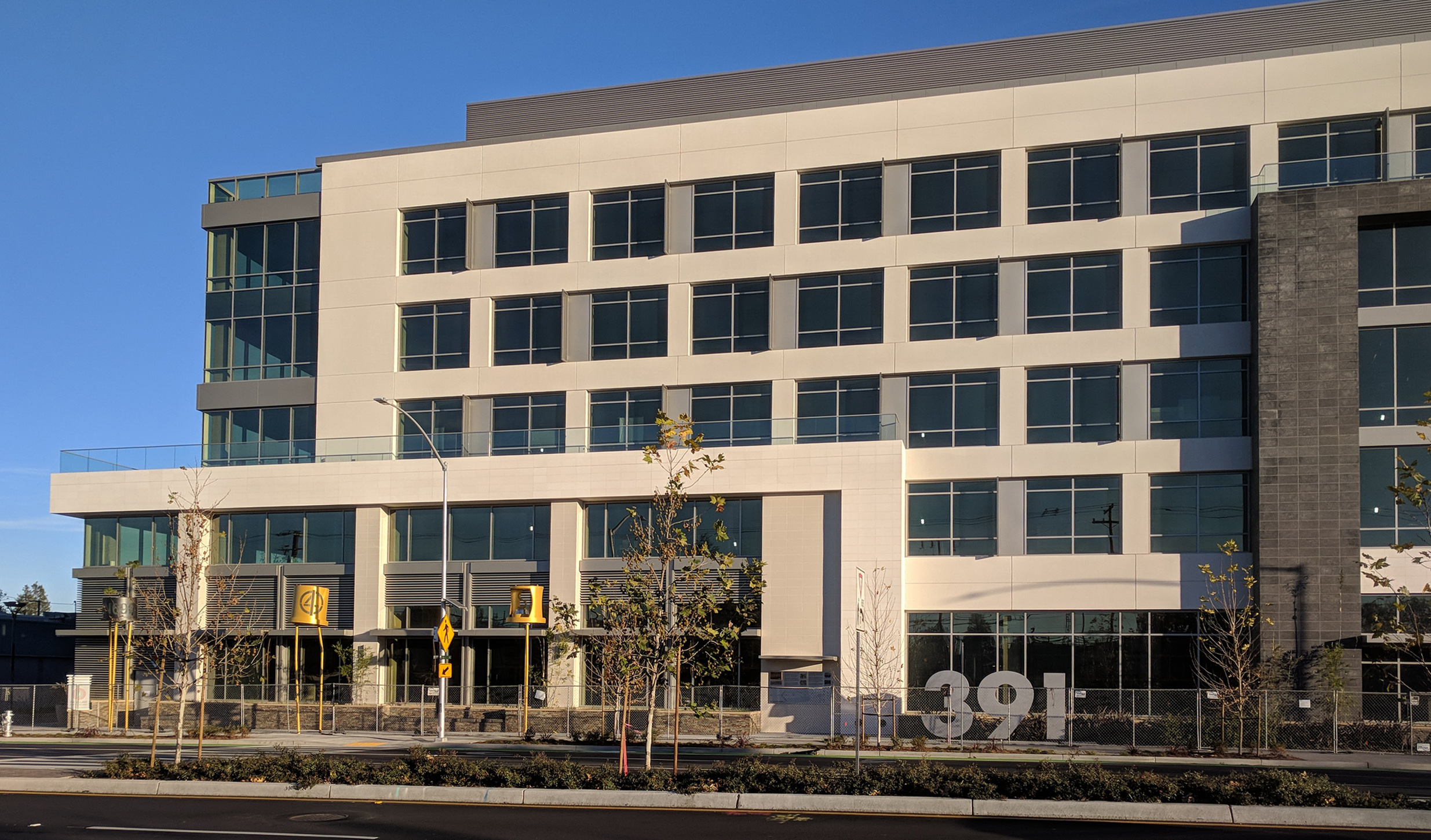
Shockley Semiconductor never recovered. It was purchased by Clevite in 1960, sold to ITT in 1968, and shortly after closed permanently. The building at 391 San Antonio Road in Mountain View had various tenants over the decades, including a produce market. By 2015, plans were made to demolish it. The site was redeveloped by 2017 with new signage marking it as the "Real Birthplace of Silicon Valley" and sculptures of semiconductor packages standing above the sidewalk. Two IEEE milestone plaques honor the lab: one for its founding, one for Moore's Law. The lesson of Shockley Semiconductor is a peculiar one: a genius whose personal failings drove away his best people, inadvertently seeding the most productive technology cluster in history.
From the Air
The Shockley Semiconductor Laboratory site is at 37.40°N, 122.11°W at 391 San Antonio Road in Mountain View. The building has been redeveloped but the site is marked with sculptures and plaques. Nearby airports: Moffett Federal Airfield (KNUQ), San Jose (KSJC), Palo Alto (KPAO). Best viewed at 2,000-3,000 ft AGL.