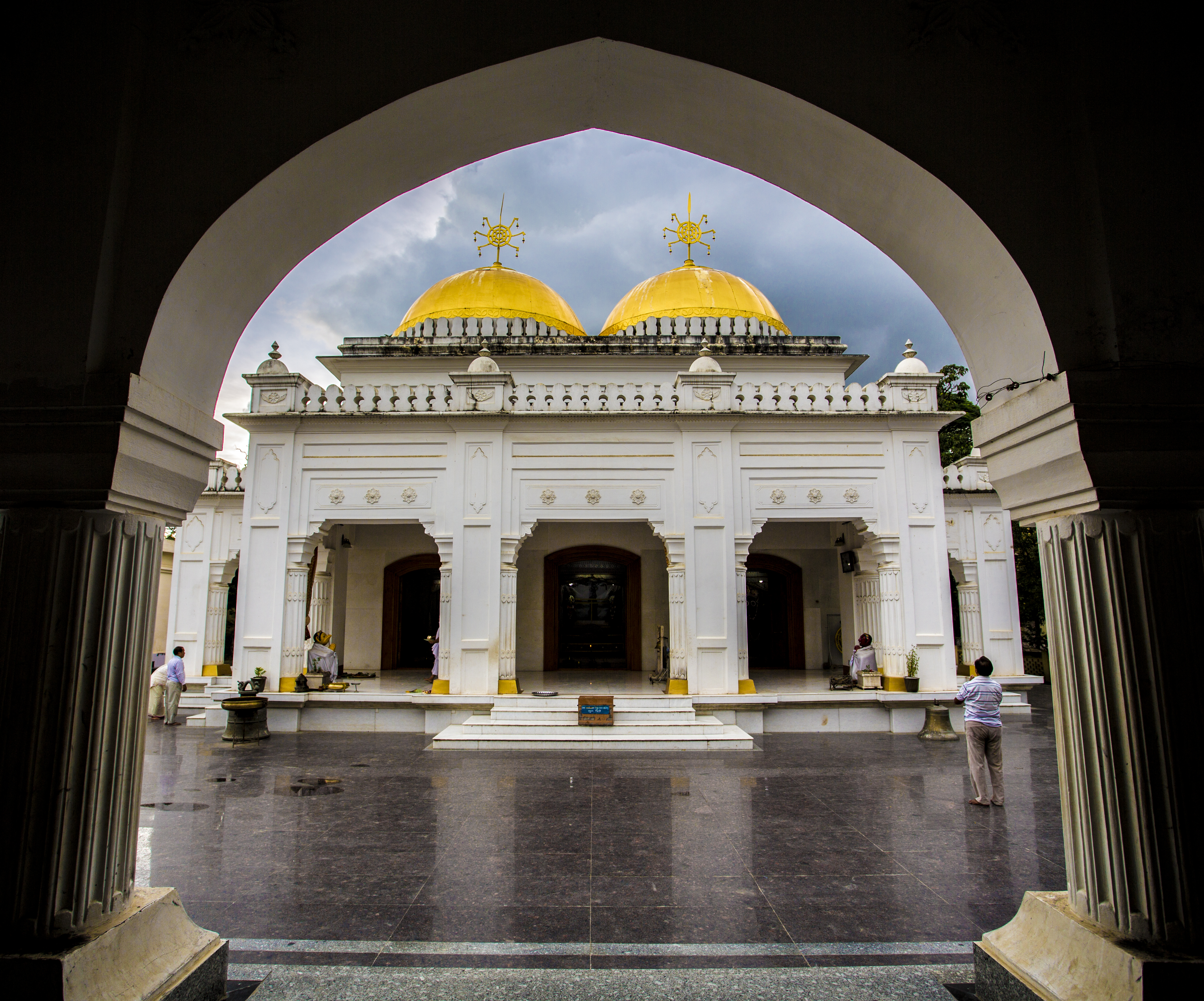
Shree Govindajee Temple
Every morning, a bell rings from a tower beside the Shree Govindajee Temple, and its sound carries across central Imphal like a summons. Conches blow. A curtain parts to reveal the carved images of Govindaji and Radha in the sanctum sanctorum. Devotees line up -- men on one side, women on the other, dressed in prescribed whites and traditional phanek -- while permanently stationed musicians play live accompaniment. This is not a ceremony preserved for tourists. It is a daily act of devotion that has continued, through earthquakes and wars and regime changes, since the 18th century.
A King's Dream, a Kingdom's Deity
The temple's origins trace to Maharaja Jai Singh, also known as Bhagya Chandra Karta, who ruled Manipur from 1763 to 1798. An ardent devotee of Lord Krishna, Jai Singh received what he understood as a divine command: carve an image of Govindaji from the wood of a jackfruit tree and build a temple to house it. He initiated the carving in 1776, and the idol was completed and consecrated in November 1779 on a full moon night. To mark the occasion, the Ras Lila -- an elaborate dance depicting Krishna's play with the gopis -- was performed for five days at Raas Mandal Pukhri at Langthabal. It was the beginning of a tradition that would become one of Manipur's most celebrated art forms.
Built, Broken, and Built Again
The present temple structure has survived through persistence rather than continuity. Maharaja Nara Singh commissioned a new temple on 16 January 1846, dedicating it to Shree Govindaji as the royal deity. An earthquake in 1868 substantially damaged both the building and its sacred images. Maharaja Chandrakriti rebuilt the temple to its original design, consecrating it on 26 April 1876. Then came the Anglo-Manipur War of 1891, and the idols had to be spirited away to Kongma for safekeeping. They did not return to their present location until 1908, when Maharaja Churchand Singh took up residence at his new palace and the images were reconsecrated. Each displacement and return reinforced the temple's meaning: this was not just architecture, but a vessel for something the Meitei people refused to let go of.
Gold Domes and Elephant Heads
The temple stands on a high square platform, its twin domes gilded with gold -- 30 kilograms of it, reapplied during renovations in 2013. The design is deceptively simple from a distance: brick and mortar walls rise through arcade-style columns to a cornice, then to a terrace, and finally to the two arched domes, each crowned with an Amalaka Sila stone disc and a Kalasa finial topped by a white flag. The sanctum contains three chambers: Govindaji and Radha at center, Jagannath, Subhadra, and Balabhadra to the north, and Krishna and Balarama to the south. Facing the temple to the east stands the mandapa, a double-storied colonnaded pavilion where elephant heads at the cornice level support the inclined roof slabs. A separate structure, the Natyashala, hosts the cultural and religious performances that remain central to temple life.
Where Dance Becomes Prayer
The Ras Lila that Maharaja Jai Singh inaugurated in 1779 remains the temple's most spectacular offering. Held during Holi, Basant Purnima in February, and Kartik Purnima in October, the dance brings dozens of gopis in traditional costume to circle the main deity, which is carried out from the sanctum onto the temple grounds. The dancers wear a distinctive skirt said to have been revealed to Jai Singh in a dream -- the Lord appearing before him in that very garment, directing him to build a temple. Janmashtami in August and the Kang chariot festival during June and July draw enormous crowds. The temple administration, once managed directly by the king under Article II of the 1949 Manipur Merger Agreement, is now overseen by a board drawn from the priestly community and prominent citizens, with the Chief Minister of Manipur serving as president.
From the Air
Located at 24.798N, 93.949E in central Imphal, adjacent to the former royal palace compound. The twin gold-plated domes may be visible glinting in sunlight from lower altitudes. Nearest airport is Imphal International Airport (VEIM), approximately 8 km southwest. Recommended viewing altitude: 2,000-4,000 feet AGL. The temple sits near Kangla Fort and the Imphal River, both useful navigation landmarks.