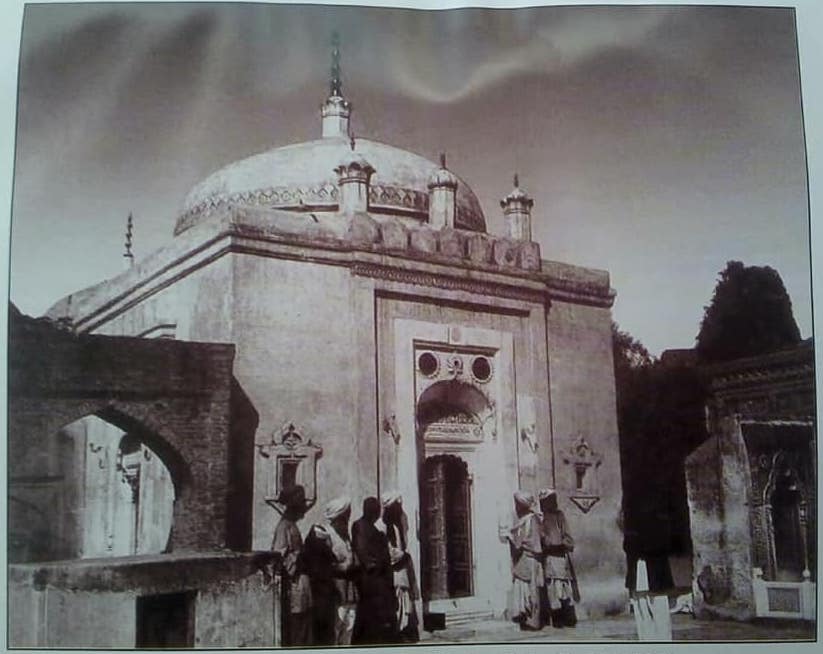
Shrine of Baba Farid
Two doors open into the white marble tomb of Baba Farid in Pakpattan. One faces east -- the Nuri Darwaza, the Gate of Light. The other faces south -- the Bahishti Darwaza, the Gate of Paradise. For more than seven centuries, pilgrims have pressed through both, entering a space so small that no more than ten people can stand inside at once. The intimacy is the point. This is not a monument built for spectacle. It is a place where the boundary between the mundane and the spiritual was meant to dissolve, one visitor at a time.
The Mystic Who Drew a Faith Eastward
Baba Farid settled in Pakpattan in the 13th century, having been born around 1173 in Kothewal near Multan and trained in the Chishti tradition in Delhi. He was a Sufi mystic and poet of the Chishti Order, the first great Sufi lineage to take root in the Indian subcontinent. Where military conquest planted Islam's political flag, Farid and his fellow Sufis planted its spiritual one -- not through force but through devotion, poetry, and the quiet magnetism of a holy life lived in public. His shrine near the right bank of the Sutlej River became a focal point for conversion that unfolded not in years but over centuries. By 1315, the Sufi mystic Amir Khusrow was documenting the 50th anniversary of Farid's death at an urs festival that drew devotees from across the region, where they heard recitations of the saint's deeds and watched dervishes perform.
Emperors at the Threshold
Power recognized what pilgrims already knew. During the Tughluq dynasty's reign between 1321 and 1398, the shrine received official patronage from the royal court in Delhi after the dynasty's founder, Ghiyath al-Din Tughluq, became drawn to what chroniclers called the "spiritual power" of Mauj Darya, the shrine's second hereditary custodian. Subsequent custodians grew so entangled with the Tughluq court that the third was placed in government service in Gujarat, while his brother earned the title "Shaikh ul-Islam" of India. In 1571, Mughal Emperor Akbar himself came to pay respects. A social hierarchy crystallized around the shrine's adab -- its code of conduct -- with the custodian's family at the apex, followed by khalifas, members of the Chishti class, and chiefs of local agricultural clans. The shrine became not just a spiritual center but a node of political and social gravity across the Punjab.
Where Two Faiths Once Knelt Together
Baba Farid's verses appear in the Guru Granth Sahib, the central scripture of Sikhism. That shared reverence once drew Sikh and Muslim devotees to the same threshold, making the shrine a rare site of joint worship -- and, inevitably, a point of contention between the two communities. Partition deepened the divide. With Pakistan and India's relations making it difficult for Pakistani pilgrims to visit the great Chishti shrines in Delhi and Ajmer, Baba Farid's tomb emerged as what scholars call the "unrivaled centre" of Chishti Sufism in Pakistan. The shrine is open 24 hours a day, every day of the year. Local agricultural clans still offer loyalty to Farid's descendants in a ritual some scholars believe echoes the Hindu concept of tirtha -- the crossing of a river ford from the everyday world into the sacred.
The Gate That Will Not Open for Everyone
The Bahishti Darwaza carries a weight that goes beyond architecture. Tradition holds that passing through the Gate of Paradise confers spiritual blessing, and each year at the urs festival, its opening draws enormous crowds. In April 2001, that devotion turned fatal when 36 pilgrims were crushed in a stampede as they rushed toward the gate. The gate sparked controversy again in 2018, when the female police commissioner of Sahiwal District -- invited to perform the ceremonial opening -- was instructed by shrine administrators to send a male guard in her place. She opened the gate herself alongside a female district police officer. The shrine's administration considered it a violation of their regulations; the police department responded by suspending and transferring her. The incident laid bare the tensions between tradition and modernity that run through Pakistan's religious institutions.
A Living Pulse in the Punjab Flatlands
From the air, Pakpattan is a modest town on the plains of southern Punjab, unremarkable against the patchwork of irrigated fields that stretch toward the Sutlej. Nothing in its geometry hints at the spiritual gravity below. Yet every year, the urs festival -- now in its eighth century -- fills the town with devotees for ten days of ritual, music, and remembrance. Following the September 11 attacks, the shrine's caretakers publicly denounced extremist interpretations of Islam, positioning the Sufi tradition as a counterweight to the ideology that was reshaping global perceptions of the faith. The shrine endures as it always has: a small white marble room, two named doors, and a steady current of believers who come not to see a monument but to feel a presence.
From the Air
Located at 30.34N, 73.39E in Pakpattan, Punjab, Pakistan, on the flat alluvial plains east of the Sutlej River. The shrine complex and surrounding town are visible at lower altitudes against the agricultural grid. Nearest significant airport is Multan International Airport (OPMT), approximately 100 km to the southwest. Faisalabad International Airport (OPFA) lies roughly 150 km to the north. Best viewed at 3,000-5,000 feet AGL for context of the town's layout within the Punjab plain.