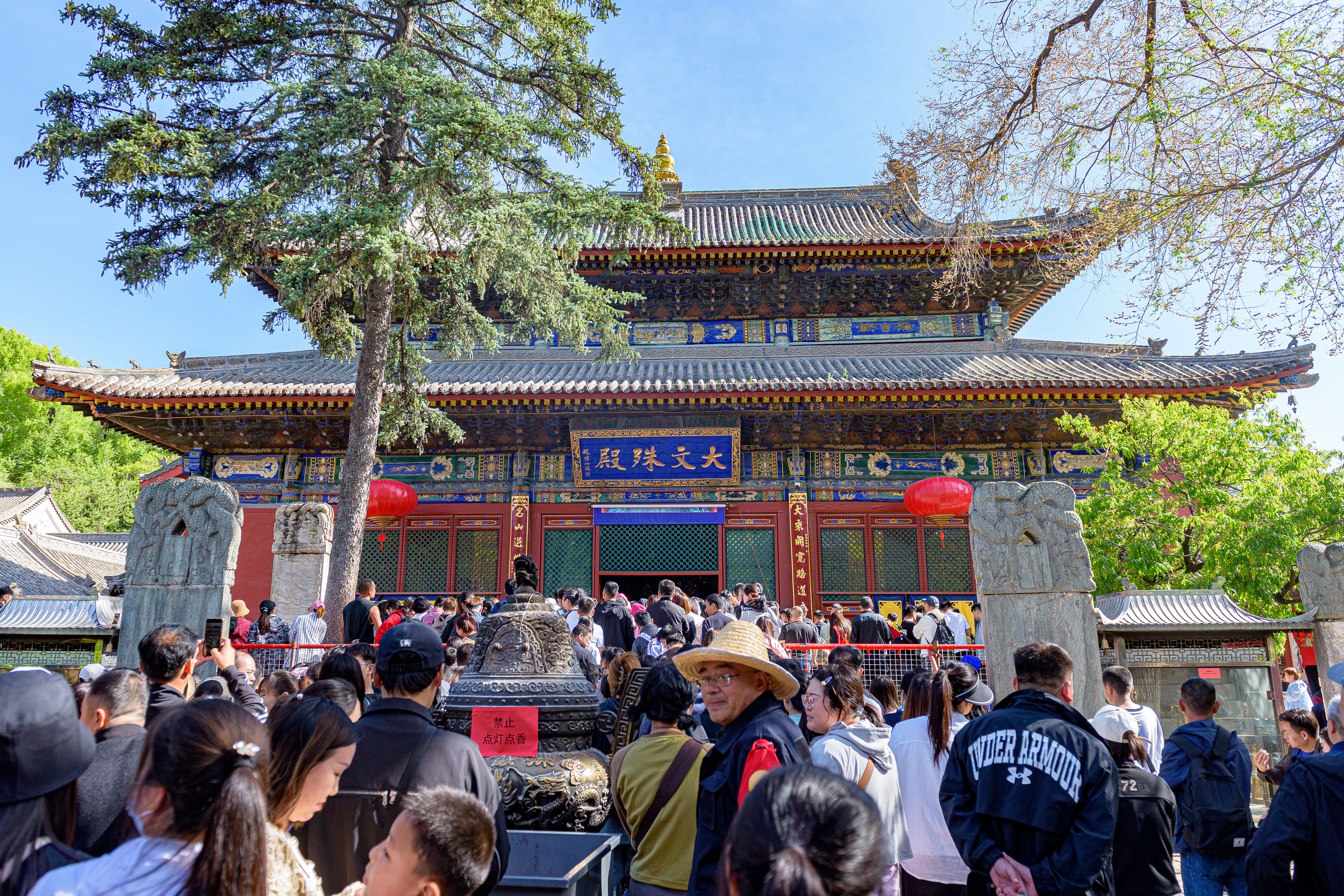
Shuxiang Temple
In front of the entrance to Shuxiang Temple, a spring emerges from the earth. The monks call it the Prajna Spring -- prajna being the Sanskrit word for wisdom, the defining quality of the bodhisattva this temple was built to honor. The spring does not freeze in winter, even when temperatures in these Shanxi mountains plunge well below zero. Pilgrims have interpreted this as a sign: wisdom, like the water, keeps flowing regardless of the season.
Four Dynasties, One Purpose
Shuxiang Temple was first built during the early years of the Eastern Jin dynasty (317-420), making it one of the oldest Buddhist foundations on Mount Wutai. It was rebuilt during the Tang dynasty, again during the Yuan dynasty in 1325, and once more during the Ming dynasty in 1496. Through all of these reconstructions, the temple's central purpose remained unchanged: it was built for worshipping Manjushri, the bodhisattva of wisdom, who is the patron deity of Mount Wutai and the reason the mountain became one of China's Four Sacred Buddhist Mountains. The temple's name, Shuxiang, refers to an image of Manjushri, underscoring that this site exists for one devotional purpose above all others.
The Tallest Manjushri
Inside the Manjushri Hall stands a painted statue of the bodhisattva riding a suan ni -- a mythical creature described as a son of the dragon with the appearance of a lion. At 9.87 meters tall, it is the largest statue of Manjushri in any of Mount Wutai's temples. The figure is not merely large but vivid, painted in full color with an expression of calm authority. On the surrounding walls, sculpted paintings depict the story of five hundred Arhats crossing a river -- a narrative of collective spiritual striving that fills the hall with visual energy. The sheer scale of the Manjushri statue, combined with the narrative complexity of the wall paintings, makes this hall one of the most immersive devotional spaces on the mountain.
A Protected Treasure
Shuxiang Temple covers 6,400 square meters and encompasses over fifty palaces and halls, located on the southwest side of the neighboring Tayuan Temple. In 1983, it was designated a National Key Buddhist Temple in Han Chinese Area. Five years later, in 1988, the State Council of China listed it among the third batch of State Cultural Protection Relics Units -- one of the earlier groups to receive this highest level of national heritage protection. The designations reflect not only the temple's architectural significance but its continuous role in Buddhist practice over sixteen centuries. It is also listed among the Major Historical and Cultural Sites Protected in Shanxi Province, layering local protection on top of national recognition.
From the Air
Located at 39.00N, 113.59E on the southwest side of Tayuan Temple in the Taihuai Town valley on Mount Wutai, Shanxi Province, China. The 6,400 square meter compound with over 50 buildings is sizable. Elevation approximately 1,700 meters. Nearest airports: Wutai Mountain Airport (ZBWT) at roughly 50 km and Taiyuan Wusu International Airport (ZBYN) approximately 230 km southwest. Recommend 3,000-5,000 feet AGL for temple complex viewing.