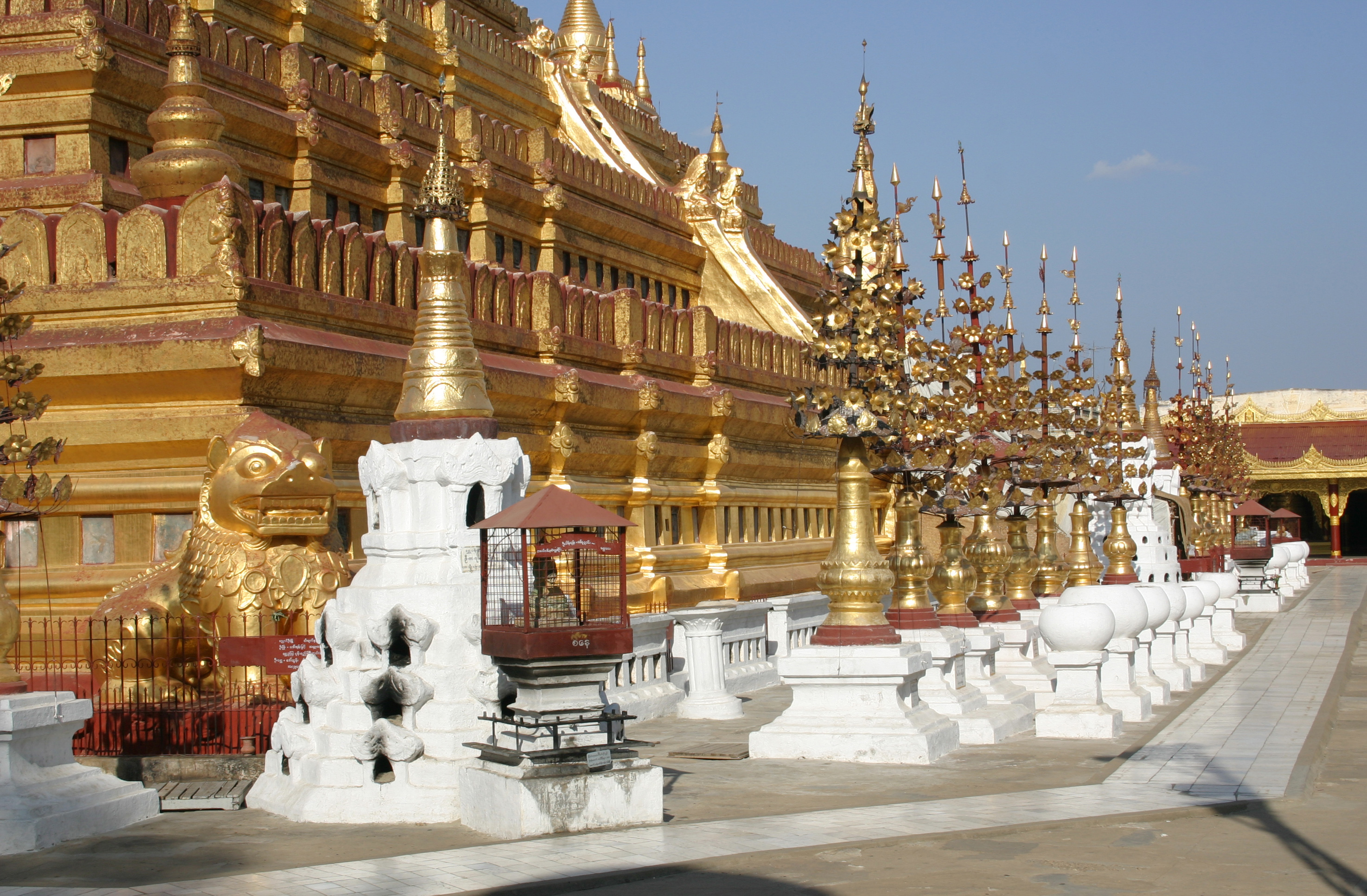
Shwezigon Pagoda
A white elephant chose this spot. According to Burmese chronicles, King Anawrahta placed a relic of the Buddha on the animal's back in 1059 and let it roam freely, declaring that wherever it stopped, he would raise a pagoda. The elephant halted on a sand dune near the banks of the Irrawaddy, in what is now Nyaung-U, and so began the construction of the Shwezigon -- the "golden pagoda on a dune." Anawrahta did not live to see it finished. He died in 1077 with only the lower terraces complete, and it fell to his son Kyansittha to raise the gilded bell of the stupa skyward by 1102. Nearly a millennium later, the Shwezigon still gleams above the plains of Bagan, its gold leaf catching the sun in a land of more than two thousand temples.
The Elephant's Choice
The founding legend of the Shwezigon belongs to the reign of Anawrahta, who unified Burma and established the Pagan Empire in the eleventh century. A devout patron of Theravada Buddhism, Anawrahta acquired what was said to be a frontal bone relic of the Buddha -- though some sources describe it as a replica of the famous Tooth Relic of Sri Lanka. The distinction mattered less than the intent: Anawrahta wanted to build a shrine worthy of the object's sanctity. By mounting it on a white elephant and surrendering the choice of location to the animal, he invested the act with divine authority. The dune the elephant selected sits near the Irrawaddy River, close to the ancient capital of Bagan, in a landscape so thick with pagodas that it earned the name "land of a thousand temples." Anawrahta built the five square terraces that form the pagoda's base, but the cone-shaped stupa rising above them is the work of Kyansittha, who completed the structure between 1084 and 1102. Father and son, two reigns, one monument -- the Shwezigon became a prototype for Burmese stupa design that influenced temple builders for centuries.
Stories in Terra-Cotta
Climb the terraces of the Shwezigon and you walk through the previous lives of the Buddha. Some 550 glazed terra-cotta tiles -- originally 584, though time has claimed a few -- line three of the five terraces, each one illustrating a scene from the Jataka tales, the canonical stories of the Buddha's earlier incarnations. The tiles are among the oldest narrative art surviving in Bagan. Above them, four flights of stairs ascend to an octagonal platform that supports the gilded stupa itself. At the top terrace's corners, miniature replicas of the main pagoda sit fitted with gilded kalashas, or ceremonial vases. Around the base, bronze castings of plants and flowers alternate with stone alms bowls in a continuous band. The effect is not one of accumulation but of layering -- each generation of builders and restorers adding their own devotion to the surface of the structure without erasing what came before.
Four Buddhas, Thirty-Seven Nats
Inside the compound, four bronze standing Buddhas face the cardinal directions: Kakusandha to the north, Konagamana to the east, Kassapa to the south, and Gautama to the west. Each stands roughly twelve feet tall, right hand raised in the abhayamudra -- the "fear not" gesture -- left hand holding the monk's robe. Below the Kassapa statue, a pair of footprints carved into a Bodhi-leaf-shaped sandstone slab features a chakra at their center. Devotees offer oblations through a slot in the stone, and the positioning creates the impression that the Buddha is walking toward the viewer. But the Shwezigon is not purely Buddhist in its pantheon. Along the outer limits of the compound stand statues of 37 nats -- the spirit deities of traditional Burmese religion -- alongside an intricately carved wooden figure of Thagyamin, the Burmese incarnation of the Hindu god Indra. Anawrahta, in a calculated act of syncretism, incorporated the pre-Buddhist spirits into his new temple's orbit, bringing old believers into the fold rather than casting them out.
Shaken and Regilded
The Shwezigon has weathered centuries of earthquakes and monsoons. King Bayinnaung ordered a major renovation in the late sixteenth century, but the most devastating blow came on July 8, 1975, when a magnitude-6.8 earthquake struck the Bagan region -- the worst seismic event in 900 years of recorded history. The spire and dome suffered considerable damage. In the restoration that followed, more than 30,000 copper plates donated by devotees from Myanmar and abroad were fitted over the structure, armoring it against future tremors. The dome was regilded in 1983-1984 and again in subsequent years. Yet the lowest terraces -- the ones Anawrahta's workers laid in the eleventh century -- remain largely in their original form, their ancient brickwork and terra-cotta tiles a direct physical connection to the pagoda's founding. A stone pillar inscribed in Mon, dedicated by King Kyansittha, still stands within the compound, its text a voice from nearly a thousand years ago.
Pilgrimage on the Plains
The Shwezigon remains one of Myanmar's most important pilgrimage sites. Monks in saffron robes circle the stupa at dawn. Devotees press thin squares of gold leaf onto the surface as acts of merit. The annual pagoda festival draws thousands. From above, the compound is unmistakable: a bright golden cone rising from a platform of concentric terraces, surrounded by smaller temples and wooden pavilions topped with pyatthat -- the tiered, spired roofs distinctive to Burmese religious architecture. The Irrawaddy curves nearby, its broad waters reflecting the same sky that has watched over this sand dune since an elephant decided, or was believed to decide, that this was holy ground.
From the Air
Located at 21.19N, 94.89E near Nyaung-U, on the edge of the Bagan Archaeological Zone. The golden stupa is visible from altitude against the dry-zone plains. Nearest airport is Nyaung-U Airport (VYNU). The Irrawaddy River runs nearby to the west and north. Best viewed below 5,000 ft AGL for detail of the compound; the golden dome catches sunlight well in clear conditions.