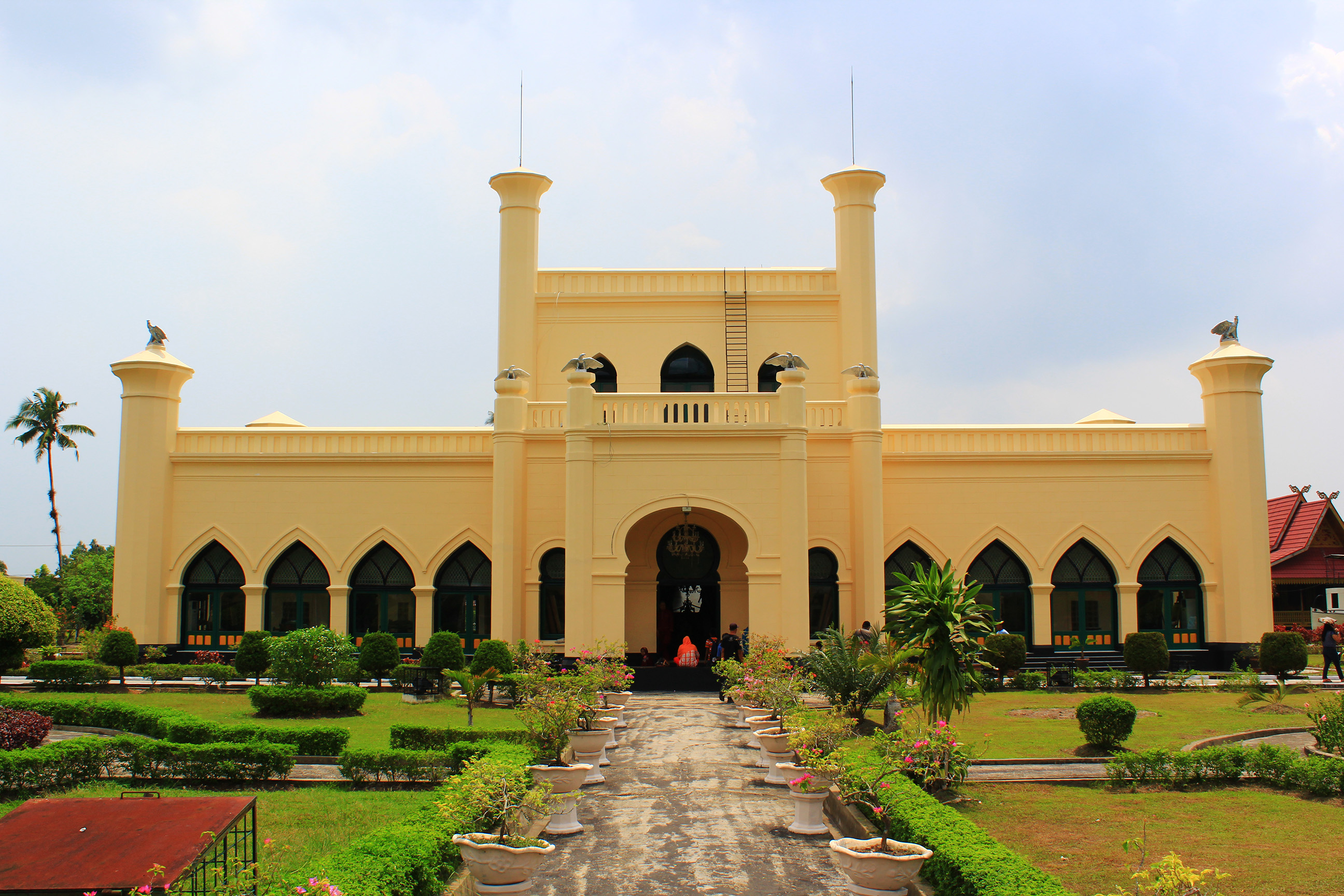
Siak Sri Indrapura Palace
Somewhere in the palace, a mechanical music box called the Komet still works. It is said to be one of only two ever made, and when it plays, the sounds of Beethoven, Mozart, and Strauss fill rooms designed by a sultan who traveled to the Netherlands and Germany before building his own vision of grandeur on the banks of the Siak River. The Siak Sri Indrapura Palace sits 120 kilometers downstream from Pekanbaru in Riau Province, Sumatra -- a place where Malay tradition, Moorish arches, and European furniture share the same floor plan without contradiction.
A Sultan's Grand Tour
In 1889, Syarif Hasyim Abdul Jalil Syarifuddin, the eleventh sultan of the Siak Sri Indrapura Sultanate, began construction of a palace unlike anything in the region. He had already traveled to the Netherlands and Germany, studying European architecture and collecting furniture to ship back to Sumatra. The result was an istana -- a royal palace -- that blended Malay structural traditions with Moorish decorative motifs and European interior design. Dragon ornaments wrapped the pillars, a nod to a founding legend: during planning discussions, a white dragon reportedly appeared on the surface of the Siak River, interpreted as a blessing. The sultan adopted the dragon as the kingdom's official emblem and wove it into the palace's visual identity. Six eagle statues perched atop the building symbolized courage, while eight cannons guarded the courtyard.
Rooms That Tell a Story
The palace complex spans roughly 32,000 square meters and includes four distinct structures: Istana Siak, Istana Lima, Istana Padjang, and Istana Baru. The main palace alone covers 1,000 square meters across two floors. The lower floor holds six formal rooms -- a guest lounge, a room of honor, separate living rooms for men and women, a courtroom that doubled as a party hall, and reception areas. Upstairs, nine rooms served as quarters for the sultan and visiting dignitaries. Behind the palace stands a small building that once functioned as a temporary prison, a reminder that royal power required enforcement as much as elegance. The Balairung Sari, or flower room, served as a ceremonial courtroom, while a royal cemetery on the grounds anchors the complex to the dynasty it housed.
Treasures Behind Glass
Today the palace operates as a museum, and its contents reveal the wealth and cosmopolitan tastes of the Siak sultans. A gold-plated crown set with diamonds sits alongside a golden throne -- objects of ceremony that once marked the apex of regional power. Personal belongings of Sultan Syarif Qasyim and his wife are displayed throughout the rooms, mixing Malay royal regalia with European imports. The Komet, that rare mechanical musical instrument, remains the collection's most unusual artifact. Its survival into the present century is itself remarkable; that it still functions and can fill these hybrid rooms with Viennese waltzes feels almost too perfect a metaphor for the palace itself -- a place where Eastern sovereignty dressed in Western finery and somehow made it cohere.
Where Three Worlds Meet
The architecture of Siak Palace resists easy categorization. Moorish arches frame doorways in a building raised on Malay structural principles, furnished with pieces brought from Europe by steamship. This was not accidental eclecticism. The sultan deliberately collected what he admired from multiple traditions and assembled it into something that expressed both his power and his worldliness. The Siak Sultanate controlled trade along the Siak River, one of the major waterways connecting Sumatra's interior to the Strait of Malacca and the broader trading world beyond. A palace that drew from multiple architectural vocabularies was a statement: the sultans of Siak were not provincial rulers but participants in a global network. That the building still stands, preserved as a museum in Mempura District, means visitors can walk through rooms where that ambition is still legible in every archway and imported chair.
From the Air
Located at approximately 0.79N, 102.05E in Siak Regency, Riau Province, Sumatra. The palace sits along the Siak River, 120 km downstream from Pekanbaru. Sultan Syarif Kasim II Airport (WIBB) in Pekanbaru is the nearest major airport. The Siak River is clearly visible from altitude, winding through lowland jungle and palm plantations. The palace complex is in Mempura District near the riverbank.