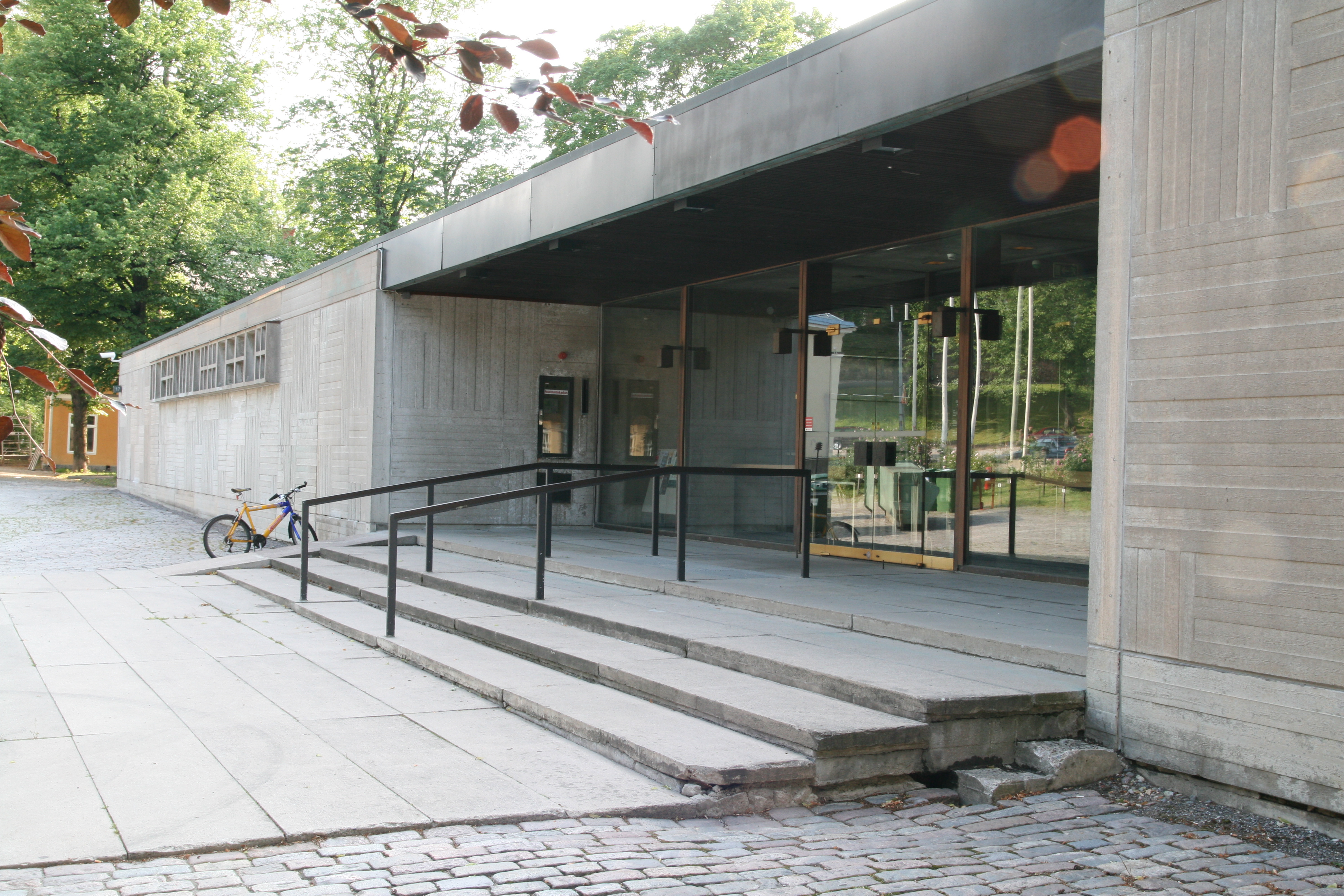
Sibelius Museum
A lone oak tree stands between the Sibelius Museum and the Aura River, the sole survivor of a botanical garden that burned in 1827. Pehr Kalm, a student of the great taxonomist Carl Linnaeus, planted this garden in 1757, filling it with specimens from his travels to North America and Russia. When the Great Fire swept through Turku, the oak endured while everything else perished. Now it guards the entrance to Finland's only museum devoted entirely to music - a Brutalist concrete monument that honors the nation's most famous composer, Jean Sibelius, while housing musical treasures from around the world.
From Botanical Garden to Musical Archive
The site's journey from garden to museum spans two centuries of transformation. After the 1827 fire, printer Christian Ludvig Hjelt purchased the scorched land in 1831 and built wooden houses on the plot. The property changed hands until 1923, when Ellen and Magnus Dahlstrom bequeathed it to the Abo Akademi Foundation. Ship-owner Robert Mattson funded a professorship and purchased materials for what began as a musicology seminar - not a museum, but an academic library. His son Curt donated a remarkable collection of instruments gathered from across the globe. Professor Otto Andersson built the archives that would eventually outgrow their seven cramped rooms in the manor house at Piispankatu 15.
A Name and a Home
Before 1949, the institution had no proper name - it was simply "The historical music collections of Abo Akademi University." The Sibelius name gave it identity and ambition. Andersson traveled to America during the 1950s, acquiring new pieces for the growing collection. But the manor house strained under the weight of instruments, archives, and visitors. Architect Woldemar Baeckman received the commission in the 1960s to design a purpose-built home. His original plans included a separate wing for the university's choir activities, but investigations in 1963 and 1966 scaled back the vision to focus on the museum itself. Construction began in 1967 and finished in February 1968.
Concrete Poetry
Baeckman's building makes no apologies for its materials. The Sibelius Museum stands as a Brutalist monument, its prefabricated concrete facades bearing the visible grain of timber formwork like a woodcut pressed into stone. Inside, a dramatic hyperbolic paraboloid-shaped concrete shell structure - inspired by the Mexican architect Felix Candela - soars over the Sibelius Hall concert space. A hidden courtyard at the building's center once held a garden designed by the noted Finnish landscape architect Maj-Lis Rosenbroijer, though it has since been demolished. The building marks a departure from Baeckman's earlier, more classical modernist work, most notably his extension to the Abo Akademi University Library.
Two Collections, One Mission
The museum divides into two primary exhibitions that circle the central concert hall. The instrument collection showcases historical musical instruments from around the world - the accumulated donations of Curt Mattson and generations of professors and benefactors. The Sibelius exhibition occupies its own dedicated corner, devoted to Finland's composer laureate. Beyond the displays, the archives hold manuscripts, photographs, recordings, and documents tracing musical life in Finland across centuries. Special collections preserve the papers of Otto Andersson himself and the records of the Musical Society of Turku.
Wednesday Nights Since 1968
The Sibelius Hall hosts more than artifacts - it resonates with live performance. The museum's Wednesday concert series has run without interruption since the building opened in 1968. The programming weaves between jazz, folk music, and classical chamber pieces, reflecting the eclectic nature of the collections themselves. Auditoriums named Brahe and Flora honor the university's student choirs, Brahe Djaknar and Florakoren, who have performed in these spaces for decades. Outside the formal series, visiting musicians fill the hall with sounds from traditions Sibelius never imagined - a fitting tribute in a museum that celebrates all of music, not just one composer's legacy.
From the Air
Located at 60.45N, 22.28E in central Turku, Finland, near Turku Cathedral on the southwest coast. The museum's distinctive Brutalist concrete form is visible from low altitude, positioned between the cathedral and the Aura River. Look for the surviving oak tree marking the site of the former botanical garden. The building's hyperbolic paraboloid roof structure creates a distinctive silhouette. Nearest airport is Turku Airport (EFTU), 8 km north of the city center. Best viewed at 1,500-2,500 feet in conjunction with the adjacent Old Great Square and cathedral complex.