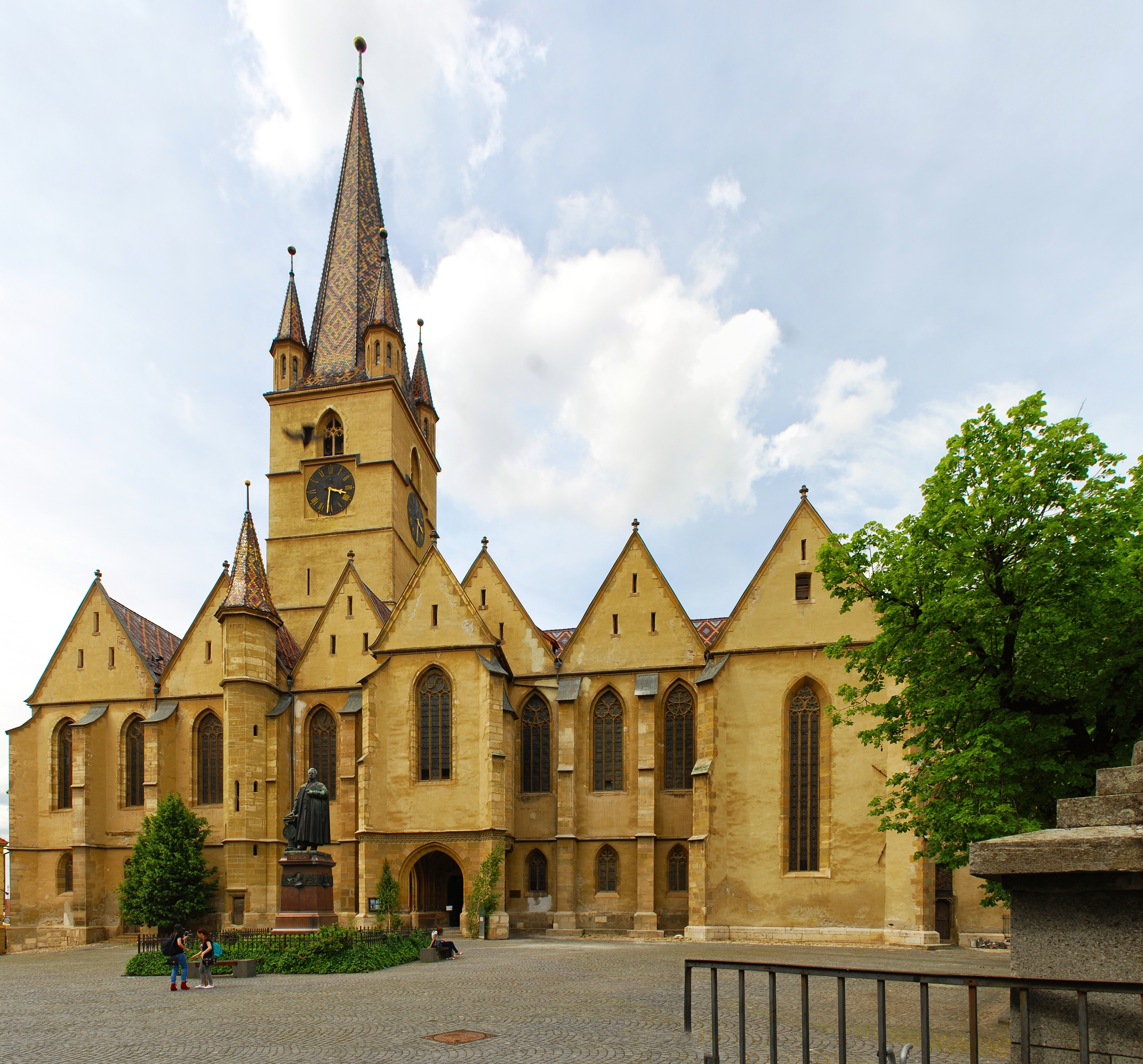
Sibiu Lutheran Cathedral
Four small turrets crown the steeple of Sibiu's Lutheran Cathedral, and they are not decorative. In medieval Transylvania, turrets atop a church tower signaled that the town below held the ius gladii -- the right of the sword, the authority to pass death sentences. At 73.34 meters, the steeple of the Cathedral of Saint Mary dominates Sibiu's skyline the way its German-speaking builders once dominated Sibiu's civic life. The Transylvanian Saxons raised this church in the 14th century on the foundations of an earlier Romanesque building from the 12th century, and for the next seven hundred years it has stood at the center of Piata Huet, accumulating layers of history in its stones, its organs, and its crypt.
From Catholic Parish to Lutheran Stronghold
The cathedral began its life as the Catholic parish church of Saint Mary, serving the German merchant community that had settled in Sibiu -- known to them as Hermannstadt -- during the medieval colonization of Transylvania. In the mid-16th century, the Reformation swept through the Saxon communities, led by Johannes Honter, a humanist scholar who had studied in Basel and Vienna before returning to Transylvania to convert his people to Protestantism. The church became Lutheran, and it stayed Lutheran. For three centuries afterward, the cathedral served as the burial place for Sibiu's mayors, earls, and prominent citizens, their tombs and epitaphs lining the nave. The practice was banned in 1796, but one final exception was made in 1803 for Baron Samuel von Brukenthal, the Habsburg governor of Transylvania, whose elaborate epitaph remains one of the cathedral's treasures.
Two Organs, Seven Centuries Apart
Records suggest an organ has stood in the cathedral since 1350, though the current instrument bears no relation to that medieval predecessor. The Sauer Organ, built between 1914 and 1915, commands the west gallery with 78 registers -- the largest organ in Transylvania. Its tone fills the Gothic nave with a resonance that the vaulted stone ceiling amplifies and sustains. On the south balcony sits a smaller but historically richer instrument: the Hahn Organ, built in 1748 by Transylvanian organ builder Johannes Hahn. This organ was not originally made for the cathedral at all. It was commissioned for the parish church in the village of Boarta, then spent years at the Samuel von Brukenthal National College before being moved to the cathedral in 1948. It has been restored twice since, in 1988 and again in 2008, each time revealing new details of Hahn's craftsmanship.
The Rosenau Fresco and a Cannon Reborn
High on the nave wall, a large fresco dating to 1445 depicts scenes from the life, passion, and ascension of Jesus Christ. The work is attributed to Johannes von Rosenau, and it survives as one of the most significant medieval paintings in Transylvania -- remarkable not only for its age but for its completeness. Many comparable frescoes across Europe were whitewashed during the Reformation or lost to subsequent renovations. The Rosenau Fresco endured. Equally arresting, though far smaller, is the cathedral's bronze baptismal font, which carries a story of transformation: it is said to have been cast from the bronze of a captured Ottoman cannon. In a region where the Ottoman Empire pressed against Christian Europe for centuries, melting a weapon of siege into an object of sacrament was an act laden with meaning -- a statement about what endures after empires recede.
Stones That Remember
Among the notable burials in the cathedral is Mihnea cel Rău -- Mihnea the Bad -- a Wallachian prince who was assassinated on the steps of the church in 1510. His tomb shares the space with Brukenthal's more stately memorial, an unlikely pairing: the murdered prince and the cultivated governor, separated by three centuries but united by the same Gothic arches. The cathedral received electric lighting and heating in 1910, a concession to modernity that its medieval builders could not have imagined. A major renovation completed in 2021 addressed structural concerns accumulated over seven centuries. Today the cathedral anchors Piata Huet, Sibiu's most atmospheric square, where cobblestones and medieval facades create an enclosure that feels less like a public space than a private courtyard the city forgot to lock.
From the Air
Located at 45.7978N, 24.1498E in Sibiu's Old Town, Romania. The cathedral's 73-meter Gothic steeple with four corner turrets is the tallest structure in the old city and a key visual landmark from the air. It sits on Piata Huet, distinguishable from the nearby Orthodox cathedral's twin Byzantine spires. Best viewed at 1,500-2,500 feet AGL. Nearest airport: Sibiu International (LRSB), approximately 3 nm west.