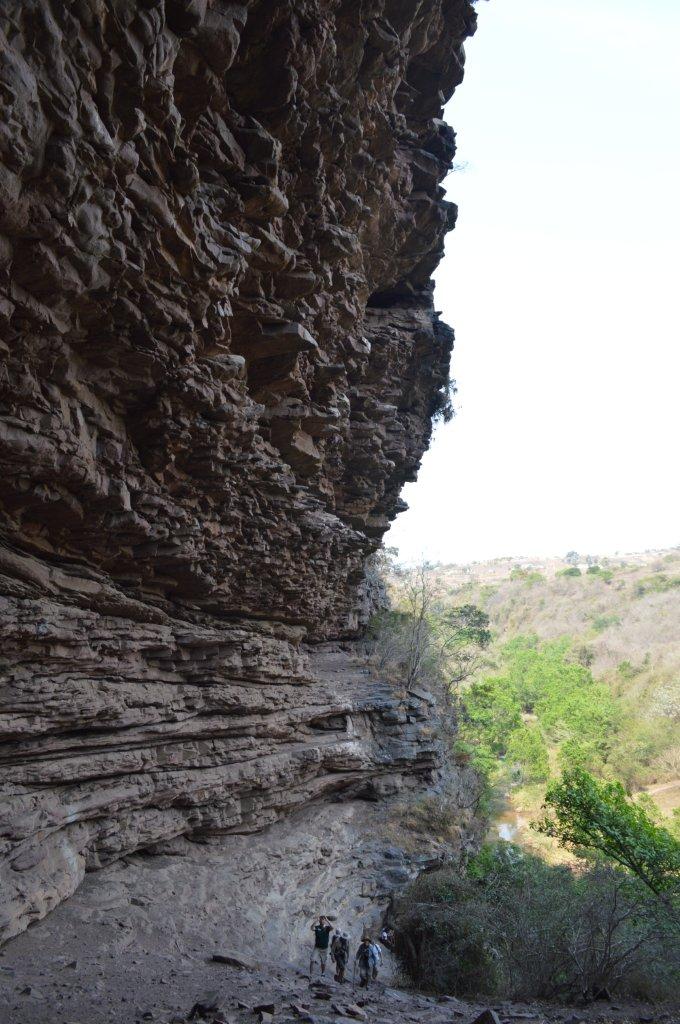
Sibudu Cave
Someone, roughly 64,000 years ago, knapped a stone point into a narrow blade, fixed it to a wooden shaft with a glue made from ochre and plant resin, and launched it from a bow. The arrow struck its target in the green river valley below. We know this because the residue of that adhesive, and the microscopic damage pattern on that stone tip, survived in the sediments of Sibudu Cave, a sandstone rock shelter perched above the Tongati River in KwaZulu-Natal, South Africa. That anonymous archer's shot represents the oldest confirmed evidence of bow-and-arrow technology on Earth. But Sibudu is not a single revelation. It is a library of firsts, layered in six meters of stratified deposits that span tens of thousands of years of continuous and interrupted human occupation, from the deep Middle Stone Age through to an Iron Age presence around 1000 B.C.
A Shelter Shaped by Water
The cave sits roughly 40 kilometers north of Durban and 15 kilometers inland, near the town of Tongaat. It is not a cave in the traditional sense but a rock shelter, carved into a steep, forested sandstone cliff by the erosional downcutting of the Tongati River, which now flows 10 meters below. The shelter floor stretches 55 meters long and 18 meters wide, spacious enough to accommodate extended groups. Sugar cane plantations now blanket the surrounding lowlands, but the cliff face retains its forest cover, a remnant of the subtropical woodland that would have provided Sibudu's occupants with food, fuel, and raw materials. Archaeologist Lyn Wadley of the University of the Witwatersrand began renewed excavations here in September 1998, uncovering a stratigraphic sequence that has since reshaped our understanding of early human cognition.
The Inventors' Workshop
What makes Sibudu extraordinary is not one discovery but the sheer density of technological firsts compressed into its layers. The cave's occupants produced the earliest known bone arrow, pushing back the origin of bow-and-arrow technology by tens of thousands of years beyond previous estimates. Stone-tipped arrows here date to 64,000 years ago. The earliest known needle was also recovered from these sediments. But the most telling artifacts may be the compound adhesives. To haft stone points onto wooden shafts, Sibudu's residents mixed ochre with plant-based resins, creating glues whose recipes required precise proportions and controlled heating. The complexity of this process, involving the mental coordination of multiple ingredients and sequential steps, has been cited by researchers as evidence that these people possessed cognitive abilities indistinguishable from our own. Each cultural phase tells a different story: the pre-Still Bay occupation relied on simple flake tools, the Still Bay people crafted elegant bifacial points, and the Howiesons Poort inhabitants produced crescent-shaped blades shaped like orange segments, designed to slot into composite weapons.
Bedding Down with Chemistry
Among the most intimate glimpses into daily life at Sibudu is the bedding. Approximately 77,000 years ago, the cave's inhabitants gathered sedges and other grasses, laid them on the shelter floor, and topped the mattress with leaves of Cape laurel, Cryptocarya woodii. This was not arbitrary. When crushed, Cape laurel releases aromatic compounds including alpha-pyrones, cryptofolione, and goniothalamin, chemicals with documented insecticidal and larvicidal properties effective against mosquitoes. The occupants of Sibudu, in other words, were practicing a form of herbal pest control tens of thousands of years before anything resembling formal medicine. Cryptocarya species remain in use in traditional medicine across southern Africa today. The bedding layers also contained dried fruits, carbonized seeds from species like Croton sylvaticus and Bridelia micrantha, and other plant remains that paint a picture of people who understood their environment with precision. They were not merely surviving in this shelter. They were engineering comfort.
Rhythms of Presence and Absence
Sibudu was not continuously occupied. The stratigraphic record reveals gaps, periods when the shelter stood empty for thousands of years. Evidence suggests these absences coincided with dry climatic intervals, the cave drawing people in only during wetter conditions when the surrounding landscape could support hunting and gathering. Innovations appeared and then vanished. Shell beads decorated the Still Bay layers but were absent from the Howiesons Poort period. This pattern, visible at Sibudu and at other South African sites, challenges any simple narrative of steady human progress. Technology was not a ratchet that only turned one way. Ideas emerged, served their purpose, and were sometimes abandoned, only to be reinvented later or replaced by something different. After the final Middle Stone Age occupation, the cave fell silent. No Late Stone Age people left their mark here. Then, around 1000 B.C., Iron Age occupants briefly returned, adding one more chapter to a record that stretches back across geological time.
World Heritage and the Weight of Deep Time
In 2024, Sibudu Cave was inscribed as part of the UNESCO World Heritage Site of Pleistocene Occupation Sites of South Africa, joining a serial nomination alongside Blombos Cave, Pinnacle Point, and other sites that collectively document the emergence of modern human behavior on the African continent. The designation was years in the making. South Africa submitted its proposal in 2015, and the site had waited on the tentative list before three of the nominated locations achieved formal recognition. Standing at Sibudu today, looking out over the Tongati River valley from the same vantage point that sheltered arrow-makers and herbalists, the scale of time involved is almost impossible to grasp. Sixty-four thousand years of arrows. Seventy-seven thousand years of insect-repellent bedding. These are not abstractions. They are the material traces of people who solved problems, adapted to changing climates, and left behind a record that speaks across millennia to anyone willing to read sediment as carefully as text.
From the Air
Coordinates: 29.52°S, 31.09°E. The cave is in a sandstone cliff overlooking the Tongati River valley, roughly 40 km north of Durban and 15 km inland near Tongaat, KwaZulu-Natal. From the air, the forested cliff face contrasts with surrounding sugar cane fields. The shelter itself is not visible from altitude but the river gorge and cliff line are identifiable. Nearest major airport: King Shaka International (FALE) approximately 25 nm south. Virginia Airport (FAVG) is also nearby. The coastal lowlands of northern KwaZulu-Natal are generally flat with subtropical vegetation. Expect warm, humid conditions year-round.