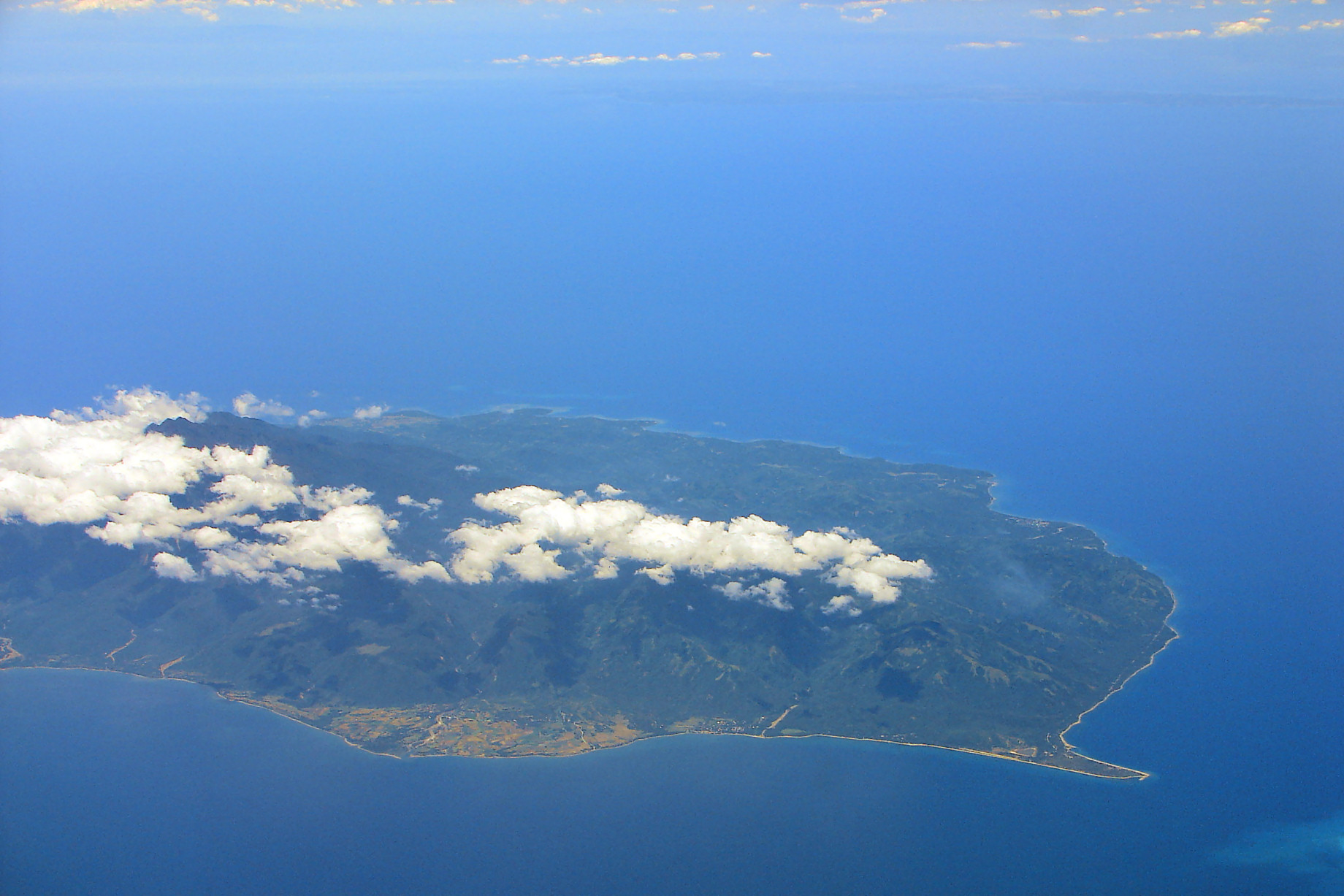
Sibuyan Island
Scientists call it the Galapagos of Asia, and the comparison is not casual flattery. Sibuyan Island has never been connected to any other landmass in its entire geological history. Not during ice ages, when sea levels dropped and land bridges stitched together much of Southeast Asia. Not during the tectonic collisions that assembled the Philippine archipelago. Sibuyan simply rose from the sea floor on its own, a crescent of volcanic rock in the Sibuyan Sea, and everything that lives on it either flew there, floated there, or evolved there from scratch.
A Mountain Like a Saw Blade
Mount Guiting-Guiting dominates the island, its name translating to "the saw-toothed mountain" in reference to a jagged ridgeline that looks like it could cut the clouds passing over it. At 2,058 meters, it is the highest point in Romblon Province, and its steep flanks are the reason Sibuyan's forests survived when so much of the Philippines was logged. The slopes were simply too precipitous to make timber extraction worthwhile. Primary forest still covers 140 square kilometers, roughly a third of the island's total area. The Mount Guiting-Guiting Natural Park protects 157 square kilometers, encompassing an unbroken gradient from lowland dipterocarp forest through montane cloud forest to mossy heathland near the summit. Walking from coast to peak is like passing through every tropical forest type in a single day.
An Inventory of the Unknown
In a single hectare of Sibuyan forest, the National Museum catalogued 1,551 individual trees belonging to 123 species. Fifty-four of those species exist nowhere else in the world. Across the island, an estimated 700 vascular plant species thrive, including the pitcher plant Nepenthes sibuyanensis, endemic as its Latin name announces. The animal inventory reads like a field biologist's wish list: 131 bird species, ten species of fruit bats, and a roster of mammals and reptiles still being formally described. Three bird subspecies are found only here, among them the Philippine hanging parrot and the Orange-bellied Flowerpecker. Five threatened mammal species, including the endangered fruit bat Nyctimene rabori, call Sibuyan home. The Sibuyan striped shrew-rat and the Sibuyan shrew are so locally specialized they were unknown to science until researchers climbed the right ridge at the right altitude.
Water Clean Enough to Drink
The Cantingas River flows down from Guiting-Guiting's slopes with water so pure it has been tested as among the highest quality for human consumption in the world. Sibuyanons drink it untreated, straight from rivers, springs, and bore holes drilled into mountain slopes. Smaller rivulets cascading through the forest canopy carry the same remarkable clarity. This is not nostalgia for a premodern past; it is a living reality for the island's 62,815 residents, spread across three municipalities: Cajidiocan, Magdiwang, and San Fernando. The ecosystem's integrity functions as municipal infrastructure. When the forest is healthy, the water is safe. The connection is not abstract here. It flows downhill every morning and people fill their glasses with it.
Snow from Canada
Mining has stalked Sibuyan since at least 1972, when exploration first began. Operations started in earnest in 2005, and the friction turned lethal in 2007 when Romblon town councilor Armin Marin was shot dead during an anti-mining protest against the Sibuyan Nickel Properties Development Corporation. The confrontation between demonstrators and the company's security guards left a community grieving and a movement hardened. In January 2023, after the government issued a permit allowing Altai Philippines Mining Corporation to extract 50,000 metric tons of nickel ore, residents erected barricades. On February 3, protesters formed a human chain to block trucks leaving San Fernando port. The trucks forced through anyway, and thirty policemen arrived to disperse the crowd. Within days, the Department of Environment and Natural Resources cited the company for operating a causeway without environmental clearance and ordered an investigation into alleged destruction of seagrass beds and illegal tree cutting.
The Waters Off the Crescent
Sibuyan's isolation cuts both ways. The same deep waters that preserved its biological uniqueness have also claimed lives. On June 21, 2008, the passenger ferry MV Princess of the Stars, operated by Sulpicio Lines, capsized off the island's coast during Typhoon Frank. Of 851 passengers aboard, only 32 survived. The disaster remains one of the deadliest maritime accidents in Philippine history. Today, the Sibuyanons Against Mining advocacy group and the Sibuyan Island Sentinels League for Environment continue their campaign to protect what remains untouched. Their argument is simple and difficult to refute: what took millions of years to evolve in isolation can be destroyed in a single mining season. The saw-toothed mountain still cuts the sky, the rivers still run clear, and the species that exist nowhere else still cling to slopes too steep for the chainsaws to reach.
From the Air
Sibuyan Island sits at approximately 12.42N, 122.58E in the Sibuyan Sea, visible as a distinct crescent-shaped landmass between Luzon and the Visayas. Mount Guiting-Guiting's 2,058-meter peak is a prominent landmark from altitude. The island has no commercial airport; nearest airports include Tugdan Airport (RPVU) on Tablas Island to the northwest. Approach from the east for dramatic views of the ridgeline against the sea. Dense tropical forest canopy is clearly visible from 5,000-10,000 feet.