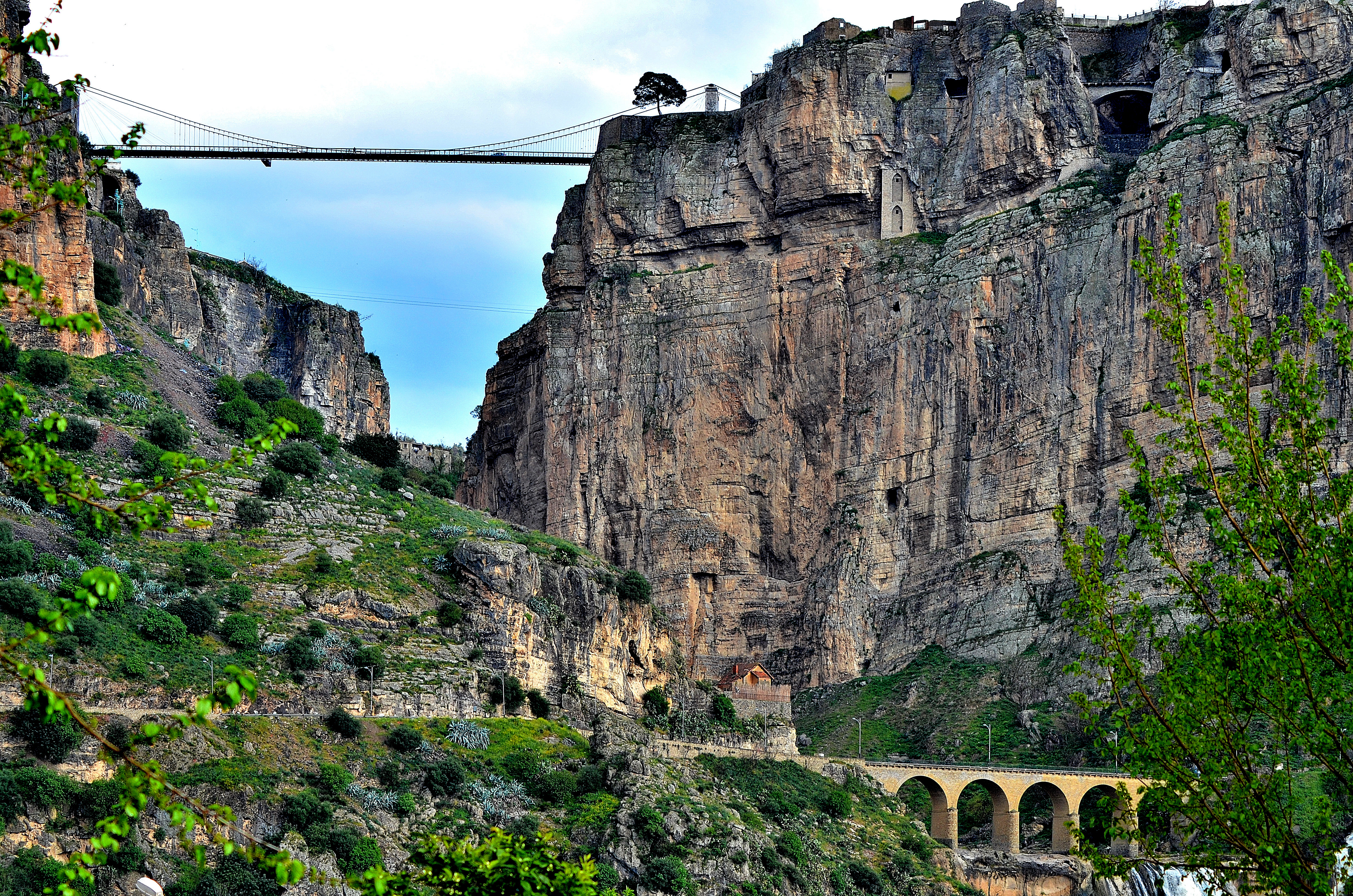
Sidi M'Cid Bridge
For 17 years, the highest bridge on Earth hung over a gorge in northeastern Algeria. The Sidi M'Cid Bridge, a 164-meter suspension span designed by French engineer Ferdinand Arnodin, opened in April 1912 and held the world record until the Royal Gorge Bridge in Colorado surpassed it in November 1929. The record is gone, but the bridge remains, swaying slightly above the Rhumel River gorge with the kind of quiet confidence that comes from having been terrifying for more than a century.
Morinaud's Modern City
The bridge was the signature project of Emile Morinaud, who served as mayor and member of parliament from 1901 to 1934, a period during which he set about modernizing a city of 50,000 people. The Sidi M'Cid Bridge and the Sidi Rached Bridge were both constructed during his tenure, along with numerous other prominent buildings. Morinaud understood that Constantine's geography, a city split by a gorge hundreds of meters deep, required infrastructure that matched the landscape's drama. He commissioned Arnodin, France's leading suspension bridge engineer, to connect the Casbah with Sidi M'Cid hill. The result was a structure that earned Constantine international attention and a place in the record books.
Steel Above the Abyss
The bridge stretches 164 meters across the Rhumel gorge, its cables anchored to the rock on either side of the chasm. Below it, almost directly beneath the span, a natural stone bridge blocks much of the river from view, a geological formation that predates the human structure by millions of years. The juxtaposition of engineered steel and natural rock creates one of the most striking visual compositions in North African architecture. In 2000, the bridge underwent restoration when 12 of its cables were replaced by the Algerian company SAPTA, but the fundamental design remains Arnodin's. The cables hum in the wind. The deck flexes under traffic. Looking down through the railings, the Rhumel is a distant thread of water in a stone channel carved by eons of erosion.
A Monument at the Far End
On the Sidi M'Cid hill side of the bridge stands the Monument of the Dead, a war memorial that commemorates the people of Constantine who died fighting for France in the First World War. The monument is a replica of the Arch of Trajan at Timgad, the Roman triumphal arch 180 kilometers to the south, a choice that links Constantine's colonial-era memorial to the region's deep Roman past. The architectural reference was deliberate: France presented itself as the heir to Rome in North Africa, and borrowing the form of a Roman arch for a war memorial reinforced that narrative. Whether the Algerian soldiers whose names appear on the monument would have endorsed the comparison is a question the memorial does not invite.
The View From the Span
Standing on the Sidi M'Cid Bridge today, you can see several of Constantine's other crossings below: the Bab El Kantra with its layers of Roman, Ottoman, and French construction; the massive stone arches of the Sidi Rached Viaduct; the modern cables of the Salah Bey Viaduct. The gondola lift passes overhead. Together, these structures form a vertical catalog of engineering ambition spanning two millennia. The Sidi M'Cid Bridge occupies a particular place in that catalog, the one that for a brief window was the most extreme crossing humans had ever built. That it was built not in New York or London but in Constantine, Algeria, says something about the challenges that geography presents and the lengths to which cities will go to overcome them.
From the Air
Located at 36.37N, 6.61E in Constantine, Algeria. The suspension bridge is visible spanning the Rhumel gorge at the northern end of the old city, connecting the Casbah with Sidi M'Cid hill. The Monument of the Dead is visible on the hillside. Best viewed at 1,500-3,000 feet AGL for perspective on the gorge depth. Nearest airport: Mohamed Boudiaf International Airport (DABC) approximately 10 km south. City elevation approximately 640 meters.