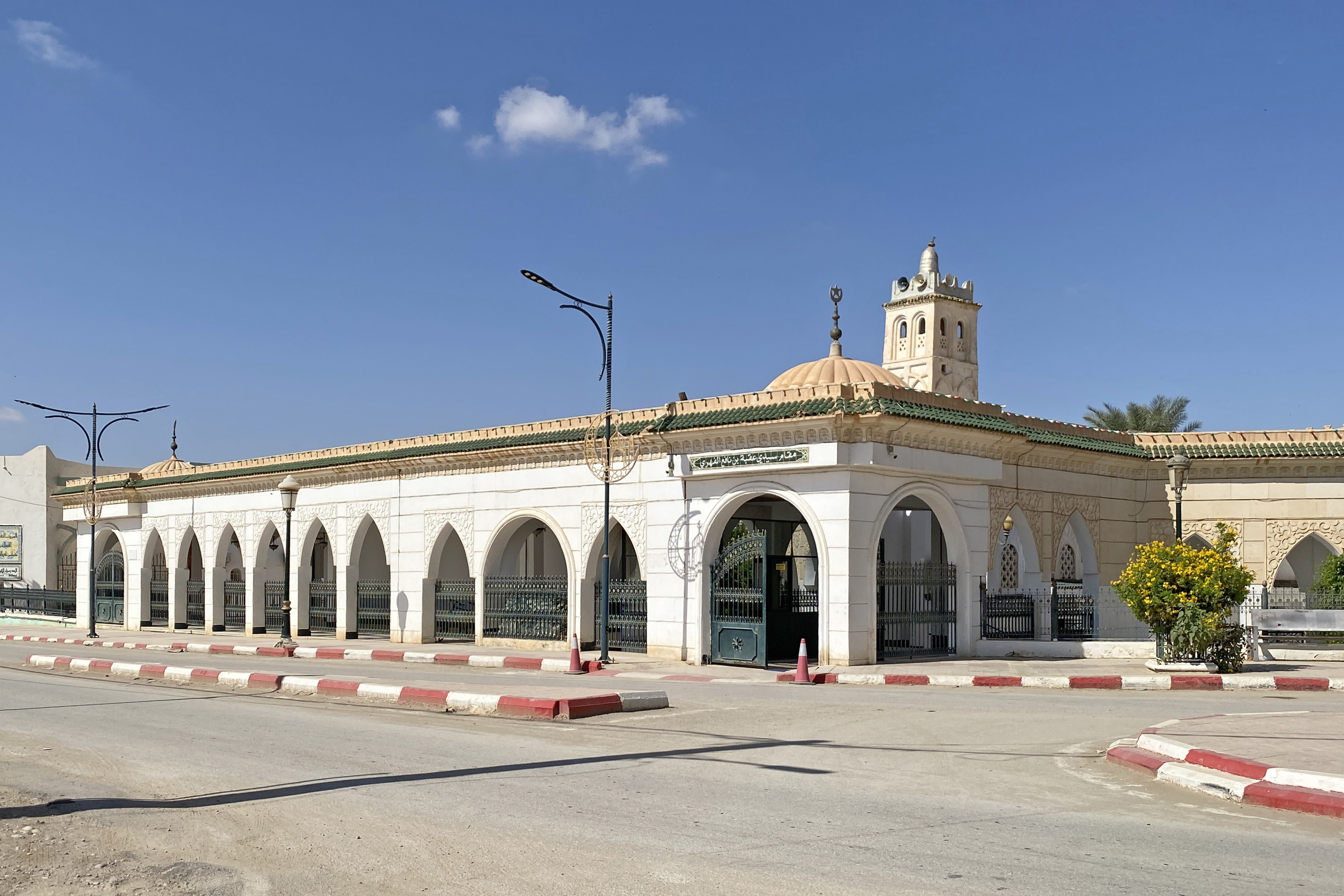
Sidi Okba Mosque
The man buried beneath this mosque rode west until the Atlantic Ocean stopped him. Uqba ibn Nafi, a companion of the Prophet Muhammad and one of the most relentless commanders of the Muslim conquest of the Maghreb, pushed his armies across the breadth of North Africa in the 7th century. According to tradition, he rode his horse into the surf of the Atlantic and declared that only the sea prevented him from carrying the faith further. Then he turned back east, toward home -- and into an ambush. He never made it. The mosque that bears his name, in the village of Sidi Okba near Biskra, stands over the place where he fell in 683 CE, making it one of the oldest Muslim monuments in Algeria.
Death at Thouda
Uqba ibn Nafi was returning from his victorious Battle of Vescera in the Atlas Mountains when the army of Kusayla ibn Lamzah, a Berber Christian king, caught him in an ambush outside the town of Thouda. The details of the battle are sparse in surviving accounts, but its outcome was decisive: Uqba was killed, along with many of his followers. He was buried in what became the village of Sidi Okba, and the site gradually transformed from a simple grave into a place of commemoration. Who built the first mosque over the tomb is debated -- some historians believe it was Uqba's surviving followers, redeemed from captivity by judges in Tunis and sent back by Commander Zuhayr ibn Qays to honor their fallen leader.
Layers of Stone and Time
The building was not raised all at once. The tomb, the oldest element, probably dates from 686 -- three years after Uqba's death. The structure grew through successive remodelings and expansions over the centuries. Two domes define its interior: one above the mausoleum in the southwest corner, the other before the mihrab. The mihrab itself is covered by a semi-dome decorated with stucco carved in simple, irregular interlace patterns, with engaged columns whose capitals bear grooved carvings and stylized palm-tree motifs. The original minaret rises on a square shaft, its exterior ornamented with niches and intersecting blind arches, crowned at the top by decorative merlons. The architectural vocabulary is modest but confident -- the work of builders who understood that endurance, not grandeur, was the point.
The Ancient and the Modern
In the 21st century, a modern Islamic complex was added around the historic mosque, including a new prayer hall large enough for 5,000 worshippers. The old mosque has been connected to the new complex through additional porticoes, and the grounds now include a Quranic school, a library, a conference room, and dormitories. The juxtaposition is striking: the original minaret with its blind arches stands beside contemporary construction, the 7th-century tomb enclosed within a compound designed for thousands. The expansion reflects Sidi Okba's continuing importance as a pilgrimage site -- a place where the origins of Islam in Algeria are not abstract history but living devotion.
A Companion's Legacy at the Edge of the Desert
Sidi Okba sits near Biskra, at the threshold where the Tell Atlas gives way to the Sahara. The mosque stands at a geographic and spiritual frontier -- the place where the westward advance of early Islam met its first serious reversal in North Africa. Uqba's status as a sahabi, a companion of the Prophet, gives the site a significance that extends far beyond Algeria. Pilgrims travel here not merely to visit a historical monument but to honor a man whose connection to the founding generation of Islam makes this patch of desert earth sacred. The village that grew around his tomb took his name, and the mosque that shelters his remains has outlasted every empire that followed -- Umayyad, Abbasid, Ottoman, French -- standing where the Atlas meets the sand, where a conqueror became a martyr, and where a 7th-century grave became a place of prayer that has never fallen silent.
From the Air
Located at 34.75N, 5.90E near Biskra, at the edge of the Sahara Desert. The village of Sidi Okba is in a flat, arid landscape where the modern mosque complex is the most prominent structure. Nearest airport: DAUB (Mohamed Khider Airport, Biskra), approximately 18 km northwest. The transition from Tell Atlas foothills to desert is clearly visible from altitude.