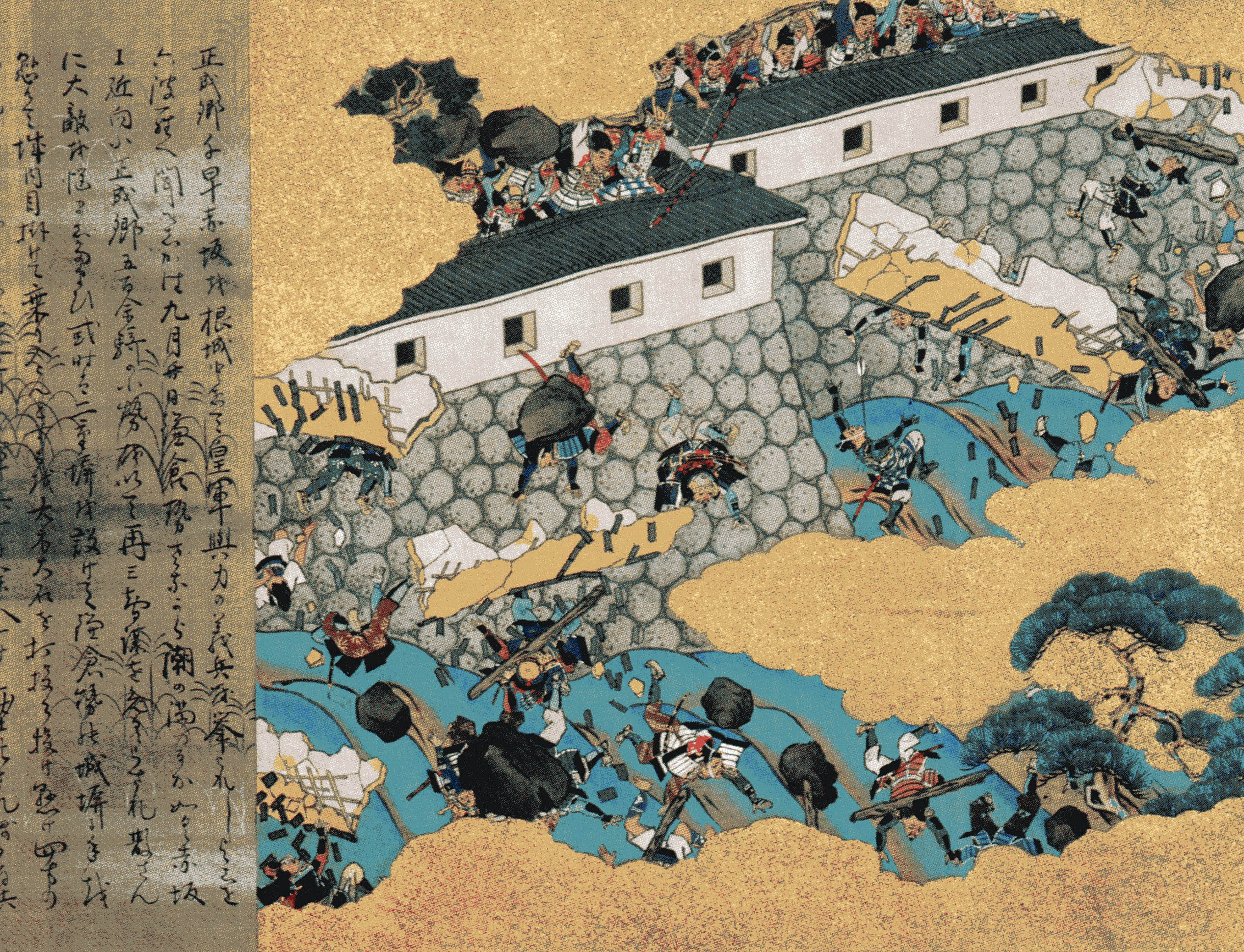
Siege of Akasaka: The Emperor's Impossible Gamble
Two hundred samurai behind wooden walls against an army that may have numbered 300,000. The arithmetic was absurd, and Kusunoki Masashige knew it. But in the autumn of 1331, on a mountainside near what is now Osaka, the warrior-tactician turned those impossible odds into one of medieval Japan's most celebrated last stands -- not by winning, but by making defeat so costly and escape so theatrical that it became the opening act of a revolution. The Siege of Akasaka was never supposed to be a victory. It was supposed to buy time for a banished emperor's dream to survive.
An Emperor Who Refused to Be a Figurehead
For most of Japanese history, the emperor was a ceremonial puppet, and the real power lay with the shogun. Emperor Go-Daigo refused to accept this arrangement. In 1324, he plotted to overthrow the Kamakura Shogunate, but his conspiracy was discovered before it could mature. Undeterred, he tried again seven years later, only to be betrayed by his own trusted adviser, Fujiwara Sadafusa. With his second plot exposed and the shogunate's patience exhausted, Go-Daigo fled from Kyoto to the mountain stronghold of Kasagi, where shogunate forces besieged and captured him. The emperor survived but was banished to the remote Oki Islands in the Sea of Japan. His cause, however, was far from dead. While Go-Daigo sailed into exile, two brothers who had sworn allegiance to the imperial cause were preparing their own stand on a mountainside in Kawachi Province.
A Fortress Built for Cleverness, Not Strength
Kusunoki Masashige and his brother Shichiro gathered their forces at Shimo Akasaka, a fortress on the slopes near Mount Yoshino. They were joined by Prince Moriyoshi, the emperor's son, who gave the rebellion a living symbol of imperial authority. The defenses were modest: a wooden palisade protected by 20 to 30 towers, garrisoned by roughly 200 samurai inside the walls, with another 300 under Shichiro's command on a nearby hill. When the Kamakura forces arrived in November 1331, the disparity was staggering. Contemporary sources describe a besieging army of 200,000 to 300,000 soldiers surrounding the tiny fortification. Masashige's response was not to fortify harder but to think harder. He deployed traps, ambushes, and improvised tactics that inflicted heavy casualties on the attackers. Sources from the era praised his cunning, comparing his battlefield schemes to those of the legendary Chinese strategists Chen Ping and Zhang Liang.
The Art of the Fighting Retreat
Despite his ingenuity, Masashige could not hold Shimo Akasaka forever against such overwhelming numbers. But defeat did not mean death. Masashige and Prince Moriyoshi escaped the fortress -- exactly how is a matter of legend, but the result was undeniable. Free again, Masashige turned to an unexpected resource: the merchant networks of Kawachi Province. Using his connections with local traders, he secured funding to raise a new army. He retook Lower Akasaka and then built a second fortress, Kami-Akasaka, on a small plateau surrounded on three sides by a low valley. The shogunate returned in force, besieged and defeated him again, and burned this second fortress to the ground. And once again, Masashige slipped away.
From Akasaka to Revolution
Masashige's third and most famous stand came at Chihaya Castle, deeper in the mountains, where he held off the shogunate long enough for other loyalist forces across Japan to rally. The pattern he established at Akasaka -- fight, delay, escape, rebuild, fight again -- became the template for the entire Genko War. Within two years, the Kamakura Shogunate collapsed. Emperor Go-Daigo returned from exile and, briefly, restored imperial rule in what became known as the Kenmu Restoration. Masashige became one of Japan's most revered warrior-heroes, celebrated not for victory in the conventional sense but for his genius at making defeat serve a larger purpose. The site of his first stand, in the hills east of modern Osaka, remains a monument to the idea that a small force with the right cause and sufficient cunning can alter the course of history.
The Mountain Today
The ruins of Shimo Akasaka Castle sit in the hills near the village of Chihayaakasaka in Osaka Prefecture, surrounded by the forested ridgelines that once gave Masashige his tactical advantage. The terrain is steep and green, cut by narrow valleys -- the kind of landscape where a small garrison could channel a much larger force into killing grounds. Little remains of the original wooden fortifications, but the earthworks and the natural defensive contours of the plateau are still legible. The area around Mount Yoshino, visible to the southeast, is today better known for its spectacular cherry blossoms than for medieval warfare. But for students of Japanese military history, this quiet hillside is where the end of the Kamakura period began.
From the Air
Located at 34.46N, 135.62E in the hills of eastern Osaka Prefecture, near the village of Chihayaakasaka. The castle ruins sit on forested slopes in the Kongo Mountains, east of the Osaka plain. From altitude, look for the ridgelines and valley terrain between the urban sprawl of Osaka to the west and the mountains stretching toward Nara to the east. Mount Yoshino is visible to the southeast. Kansai International Airport (RJBB) lies approximately 25 nautical miles to the west-southwest. Osaka Itami Airport (RJOO) is about 20 nautical miles to the north-northwest. Best viewed at 3,000-5,000 feet AGL to appreciate the defensive terrain that made Masashige's stand possible.