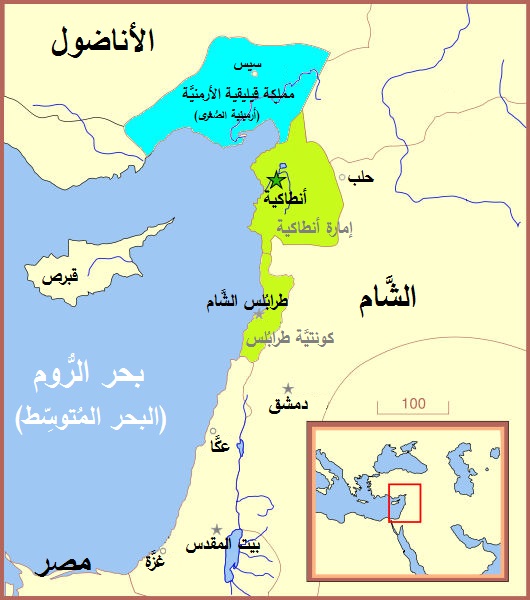
Siege of Antioch (1268)
When Baibars wrote to Prince Bohemond VI after sacking Antioch, his letter was not a demand for surrender or a diplomatic communique. It was a taunt. The Mamluk Sultan mocked the absent prince for his title -- what use was "Prince of Antioch" when Antioch no longer existed? The letter cataloged, in precise and deliberate detail, exactly what had been done to the city and its people. Baibars wanted Bohemond to know what he had missed, and the message carried an unmistakable subtext: the Crusader era in the Levant was ending, and the Crusaders were too diminished to even witness its final act.
An Absent Prince, A Weakened City
By the 1260s, Antioch was a shadow of the great Crusader stronghold it had been. The Principality of Antioch, established after the First Crusade captured the city in 1098, had once been one of the four pillars of Crusader power in the Levant. But decades of conflict had hollowed it out. Prince Bohemond VI had relocated his court to Tripoli, capital of his other domain, the County of Tripoli. The city itself was badly defended and largely abandoned by its wealthier inhabitants. In 1268, the garrison and knights left behind were commanded by Simon Mansel, Constable of Antioch, whose wife was related to Sibylla of Armenia. The Principality had angered the rising Mamluk power by supporting the Mongol invasions -- a strategic miscalculation that placed Antioch squarely in Baibars's crosshairs.
Baibars's Gathering Storm
Sultan Baibars had been systematically dismantling Crusader holdings since 1265, when he took Caesarea, Haifa, and Arsuf. A year later, he conquered Galilee and devastated Cilician Armenia. Antioch was the natural next target -- a city of enormous symbolic importance to the Crusaders, yet one whose long walls could no longer be adequately manned. Before the siege began in earnest, Constable Simon Mansel led a desperate cavalry sortie against the Mamluk army, hoping to prevent the city from being encircled. The attack failed. Mansel himself was captured, and Baibars ordered him to command his lieutenants to surrender. The garrison refused. They continued to defend the walls, but the outcome was no longer in doubt.
Three Days of Destruction
Antioch fell on May 18, 1268. The citadel held for two more days before it too was taken. What followed was, in the words of historian Thomas Madden, "the single greatest massacre of the entire crusading era." Over three days, 17,000 people were killed and 100,000 were taken prisoner. Eight thousand had taken refuge in the castle; they eventually surrendered and were enslaved. Baibars ordered the fortress burned. The churches of Saint Paul and Saint Peter were destroyed. The monastery of Saint Simeon Stylites the Younger, outside the city, was demolished during the campaign. The inhabitants had agreed to surrender on the condition that their lives would be spared. That condition was not honored. Entire families were killed. The city that had been one of early Christianity's most important centers was reduced to rubble and depopulated.
The Letter and the Legacy
Baibars's secretary -- who was also his biographer -- composed the infamous letter to Bohemond with evident relish, describing in detail the carnage, the enslavement, and the destruction of churches. The cruelty was calculated. Baibars understood that the fall of Antioch would resonate far beyond its walls. Louis IX of France launched the Eighth Crusade partly in response to these losses, though the expedition went to Tunis rather than the Levant, diverted by the political interests of Louis's brother Charles of Anjou. The Hospitaller fortress of Krak des Chevaliers fell three years later. By the time Baibars died in 1277, the Crusaders were confined to a handful of coastal strongholds, and their final expulsion from the Middle East would come by the start of the fourteenth century.
The Mirror of 1098
The fall of Antioch in 1268 was a deliberate inversion of its capture in 1098. The First Crusade's success had hinged on taking Antioch after an agonizing eight-month siege -- a victory so improbable that the Crusaders attributed it to divine intervention and the discovery of the Holy Lance. That triumph had established the Principality and opened the road to Jerusalem. Now, 170 years later, the city fell in days rather than months, defended by a fraction of the forces the Crusaders had once commanded. The symmetry was not lost on contemporaries. As one chronicle noted, the fall of Antioch proved as detrimental to the Crusader cause as its capture had been instrumental to its first success. The same city that had made the Crusader project possible now marked its irreversible decline.
From the Air
Located at 36.20N, 36.15E at the site of ancient Antioch, now the modern city of Antakya in Hatay Province, Turkey. The city lies in the Orontes River valley surrounded by mountains. From altitude, the river (Asi River) is clearly visible winding through the valley. The ruins of the ancient citadel are on the slopes above the modern city. Hatay Airport (HTY) is approximately 25 km to the south. The Mediterranean coast is visible approximately 30 km to the west.