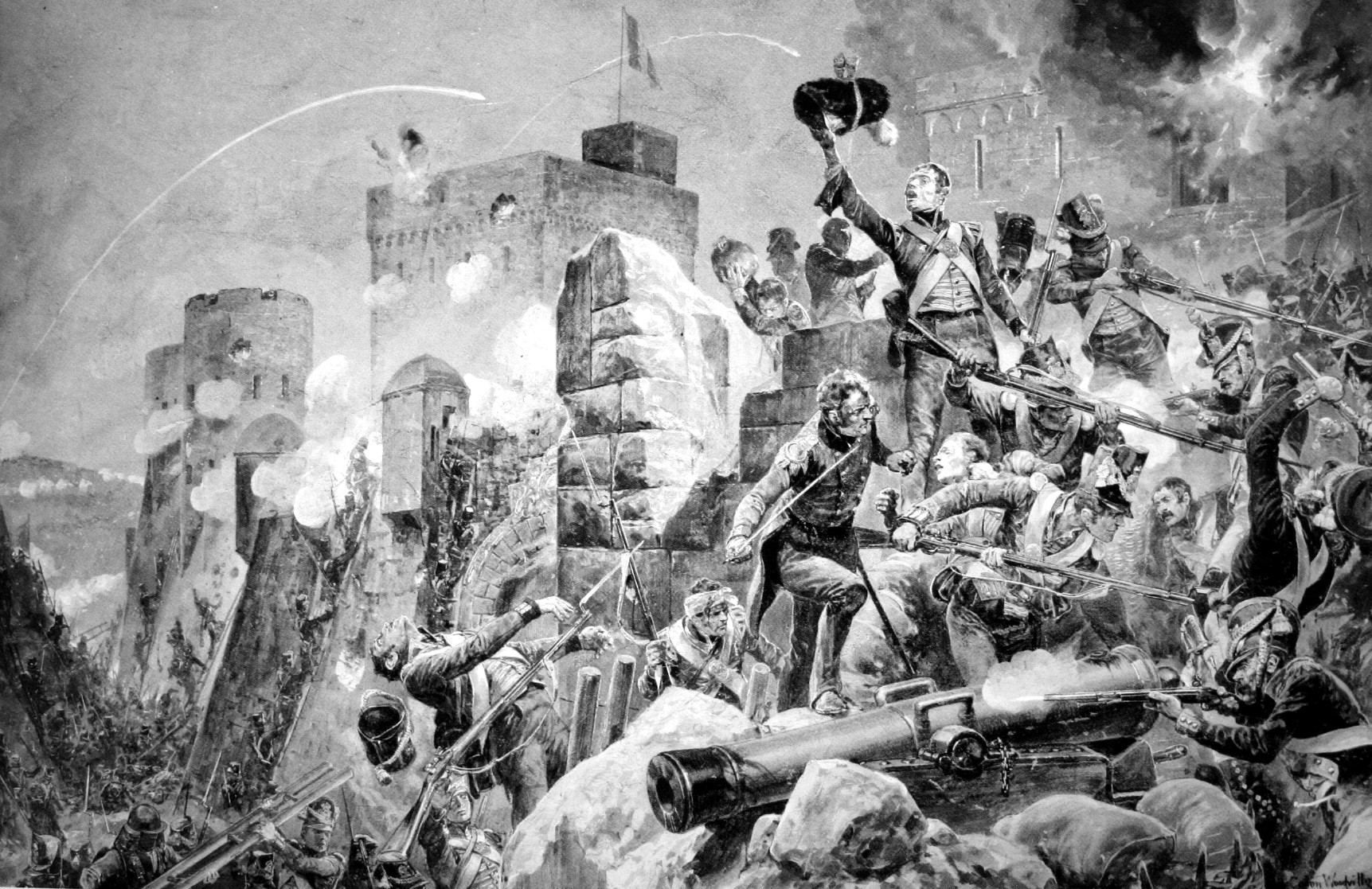
Siege of Badajoz (1812)
When dawn came on April 7, 1812, the Duke of Wellington wept. Below the breached walls of Badajoz, British and Portuguese dead were piled so deep in the ditches that the survivors had climbed over their comrades' bodies to reach the ramparts. Blood, in the accounts of those who were there, ran like rivers through the trenches. In a few hours of fighting the night before, some 4,800 Allied soldiers had been killed or wounded -- and the horror was not yet over. What followed the victory would stain the reputation of one of history's finest armies.
The Prize on the Frontier
Badajoz commanded one of the most important invasion routes on the Iberian Peninsula, controlling the lines of communication between Wellington's base in Lisbon and the Spanish interior. After seizing Ciudad Rodrigo to the north in January 1812, Wellington turned south to this frontier fortress, garrisoned by 5,000 French troops under General Armand Philippon. The town was far more formidable than anything the allies had yet faced -- a strong curtain wall reinforced by numerous bastions, areas around the walls flooded or mined with explosives, and a garrison that had already repulsed two previous sieges. Philippon knew exactly how to defend a fortress, and he had prepared meticulously for the third attempt.
Three Weeks in the Mud
Wellington's army of 27,000 encircled Badajoz on March 17 and began the grueling work of siege engineering -- digging trenches, building earthworks, positioning heavy guns. Torrential rains turned the works into muddy channels and swept away bridging needed to bring forward siege artillery. On March 19, the French sallied out with 1,500 men and 40 cavalry, surprising the working parties and wounding Lieutenant-Colonel Richard Fletcher, the chief engineer. The storming of Fort Picurina on March 25 cost 300 casualties but gave the allies a forward position from which to dig closer. By early April, heavy 18-pound and 24-pound guns were hammering the curtain wall relentlessly. When Marshal Soult was reported marching to relieve the town, Wellington ordered the assault for the night of April 6.
Into the Breach
At 10 p.m. on April 6, three attacks went forward simultaneously. The men of the forlorn hope -- volunteers who knew they were likely to die -- led the 4th Division toward two breaches in the wall, while Alten's Light Division targeted a third. A French sentry raised the alarm, and within seconds the ramparts erupted with musket fire, grenades, stones, barrels of gunpowder with crude fuses, and bales of burning hay hurled down to illuminate the killing ground. The breaches had been sown with caltrops and chevaux de frise. Bodies piled so quickly that the storming parties had to clamber over their own dead. In under two hours, 2,000 men fell at the main breach alone. The Light Division, confused by the carnage, accidentally assaulted a ravelin that led nowhere. Wellington was preparing to call off the attack when word arrived that Picton's 3rd Division had scaled the castle walls on the far side. The 5th Division, whose ladder party had gotten lost, finally reached the San Vicente bastion and lost 600 men taking it. Major Lord FitzRoy Somerset -- the future Lord Raglan -- was the first over that wall, securing a gate for reinforcements. The linkup of the 3rd and 5th Divisions sealed the town's fate, and Philippon surrendered.
The Three Days After
What happened next haunts the siege's memory. Enraged by the slaughter they had endured, the surviving troops broke into houses, stores, and wine cellars. For three days, British soldiers rampaged through Badajoz, looting property, assaulting civilians, and threatening or shooting their own officers who tried to restore order. Captain Robert Blakeney wrote that his comrades, who twelve hours earlier had been a disciplined army, now resembled "hell hounds vomited up from infernal regions." An estimated 200 to 300 Spanish civilians -- people the army had come to liberate -- were killed or injured during the sack. Only about 300 families, perhaps 1,500 people, had remained in the city, meaning between 20 and 30 percent of the remaining civilian population was harmed. Wellington finally issued orders to stop the rampage and erected a gallows, though no one was hanged. Full order took 72 hours to restore.
The Cost of Victory
In a letter to Lord Liverpool the following day, Wellington wrote that the storming "affords as strong an instance of the gallantry of our troops as has ever been displayed," but added: "I greatly hope that I shall never again be the instrument of putting them to such a test." The elite Light Division had lost 40 percent of its fighting strength. Within two weeks, the scale of the casualties prompted the formation of the Royal School of Military Engineering -- an acknowledgment that the hasty assault, driven by the need to beat Soult's relief force, had cost lives that better siege techniques might have saved. Wellington advanced into Spain toward the Battle of Salamanca, but for those who survived the breaches of Badajoz, the victory never felt like one.
From the Air
Located at 38.88N, 6.97W in Badajoz, western Spain. The city's bastioned walls and the old castle are visible from lower altitudes along the Guadiana River. Badajoz airport (LEBZ) lies approximately 14 km east. The breaches that Wellington's army stormed were in the southeastern section of the walls, near the Trinidad and Carros gates.