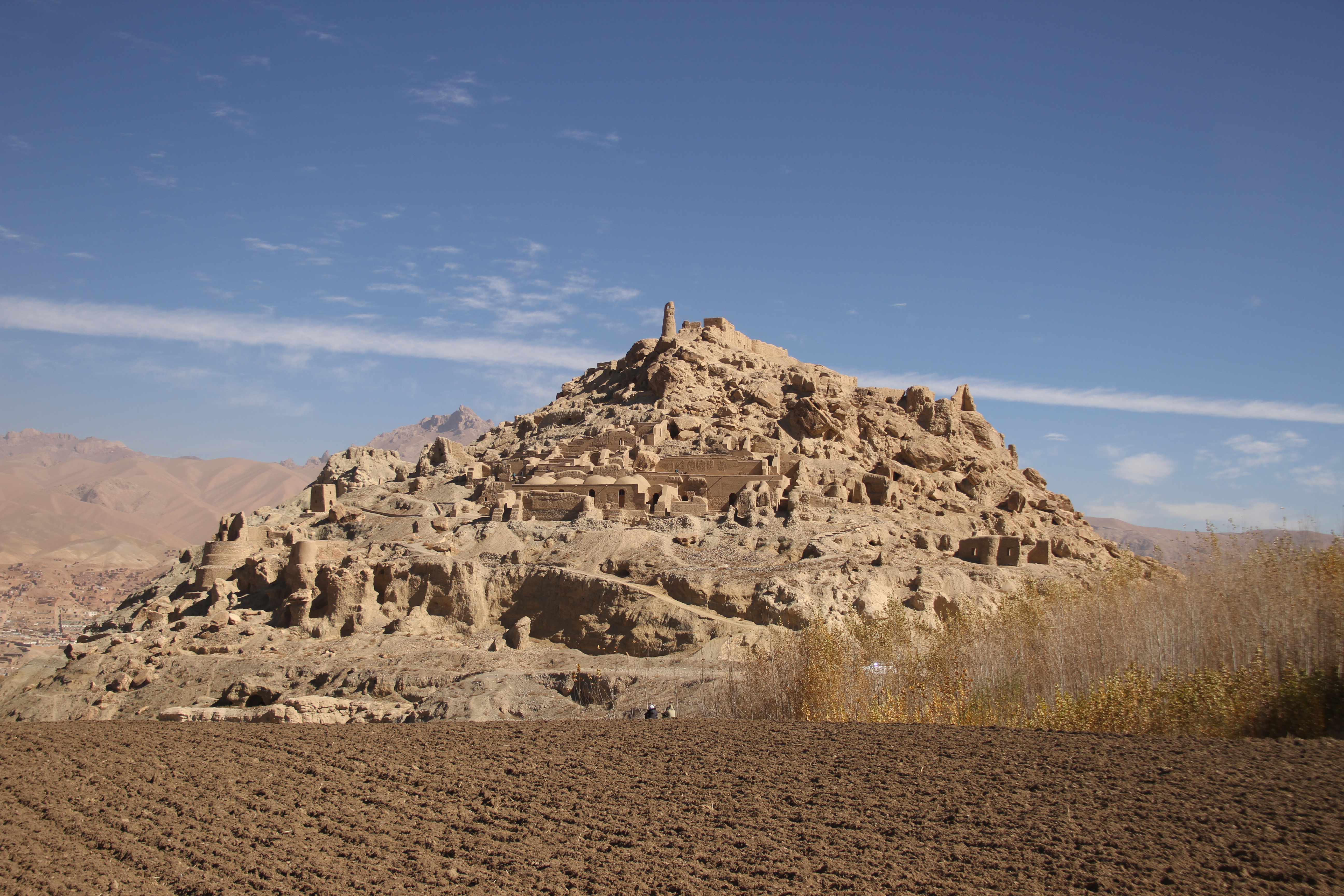
Siege of Bamyan
They called it the City of Screams. For centuries after the Mongol army left, the ruins of Bamyan bore a name that needed no explanation: Shahr-e-Gholghola, the place where the cries of the dying had echoed off the Hindu Kush and never quite faded. What happened here in the spring of 1221 was not merely a siege. It was the annihilation of a city by an empire's grief, a grandfather's rage made policy, and the erasure of a population so complete that even the animals were not spared.
The Arrow That Changed Everything
Genghis Khan had crossed the Hindu Kush in pursuit of Jalal al-Din Mangburni, the last ruler of the Khwarazmian Empire, who had recently humiliated a Mongol force at the Battle of Parwan. The Mongol army arrived before Bamyan, a city in the valley northwest of Kabul whose Friday Mosque could hold roughly nine thousand worshippers -- a settlement perhaps a third the size of Balkh, but fortified and defiant. The inhabitants made their intentions clear: they would resist. Both sides deployed archers and catapults, and for weeks the siege ground on in the manner of medieval warfare -- brutal, incremental, measured in stones thrown and walls breached. Then Mutukan, eldest son of Chagatai Khan and Genghis Khan's favorite grandson, stepped into the path of an arrow. He died soon afterward. In that single moment, the siege of Bamyan ceased to be a military operation and became something far worse.
A Grandfather's Edict
Genghis Khan ordered the assault accelerated. According to some accounts, a daughter of Jalal al-Din Mangburni revealed a secret entrance to the Mongols, and the city fell after roughly a month of fighting. No quarter was given. But the Khan's rage extended beyond the battlefield. He issued a yasak -- a formal edict -- commanding that every living thing in Bamyan be killed: every person, every animal, every bird, every wild creature. No booty was to be taken; the city's wealth was to be left in the dust alongside its dead. Not even pregnant women were spared. The edict was not a commander's tactical brutality. It was a mourning rite disguised as military policy -- a grandfather's attempt to make the world pay for what it had taken from him. He further ordered that no one tell Chagatai what had happened to his son. When Chagatai eventually arrived and learned the truth, his father commanded him not to weep. So Chagatai turned to eating and drinking to dull the pain, and under a pretext withdrew to the steppe, where he could grieve alone without disobeying his father.
The Cursed City
According to the chronicler Yaqub al-Herawi, every inhabitant of Bamyan was killed. The city was left in ruins and remained that way for decades. It acquired the Persian name Mao-Kurgan, or Ma'u-Baligh -- the Cursed City. Some called it the City of Sorrows, others the City of Cries. The names stuck because the reality behind them was total. Sources written generations later still described Bamyan as largely uninhabited and broken. Recovery, when it came, took an extraordinarily long time. A common tradition holds that after the annihilation of the local population, Genghis Khan resettled the area with Mongol soldiers and their enslaved women to garrison the region. These settlers may have become the ancestors of the Hazara people, whose name likely derives from the Persian hezar, meaning thousand -- a reference to the Mongol military unit of one thousand soldiers. Another theory traces Hazara ancestry to the ancient Kushan peoples who once ruled these same valleys.
The Conquest Rolls On
With Bamyan destroyed, the Mongols continued their sweep through Khorasan. They plundered Tus and Mashhad. By spring, the entire region was under their control. Genghis Khan spent that summer in the foothills near Taloqan with his sons and armies, planning the next phase of his campaign against Jalal al-Din Mangburni. His sons Chagatai and Ogedei joined him there. He then pushed toward the Indian subcontinent, carrying forward the momentum of a campaign that had reshaped Central Asia. The Swedish historian Carl Fredrick Sverdrup estimated that only in the second half of 1221 did Genghis Khan finally consolidate enough troops to operate effectively across Khorasan, while his generals Jebe and Subutai ranged across the western Iranian Plateau and his son Jochi moved into the northern steppes. The death of Mutukan rippled through Mongol succession as well: because Chagatai's eldest son was gone, it was eventually Mutukan's own son, Qara Hulegu, who inherited the Chagatai Khanate.
What Remains
Today the site of ancient Bamyan is a UNESCO World Heritage Site, recognized not for the siege but for the Cultural Landscape and Archaeological Remains of the Bamiyan Valley. The cliffs that once framed a thriving city along the Silk Road still stand, though the colossal Buddha statues that survived the Mongols for nearly eight centuries were destroyed by the Taliban in 2001. The valley is quiet now, the screams long silent. But the name Shahr-e-Gholghola persists on local maps, a reminder that what happened here in 1221 was considered so devastating that ordinary words for ruin were insufficient. A city needed a new name -- one built from the sound of human suffering -- to describe what Genghis Khan's grief had wrought.
From the Air
Located at 34.82N, 67.82E in the Bamyan Valley of central Afghanistan, flanked by the Hindu Kush mountains. The ruins of Shahr-e-Gholghola sit on a hilltop northwest of modern Bamyan town. Approach from the east along the valley for the clearest view of the citadel ruins against the mountain backdrop. Recommended altitude: 8,000-10,000 feet AGL. Nearest airport: Bamyan Airport (OABN). The famous empty Buddha niches carved into the sandstone cliffs are visible landmarks to the east of the fortress site.