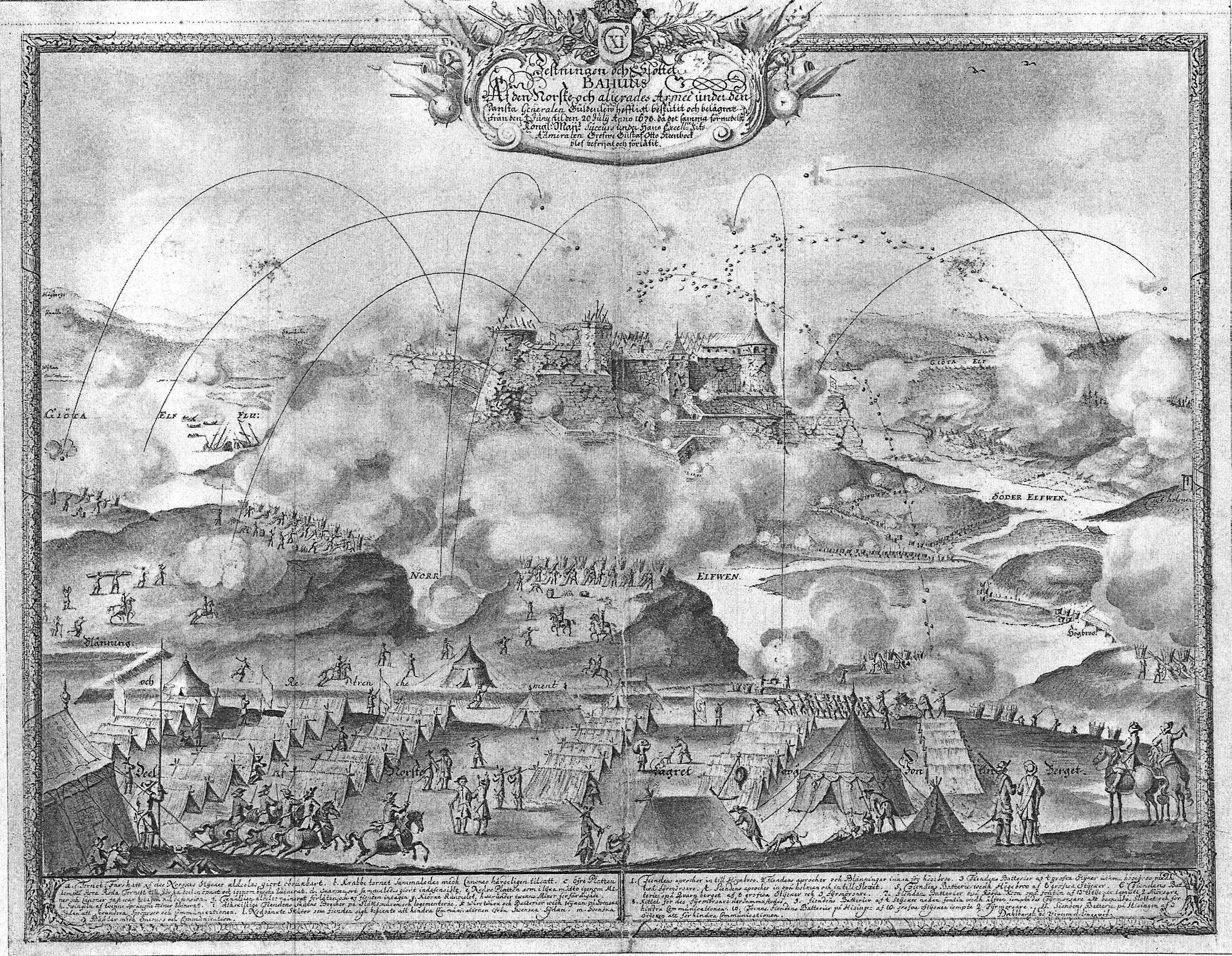
Siege of Bohus Fortress (1678)
Anyone who spoke of surrender was to be executed as a traitor. That was the order given to the 400 Swedish soldiers garrisoned inside Bohus Fortress in the summer of 1678, as they stared down at an approaching army of 15,000 Dano-Norwegian troops under General Ulrik Frederik Gyldenløve. The odds were impossible, the outcome seemingly certain. Yet for weeks, this battered medieval fortress on the Swedish-Norwegian border would become the site of one of Scandinavia's most stubborn defensive stands.
Echoes of Continental Conflict
The siege of Bohus was a distant consequence of France's ambitions in the Low Countries. In 1672, Louis XIV had turned his expansionist gaze toward the Netherlands, drawing European powers into a web of alliances and counter-alliances. Sweden, its treasury empty and Denmark perpetually plotting revenge for past defeats, had struck a deal with France that April. The Swedes would intervene against any German princes who aided the Dutch, and in return, France would provide subsidies and guarantee Danish neutrality. But treaties are only as reliable as the armies that enforce them, and by 1678, the Scanian War had swept across Scandinavia. When Gyldenløve crossed the Swedish-Norwegian border at the end of May with his massive force, Bohus Fortress stood directly in his path.
The Walls Hold
The bombardment began almost immediately, and it was devastating. The garrison commanders, Fredrich von Börstell and Carl Gustaf Fröhlich, watched helplessly as their defenses crumbled. By June 17, the Blockhouse and the "Alarm Place" lay in ruins. The outer works had been systematically destroyed, their cannons damaged or wrecked, their skilled engineers killed or wounded. On June 18, Börstell sent a desperate plea to Gustaf Otto Stenbock requesting reinforcements. A hundred men departed on June 19 under a commander named Edington. Sixty of them were killed or wounded before reaching the fortress. Edington himself died on June 21 from severe arm wounds. Still, the garrison refused to yield.
The Bridge and the Fire
The Dano-Norwegians attempted to build a bridge from Hisingen Island to the fortress, seeking to tighten their stranglehold. Börstell launched a counterattack and burned it. Though the besiegers eventually repaired the crossing and advanced toward Skarpenort, the Swedish defenders continued their resistance even as the enemy set mines and initiated a blockade. The fortress was increasingly surrounded, its walls pockmarked by bombardment, yet surrender remained unthinkable. Meanwhile, Stenbock was assembling a relief force, destroying the retreat bridge at Kviström to prevent the enemy from escaping, and preparing a bold counter-stroke.
Night Crossing
On July 18, Stenbock began his march toward Bohus with an army of 12,000 men. He constructed a bridge to Hisingen, protected by armed barges and pontoon bridges. Under cover of darkness on the night of July 18-19, the entire Swedish army crossed to the island. At dawn, Stenbock sent 60 men to secure a nearby hill, sparking a confrontation with Danish forces. Swedish reinforcements under Colonel Mörner and Lieutenant Colonel Gripensköld drove the Danes back with 30 casualties. The following day, the army passed through Quillån pass unopposed, musketeers scouting ahead to prevent ambush. Around midday, the Swedish force signaled the besieged garrison with double Swedish signals from a height overlooking Bohus.
Relief and Ruin
The Danes at Gullön had built fortifications and a bridge to communicate with the mainland, but the approaching Swedish army was overwhelming. On the night of July 22, the Swedes forced them to retreat, systematically destroying their fortifications, bridges, and camp. The next day, the Dano-Norwegian force abandoned Fontin entirely, leaving behind artillery and unexploded ordnance. When the relief force finally entered Bohus Fortress, they found devastation. The walls had absorbed 2,265 large bombs, 200 glowing bullets, and 75 baskets of hand grenades. Yet the garrison had held. The impossible had become history.
From the Air
Bohus Fortress sits at 57.86°N, 12.00°E, on a rocky island at the confluence of the Göta älv and Nordre älv rivers, just north of modern Gothenburg, Sweden. From the air, the fortress ruins are visible on a low hill surrounded by water and marshland. The nearby island of Hisingen, mentioned prominently in the siege, is clearly visible to the south. Approach from the west for the best view of the strategic river crossings that made this position so valuable. Nearest airports: Göteborg Landvetter (ESGG) approximately 30km southeast, Göteborg City (ESGP) about 15km southwest. Best viewed at 1,500-2,500 feet in clear conditions.