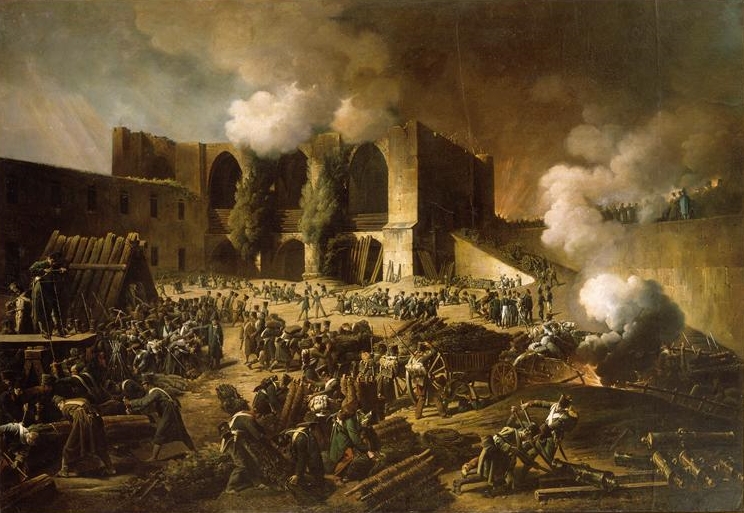
Siege of Burgos
"This is altogether the most difficult job I ever had in hand with such trifling means. God send that they may give me a little more time." Wellington wrote those words from the siege trenches outside Burgos Castle in October 1812, and they capture something rare in the career of Britain's most successful general: desperation. With only a handful of siege guns, five engineer officers, and eight sappers, he had thrown his army against a fortress defended by 2,000 Frenchmen under General Jean-Louis Dubreton -- and for five weeks, the fortress held.
The Trap of Victory
Wellington arrived at Burgos riding a wave of triumph. His decisive victory over Marshal Marmont at the Battle of Salamanca in July 1812 had shattered the French position in central Spain. King Joseph Bonaparte had fled Madrid. The Retiro forts surrendered, yielding 2,046 prisoners, 20,000 muskets, and 180 brass cannon. But Wellington understood the danger behind the glory: the French armies of Soult, Suchet, and the rebuilt Army of Portugal could converge on him from three directions. He needed Burgos -- an important French supply base 210 kilometers north of Madrid -- to anchor his northern flank. He expected to take it quickly. He did not.
A General Without Tools
The fundamental problem at Burgos was resources. Wellington had as few as three heavy siege guns with only 1,306 rounds -- accounts vary, but no historian credits him with adequate firepower. Admiral Home Popham offered to land heavier artillery from the Royal Navy at Santander, but Wellington declined. His sapper corps, the Military Artificers, numbered five officers and eight men. During the siege, one engineer and one sapper were killed, two engineers wounded, and all seven remaining sappers wounded. Every mine had to be dug by infantry soldiers with no training in the work. Every battery had to be built by soldiers who were learning the craft under fire.
Dubreton's Masterclass
Against Wellington's clumsy attacks, Dubreton conducted a defense that military historians still study. When the British captured the San Miguel hornwork on the first night -- at a cost of 421 Allied casualties -- Dubreton simply retreated to the inner walls and waited. A hasty assault on September 22 sent men of the 1st and 6th Divisions forward with axes and five ladders against a 24-foot wall; 150 of 400 attackers fell. When the British detonated a mine on September 29, it blew up an ancient buried wall in front of the actual fortifications, leaving the French defenses unscathed. And when Wellington finally breached the outer wall on October 4, Dubreton struck back with sorties that were models of aggressive defense -- French soldiers swarming out at 2 a.m. on October 8, killing and wounding 184 men and carrying off British equipment.
Rain, Cannonballs, and Retreat
By mid-October, rain was falling in sheets, flooding the siege trenches. The British guns on the captured hornwork ran so low on ammunition that soldiers retrieved fired French cannonballs and loaded them back. A third mine was detonated under the Chapel of San Roman on October 18, but the subsequent assault withered under intense fire, adding 170 more casualties. Meanwhile, two French armies were closing in: Souham with 53,000 troops from the north, and Joseph with 61,000 from the south. Wellington's position was becoming untenable. On October 21, he withdrew, unable to bring his remaining siege guns with him. Total British losses: 550 killed, 1,550 wounded. French losses: 304 killed and 323 wounded, plus 60 captured.
The Long Walk Home
The retreat from Burgos became one of the most punishing marches of the Peninsular War. Wellington and his lieutenant Rowland Hill joined forces near Alba de Tormes on November 8, but logistics had collapsed. Allied soldiers marched through cold rain for four days with almost no food. French cavalry scooped up hundreds of stragglers. On November 17 alone, the captures included Wellington's second-in-command, General Edward Paget. By the time the army reached the safety of Ciudad Rodrigo, it had lost 5,000 men to hunger, exposure, and capture. It appeared that the entire campaign of 1812 had been for nothing. But appearances deceived: the Anglo-Portuguese army had gained a moral advantage over the French that it would never relinquish, and within months Wellington would march east again -- this time, all the way to victory.
From the Air
Located at 42.35°N, 3.70°W at the Castle of Burgos, on a hilltop overlooking the city of Burgos in northern Spain. The castle ruins sit above the cathedral and old city. Nearest airport: Burgos (LEBG), approximately 4 km northeast. The Arlanzon River runs through the city below. The flat Castilian meseta stretches in all directions, making the elevated castle position clearly visible from altitude.