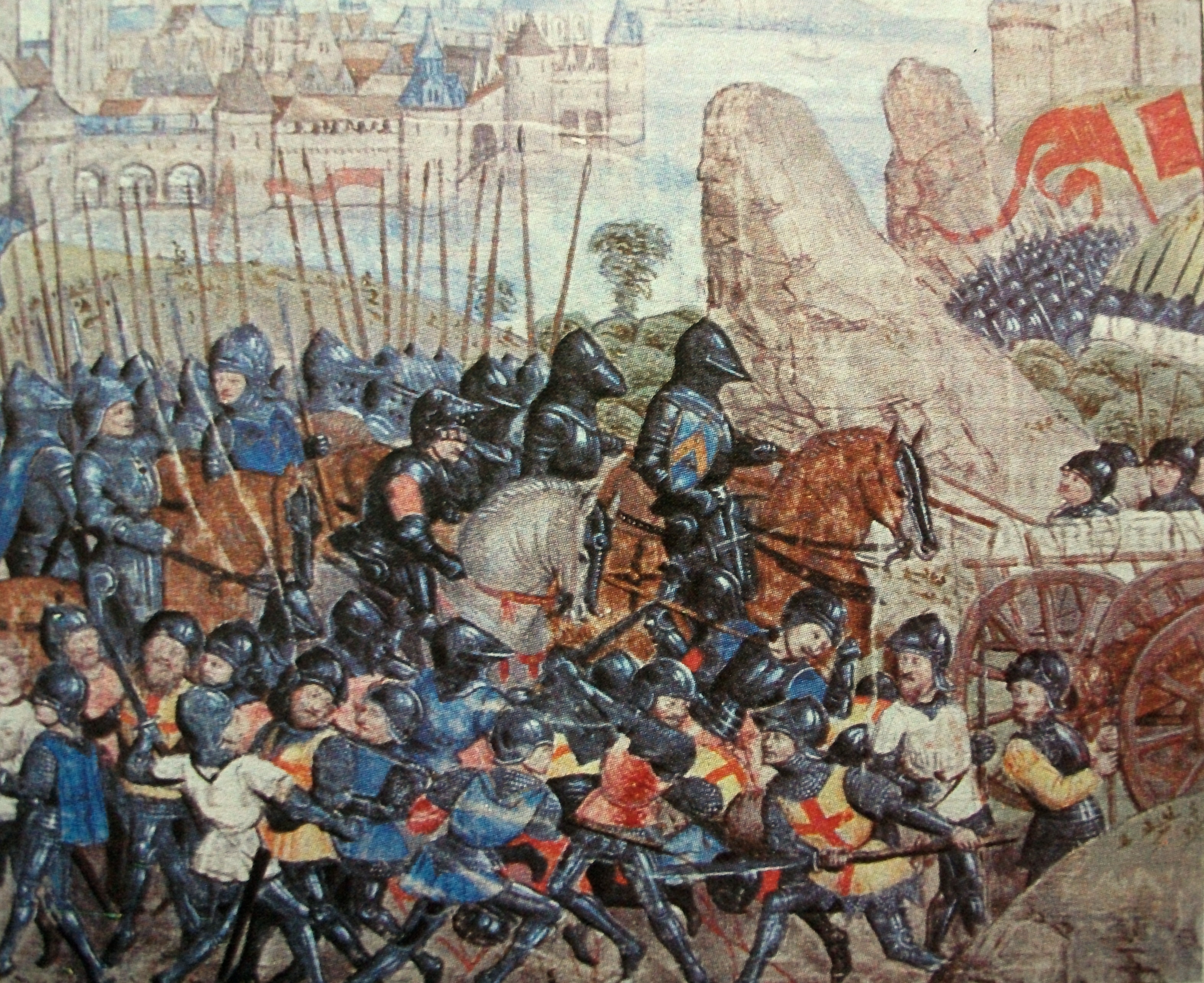
Siege of Calais (1346-1347)
On the morning of 3 August 1347, six men walked out of Calais in their shirts, ropes around their necks, the keys to their city and citadel in their hands. They expected to be executed. Their names were Eustache de Saint Pierre, Jean d'Aire, Jacques and Pierre de Wissant, Jean de Fiennes, and Andrieu d'Andres - the wealthiest leaders of a starving town. Saint Pierre had volunteered first. Five others stepped forward to join him. Behind the gates they were leaving, their neighbours had spent the last weeks eating leather and considering cannibalism. Behind the king they were walking toward, an English army of 32,000 men waited for the answer to a question of mercy.
After Crecy
The siege did not begin as a siege at all. It began as the aftermath of a slaughter. A week before, on 26 August 1346, Edward III had broken the French royal army at the Battle of Crecy on ground of his own choosing. His longbowmen had cut down French knights in numbers no chronicler could quite believe. The English then needed a port - somewhere defensible, somewhere they could be resupplied from the sea, somewhere close to their Flemish allies. Outside the burning ruins of Wissant, Edward held a council and named his target. On 4 September the English arrived before Calais and looked at what they had chosen. A double moat. Substantial walls. A citadel in the north-west corner with its own moat. Marshes on every side, some tidal, that would defeat trebuchet platforms and tunnelling. Inside, the experienced Jean de Vienne and a garrison strong enough to make every assault a corpse-strewn failure.
The town that became a town
Because the walls would not fall, Edward decided to wait them out - and a siege that long demanded a town of its own. The English built one. They called it Nouville, the "New Town," west of Calais, with houses and two market days each week. Eight hundred and fifty-three ships, crewed by twenty-four thousand sailors, ran supplies across the Channel over the course of the siege. Wool, grain, ale, arrows, fresh men to replace the ones taken by dysentery in the wet camp. Parliament grumbled but paid. Edward declared his honour bound to the place and would not leave until it fell. Two cardinals dispatched by Pope Clement VI shuttled between the two armies trying to broker a peace; neither king would speak to them. The French, meanwhile, kept slipping galleys past the harbour mouth all winter and spring. In late April 1347 the English finally built a fort on the sand spit north of the town and closed the door to the sea.
Hunger inside the walls
What Jean de Vienne wrote to Philip VI on 25 June 1347 survives because the letter was intercepted. The food was gone. The garrison and the people of Calais, he warned, might soon have to resort to cannibalism. The bare fact of the sentence - written in the same matter-of-fact hand that had managed nine months of disciplined defence - is one of the more devastating moments in medieval correspondence. By then the people of Calais had been eating their horses, their dogs, their cats. The non-combatants who could not fight had been pushed out of the gates earlier in the year, and the English had refused to let them pass, so they had starved in the no man's land between the walls. On 17 July Philip finally marched north with fifteen to twenty thousand men. He arrived on 27 July to find an English and Flemish force of over fifty thousand behind earthworks and palisades. He looked at it for a week. On the night of 1 August, while the garrison watched from the walls, the French army turned around and went home.
Six men with nooses
Two days later Calais surrendered. Edward's terms, as the chronicler Jean Froissart recorded them, were specific and theatrical: six of the town's leaders were to come out bareheaded and barefoot, in their shirts, with ropes around their necks and the keys of the town and castle in their hands. Their lives would be at the king's mercy. The richest man in Calais, Eustache de Saint Pierre, stood up first. Jean d'Aire followed, then Jacques and Pierre de Wissant, then Jean de Fiennes, then Andrieu d'Andres. They walked out of the gate expecting to die. Edward ordered their execution. According to Froissart, his queen, Philippa of Hainault - then pregnant - fell to her knees and begged her husband to spare them, arguing their deaths would be a bad omen for her unborn child. The king relented. The burghers lived. Five hundred and forty-two years later, Auguste Rodin would sculpt that moment of walking out, and the world would understand that what those six men did at the gate was something rarer than victory.
What followed
Edward expelled the rest of Calais and repopulated it with English settlers. The booty was so vast it changed the prices of luxury goods in London. The town would remain English for 211 years, the keystone of an enclave called the Pale of Calais, garrisoned at one point by 1,400 standing soldiers - a small army in itself. From this port, every later English campaign in France would launch. The wool trade reorganised itself around the Calais Staple. Coins of Edward III were minted inside the walls between 1361 and 1369. The town stayed English until Mary I lost it in January 1558 and reportedly told her family on her deathbed: "When I am dead and opened, you shall find Calais lying in my heart." The story that began with six men in nooses ended with a queen of England saying that the name of a French port was carved into her body.
From the Air
Calais sits at 50.96 N, 1.85 E on the southern shore of the Strait of Dover. Calais-Dunkerque (LFAC) is on the western edge of town; Calais-Marck airfield lies just east. The medieval citadel sat in the north-west corner of the old enceinte, near today's Parc Richelieu and the Hotel de Ville, where Rodin's Burghers now stand. From altitude the white cliffs of Dover are visible 21 nautical miles north across the Strait.