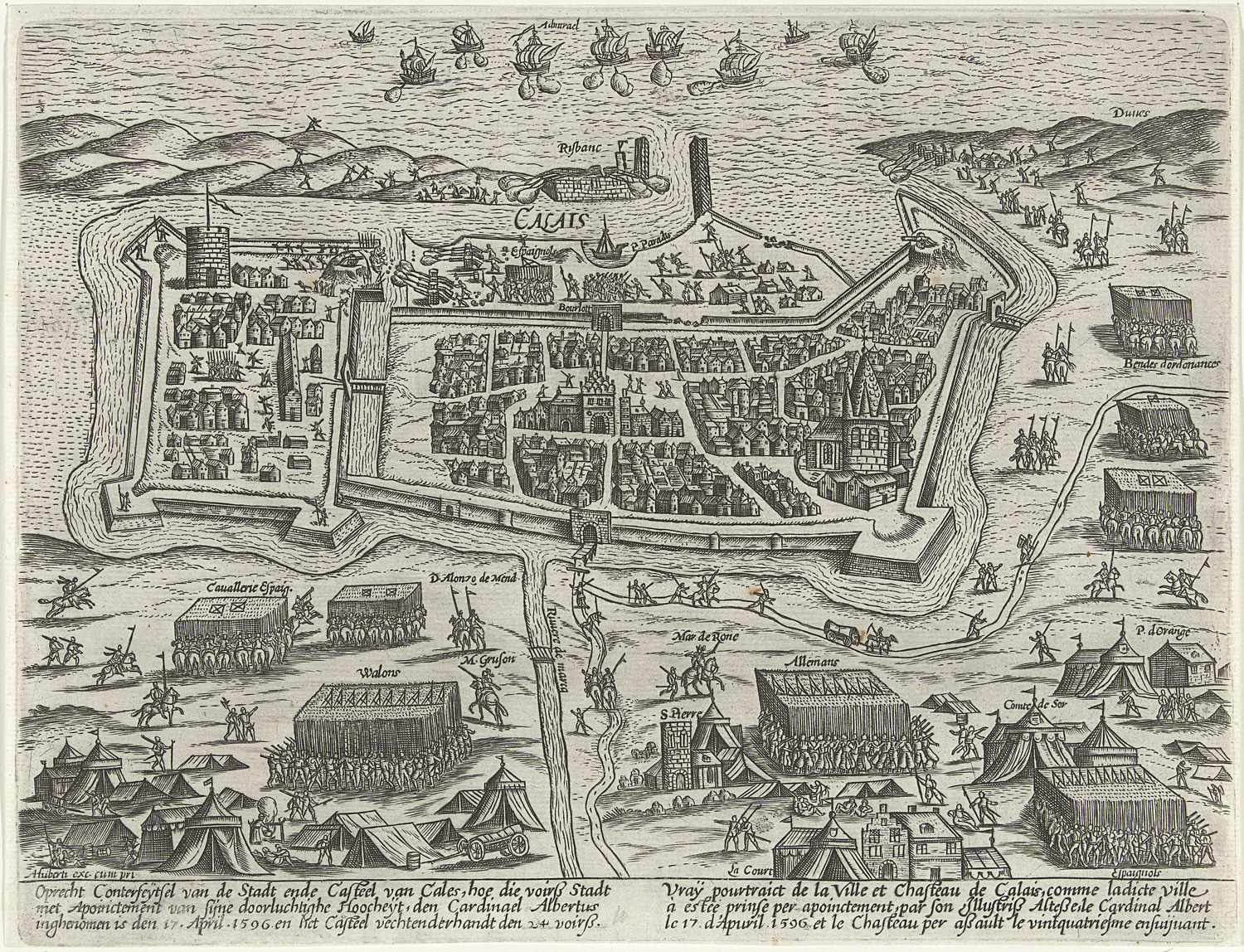
Siege of Calais (1596)
Two years before he besieged Calais, Henry IV of France converted to Catholicism. "Paris is well worth a Mass," he is said to have shrugged, walking into the city he had spent four years trying to win on horseback. In 1596 the bill arrived. Habsburg Spain, the great Catholic empire of the late sixteenth century, had no intention of letting a former Huguenot enjoy a French throne in peace, especially one whose declaration of war was barely a year old. So on 8 April 1596, Archduke Albert of Austria - governor-general of the Spanish Netherlands and commander of the Army of Flanders - arrived outside the walls of Calais. Sixteen days later, the city that had taken Edward III eleven months in 1347 fell to Spain.
A war for a throne and a religion
The Franco-Spanish War of 1595-1598 was the final overlap of two larger conflicts - the French Wars of Religion, which had bled France for three decades, and the Eighty Years' War in the Low Countries, where Spain was fighting Protestant rebels. Henry IV had been Protestant, then Catholic, then king. Philip II of Spain had supported the Catholic League against him and would not concede the war was over. The two sides moved against each other along the Franco-Flemish frontier through the towns and villages that had been fought over for centuries: Doullens, taken by the Spanish in 1595, became a benchmark for what professional Spanish tercios could do to a French garrison. Calais was the next prize. It was the great Channel port - the place England, France and Spain all watched, because whoever held it could threaten or trade with the other two.
Albert's march
Archduke Albert had a reputation. He was a man of the Catholic Reformation - had been a cardinal in his youth - and now, at thirty-six, he was running a Habsburg army that knew its business. On 29 March 1596 he left Brussels for Valenciennes, took command of the Army of Flanders, and pivoted away from a possible relief of the besieged French garrison at La Fere. Instead he marched on Calais. He arrived on 8 April with a force trained on the slow grinding sieges of the Eighty Years' War, where Spanish engineers had refined the art of taking a fortified town. The defenders, French and outnumbered, settled in for what they hoped would be a long defence.
Sixteen days
The siege was short and intense. Spanish engineers worked the approaches. The assault came hard enough to kill Spanish captains Juan Alvarez de Sotomayor and Hernando de Isla and seriously wound Diego de Durango at the breach. The city fell on 24 April. Albert had taken Calais in sixteen days. Behind the speed of it lay a particularly bitter sub-plot. Across the Channel, Elizabeth I of England was being asked by Henry IV for help, and Elizabeth - whose grandmother and grandfather and uncles had all known Calais as English ground until 1558 - was inclined to listen. But she had a price. She demanded that Calais, if recovered by English intervention, return to English rule. Henry refused. The two monarchs were still arguing the terms when Spanish troops walked through the breach. The city changed hands while its potential allies bickered.
Aftermath
Albert did not stop. He left a strong garrison in Calais and moved on Ardres, the small fortress town to the south, which had been English-held in the fourteenth century and was French in the sixteenth. Then he turned east toward the Dutch front and Hulst, which fell to him in July despite Prince Maurice of Nassau's attempts at relief. It was a remarkable summer for one army. For Henry IV, who had spent the previous five years building a kingdom out of a civil war, the loss of Calais was a hard blow. His Protestant allies in the Low Countries saw the gateway port go to the very Habsburg power they were fighting. Calais sat in Spanish hands for two years.
Vervins
What ended the occupation was diplomacy, not arms. By 1598 Spain was financially exhausted, Philip II was dying, and Henry IV was consolidating his throne with the Edict of Nantes, which gave French Protestants legal protection and effectively ended the French Wars of Religion. On 2 May 1598 the Peace of Vervins was signed. Spain returned Calais and most of its other northern conquests to France. Philip II died in September. The 1596 siege left no statues, no romantic chroniclers, no Rodin. It was a short professional operation by a competent Habsburg commander against an undermanned French garrison while the king who lost it haggled with a queen who would not help him without a fee. In the long history of Calais being taken and retaken - English 1347, French 1558, Spanish 1596, French 1598, German 1940, French 1944 - the Spanish episode is the briefest hand on the door. But it was a Spanish hand all the same, and the Channel port that Edward III had wanted as his gateway to France spent two of its sixteenth-century years pointing the other way.
From the Air
Calais sits at 50.95 N, 1.86 E on the southern shore of the Strait of Dover. The medieval citadel, where the Spanish breach was contested in 1596, stood in the north-west corner of the old enceinte near today's Parc Richelieu. Ardres, Albert's next target after Calais, lies 17 km south along the D943. Calais-Dunkerque airfield (LFAC) is on the western edge of the city. From altitude, the white cliffs of Dover are 21 nautical miles north across the Strait - close enough that English warships could be seen but not, in 1596, called on.