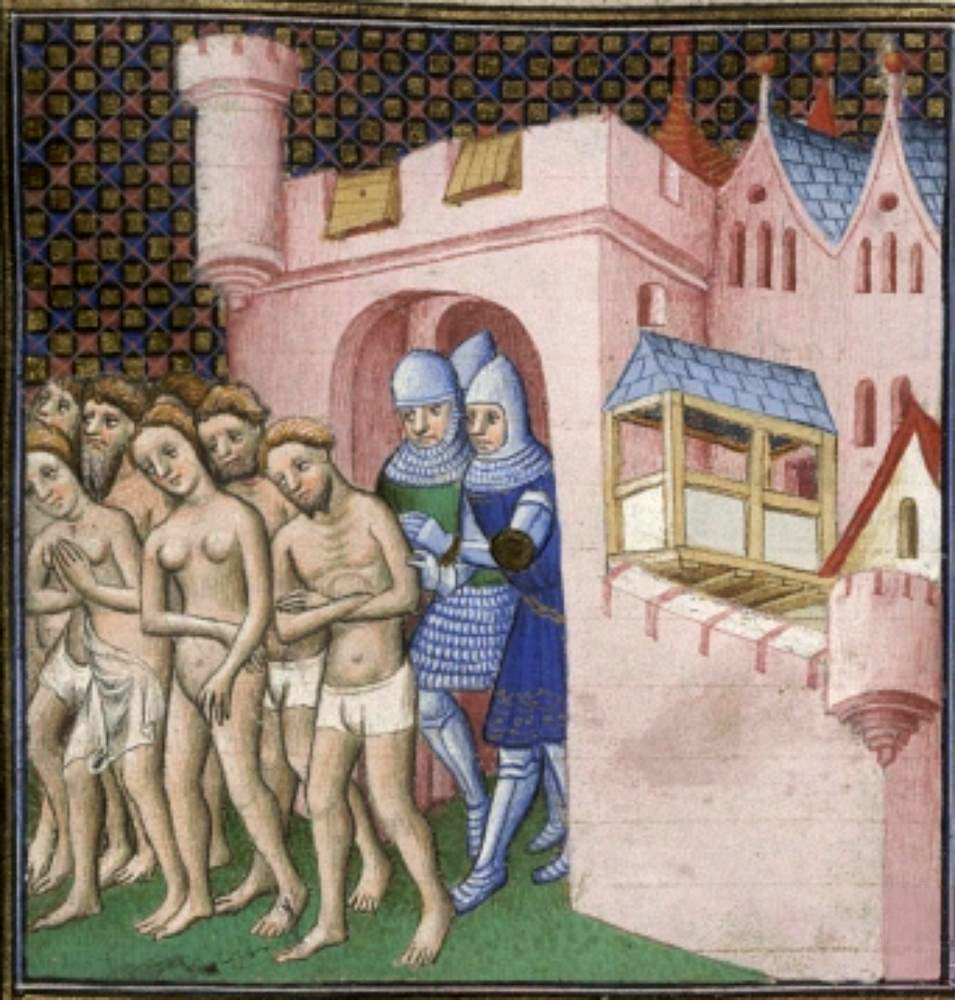
Siege of Carcassonne
The Crusaders arrived fresh from Béziers, where they had massacred most of the town's inhabitants. That was the context in which the Viscount of Carcassonne, Raymond Roger Trencavel, watched a force of approximately 20,000 soldiers appear outside his walls on August 1, 1209. He had ten days to prepare. What followed was a two-week siege during the Albigensian Crusade that ended not with a massacre but with a negotiated surrender — one that saved the city's people at the cost of their viscount, their possessions, and ultimately, the independence of the entire Languedoc.
After the Slaughter at Béziers
The Albigensian Crusade had been launched by Pope Innocent III to eliminate Catharism, a Christian dualist sect that had taken root across southern France. The Abbot of Cîteaux, Arnaud Amaury, led the Crusade with the backing of some of the most powerful nobles in France: Simon de Montfort, Odo III, Duke of Burgundy, Walter III of Châtillon, Hervé IV of Donzy, and others. Their first major action was the Siege of Béziers, which ended in a brief, catastrophic sacking. The army then marched 45 miles south to Carcassonne and arrived ten days later. At that point, Carcassonne consisted of a heavily fortified main town with its castle, surrounded by three suburbs: the northern and southern ones fortified, the western one — nearest the Aude River — undefended. The town was well prepared for a siege, with one critical weakness: its distance from the river, its primary water source.
The Walls Hold, the Water Runs Out
Trencavel wanted to meet the Crusaders in open battle. His vassal Pierre Roger de Cabaret convinced him otherwise: fight from behind the walls, not in the field. The Crusaders struck the unfortified western suburb first on August 3, pushing out the defenders and cutting the town off from the Aude. Three days of fighting followed for the northern suburb; once taken, it was burned to prevent recapture. Assaults on the southern suburb were repelled, forcing the attackers to build catapults, mangonels, and a wooden siege shelter called a cat to protect sappers undermining the walls. When a section of wall collapsed, the Crusaders stormed in — but a sortie by the defenders killed the small garrison left behind and set the suburb ablaze. Even as the military situation see-sawed, the real siege was being fought in the wells and cisterns inside the walls. The summer heat, the severed river access, and the influx of refugees who had fled the approaching army all strained water supplies to the breaking point.
A King Who Could Not Help
At this critical moment, King Peter II of Aragon arrived to mediate. As Count of Barcelona, Peter was technically the overlord of Carcassonne, but he was unwilling to challenge the Pope by offering military support to his own vassal. He hoped diplomacy could accomplish what arms could not. After conferring with both sides, the best terms Peter could extract from the Crusader commanders were blunt: Trencavel could leave the city with eleven companions of his choosing. Everyone else would stay. The viscount refused. He would not abandon the people he had sworn to protect for a personal escape. Peter II returned to Spain, and negotiations collapsed. The siege resumed with a new intensity.
Surrender on Their Backs
With the wells dry and no relief in sight, Trencavel agreed to parlay. Both sides understood the arithmetic: the defenders could not hold much longer, and if the Crusaders took the town by storm, another Béziers was likely. The surrender terms reflected this balance of desperation. Trencavel gave himself up voluntarily, but secured safe passage for every inhabitant of Carcassonne. The people were forced to leave with nothing but the clothes on their backs — no possessions, no valuables, no dignity beyond their lives. They dispersed into the countryside as refugees. Trencavel was imprisoned in his own castle. Within months he was dead, officially of dysentery, though rumors persisted that he had been murdered. His sacrifice had saved thousands of lives, but it had cost him everything.
From Holy War to Land Grab
With Carcassonne taken, the Crusade needed a new lord for the conquered territory. The Duke of Burgundy, the Count of Nevers, and the Count of St. Pol were all offered the prize and all refused — they had enough land and saw no profit in defending hostile territory indefinitely. Simon de Montfort accepted, on the condition that every assembled lord would swear to come to his aid if called. In that transaction, the nature of the Crusade shifted permanently. What had begun as a religious campaign to eradicate heresy became a political enterprise to conquer and hold the lands of the Languedoc. The shift would define the rest of the Crusade and, ultimately, the absorption of southern France into the French kingdom. Carcassonne's walls had held against catapults and sappers. They could not hold against the ambition that the Crusade had awakened.
From the Air
Located at 43.21°N, 2.35°E. The Cité de Carcassonne is one of the most recognizable fortified cities in Europe from the air, sitting on a hill above the Aude River. Best viewed at 2,000-4,000 ft AGL. Nearest airport: LFMK (Carcassonne-Salvaza). The river Aude, critical to the siege's outcome, is visible winding past the western base of the citadel.