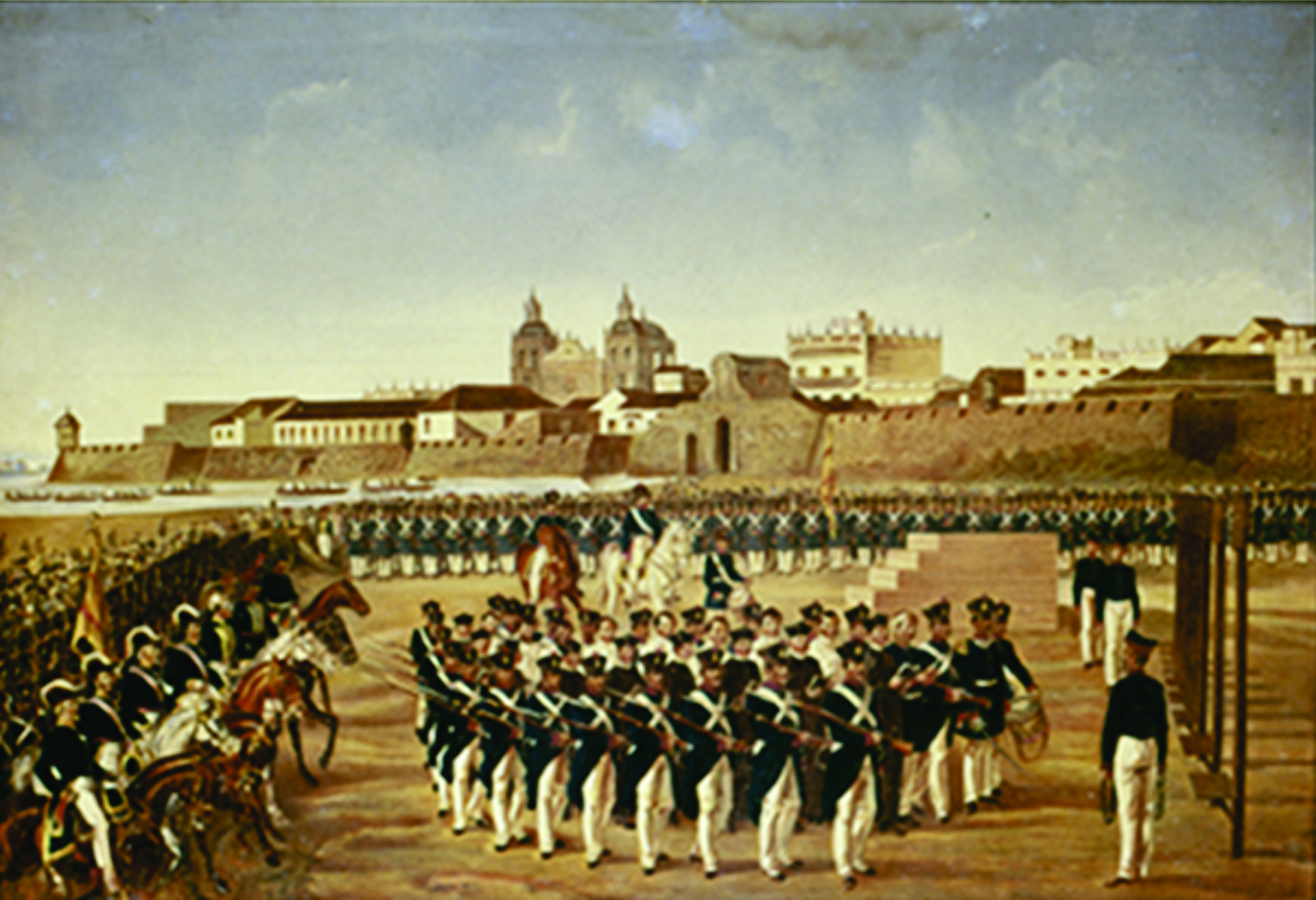
Siege of Cartagena (1815)
In the final weeks, they boiled their shoes. The leather belts went first, then the straps from saddles and harnesses, then anything that could be softened in water and chewed. Inside the walls of Cartagena de Indias, 18,000 people - soldiers, families, refugees from the surrounding countryside - were starving to death while a Spanish army waited patiently outside. The siege of 1815 lasted 105 days. By the time it ended, a third of those trapped inside were dead. The city that had defied pirates, buccaneers, and the British Empire fell not to cannon fire but to hunger, and in doing so earned a name that Colombians still use with reverence: La Heroica.
A Republic Divided Against Itself
The tragedy of Cartagena's siege began long before Spanish General Pablo Morillo arrived at its gates. The United Provinces of New Granada had declared independence from Spain in 1811, but the new republic immediately fractured. Between 1812 and 1814, the New Granada Civil War pitted the federated provinces against the centralist State of Cundinamarca, draining resources and goodwill on both sides. When Simon Bolivar marched toward Santa Marta in early 1815 and asked Cartagena for men and supplies, the city's governor, Manuel del Castillo y Rada, refused. Bolivar's response was to besiege Cartagena himself for six weeks - a siege of one patriot force against another. He failed, lost half his army to disease and desertion, and departed for Jamaica in disgust. The city that had just survived one siege by its own allies now faced a far more dangerous enemy.
Morillo's Patience
King Ferdinand VII of Spain, restored to his throne after Napoleon's defeat, dispatched Morillo with a powerful fleet and veteran troops to crush the American rebellions. Morillo landed at royalist Santa Marta and added 3,000 llaneros - the fierce horsemen of the Colombian and Venezuelan plains - under Francisco Tomas Morales to his force. On 26 August 1815, this army appeared before Cartagena's walls. Morillo quickly recognized that storming the fortifications would be costly and unnecessary. The Republican defenders had made a critical miscalculation: rather than evacuating civilians, they had allowed refugees from the surrounding region to crowd inside the walls, swelling the population to 18,000. All Morillo had to do was wait. He blockaded the harbor by sea and sealed the land approaches, then settled in for what he knew would be a war of attrition against the defenders' food supply.
The Slow Horror
Famine set in within a month. Disease followed, accelerated by the overcrowding and the tropical heat that made sanitation impossible for so many people confined in so small a space. As the weeks dragged on, the situation inside the walls became almost incomprehensible. Horses and mules were slaughtered first, then dogs and cats. When those were gone, the defenders turned to rats. During the last twenty-two days, people cooked leather goods in desperate attempts to extract nourishment. There were verified cases of cannibalism. More soldiers died of hunger than in any of the scattered fighting. Outside the walls, Morillo waited with a well-supplied army while the sounds of suffering carried across the fortifications.
Surrender and the Reign of Terror
On 6 December 1815, Spanish troops entered a city of corpses. The streets were littered with the dead. Of the 18,000 people who had sheltered inside the walls, roughly 6,000 had perished from starvation and epidemic disease. Many Republican leaders had escaped by sea in the final days, but those who remained faced Morillo's retribution. Manuel del Castillo y Rada and Jose Maria Garcia de Toledo were among nine independence leaders publicly executed in what became known as the case of the Nine Martyrs. Morillo continued his reconquest, entering Bogota on 6 May 1816, imposing what Colombians came to call the Reign of Terror - a period of executions, imprisonment, and repression aimed at destroying the independence movement entirely.
Why Colombians Remember
Morillo's reconquest failed. Within five years, Bolivar returned from exile, crossed the Andes, and liberated New Granada at the Battle of Boyaca in 1819. Cartagena itself was freed in an 1820-21 siege that reversed the roles, with patriots blockading the Spanish garrison. But it is the 1815 siege that defines the city's identity. Bolivar himself bestowed the title La Heroica on Cartagena for its resistance, and the city has worn it ever since. The siege was not a military victory - it ended in surrender and occupation. What Colombians honor is the refusal to capitulate easily, the willingness to endure suffering that most cities would have surrendered to avoid. In Cartagena today, the fortifications that held for 105 days still ring the old city, and the week commemorating the siege remains one of the most significant civic observances in Colombia.
From the Air
Located at 10.42N, 75.53W. The walled city of Cartagena and its harbor are clearly visible from altitude, with the ring of colonial fortifications still intact. Nearest airport is Rafael Nunez International (SKCG/CTG), approximately 2 nm northeast. From the air, the natural harbor geography that made Cartagena both valuable and defensible is unmistakable - the narrow bay entrances, the protective islands, and the elevated ground of San Felipe fortress. Best viewed at 3,000-5,000 ft for full appreciation of the siege perimeter.