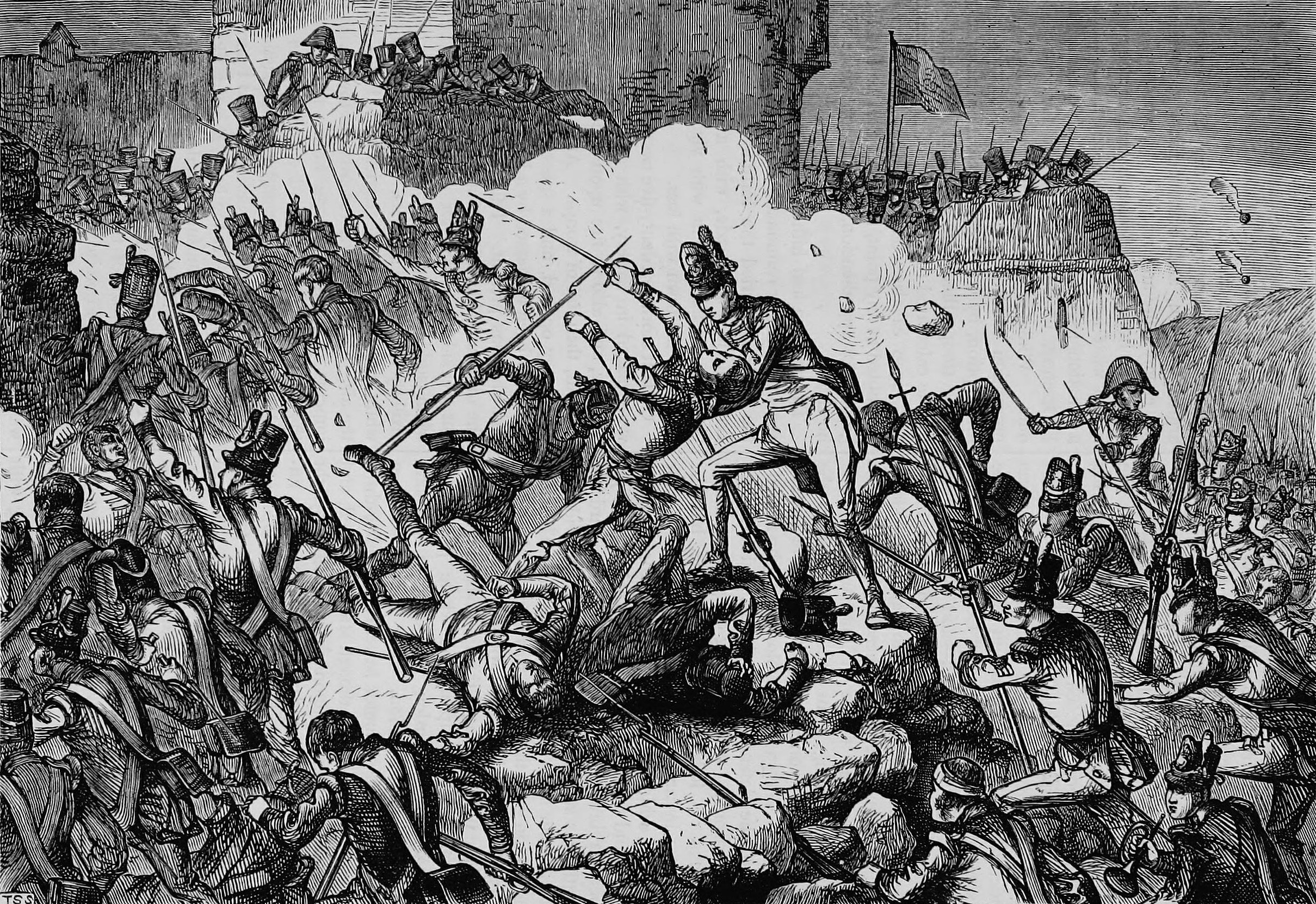
Siege of Ciudad Rodrigo (1812)
Digging in frozen ground at night could kill you before the French ever fired a shot. When a pickaxe struck rock in the trenches outside Ciudad Rodrigo, the spark it threw drew accurate musket fire from the walls above. Wellington's soldiers learned to work in silence, chipping through the stony Spanish soil in January darkness, racing against a clock only their commander could see. Marshal Marmont had sent 14,000 troops east on Napoleon's orders. That left a window -- narrow, freezing, and potentially fatal -- to take the fortress that controlled the northern corridor from Portugal into Spain.
A Fortress on Borrowed Time
Ciudad Rodrigo was not an impressive fortification. Its main wall stood 32 feet high but was built of poor masonry, without proper flanking positions, with weak parapets and narrow ramparts. The Grand Teson, a 600-foot hill to the north, dominated the city completely -- whoever held that hill could look down into the streets. The French garrison under General Barrie numbered just 2,000 men, far too few to properly defend the perimeter. They had 153 cannons but only 167 artillerists to fire them. Wellington arrived on 6 January 1812 with up to 40,000 troops. On the night of 8 January, the Light Division stormed the Grand Teson redoubt by surprise, and British engineers began the grim work of digging siege trenches toward the walls, their progress measured in yards and counted in casualties from French fire.
Nine Thousand Rounds
Speed was everything. Wellington received intelligence that Marmont was preparing to march west, and every day brought the possibility of a French relief force appearing on the horizon. The Santa Cruz Convent fell to the King's German Legion on 13 January. The San Francisco Convent was taken by escalade the following night, driving all French troops back within the city walls. On the afternoon of 14 January, thirty-four 24-pound and four 18-pound siege cannon opened fire. Over five days, these batteries hurled more than 9,500 rounds into Ciudad Rodrigo's walls, eventually blasting two breaches -- one large gap in a curtain wall and a smaller one through an exposed tower. Wellington ordered the assault for the evening of 19 January, twelve days after investing the city. Marmont had expected the fortress to hold for three weeks. It would not hold for two.
Into the Breach
At 7 pm on 19 January, 10,700 men moved against the walls. Picton's 3rd Division attacked the greater breach on the northwest while Craufurd's Light Division assaulted the lesser breach on the north. Pack's Portuguese brigade probed the eastern San Pelayo Gate as a diversion. The greater breach was a killing ground. Two French cannons had been embedded in the rubble of the wall, and they tore into the attacking columns. The 88th Connaught Rangers silenced one gun while the 45th Nottinghamshire Regiment took the other. At the smaller breach, the Light Division forced through more quickly, getting behind the defenders of the main breach and making further resistance impossible. The assault succeeded, but at terrible cost. Among the 195 killed were two generals: Henry MacKinnon and Robert Craufurd, the brilliant commander of the Light Division whose loss Wellington felt deeply.
Liberation and Its Shadow
What followed the storming stained the victory. British soldiers, enraged by the 562 casualties suffered in the assault, turned on the city they had just liberated. For several hours, the rank and file sacked Ciudad Rodrigo, looting homes and businesses while their officers struggled to restore order. The violence was not directed at the French garrison -- those 529 survivors who were not killed or wounded were taken prisoner -- but at the Spanish civilians who had endured years of French occupation only to face chaos from their rescuers. Officers eventually regained control, but the episode foreshadowed the far worse sacking that would follow the storming of Badajoz two months later.
The Gateway Opens
The strategic consequences were enormous. Marmont lost his entire siege train along with those 153 captured cannon, and with only 32,000 troops of his own, he decided against trying to retake the fortress. The northern invasion corridor from Portugal into Spain was now open. Wellington received an earldom from the British crown, a generous pension, and -- in a gesture of gratitude from a nation still under occupation -- the Spanish title of Duque de Ciudad Rodrigo. More practically, the fall of the city freed Wellington to move south against Badajoz, whose capture would open the second corridor into Spain and set the stage for the campaign that would eventually drive Napoleon's armies from the Peninsula. The price of that next siege, however, would make Ciudad Rodrigo look merciful.
From the Air
Located at 40.60N, 6.52W in the province of Salamanca, western Spain, near the Portuguese border. The walled town sits on relatively flat terrain along the Agueda River, with the Grand Teson hill visible to the north. Nearest airports include Salamanca (LESA) approximately 90 km to the east. The Portuguese fortress town of Almeida lies about 25 km to the west. Terrain elevation is around 650 m with open rolling countryside.