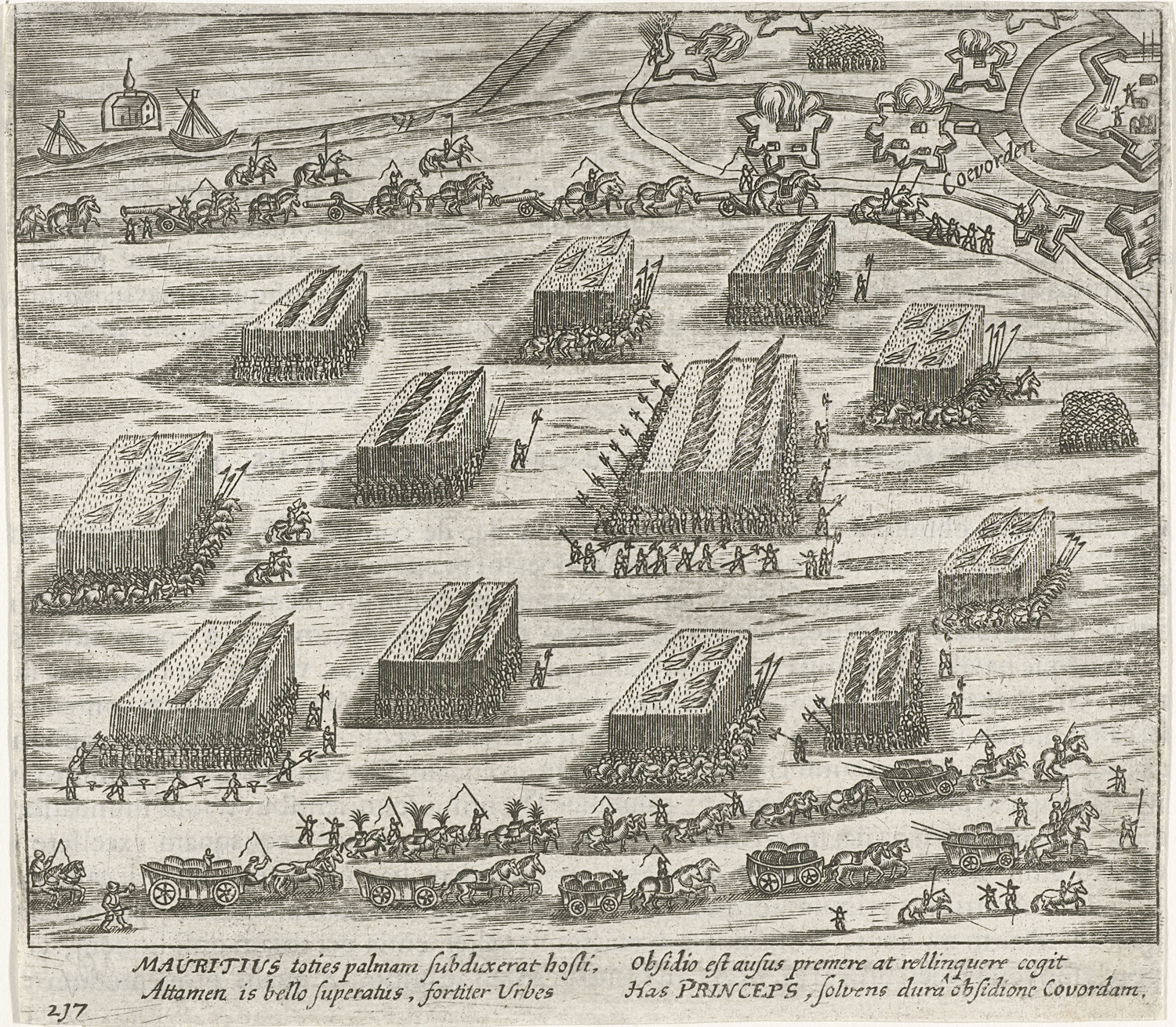
Siege of Coevorden (1593)
When you build a siege dike around a city, you mean to be there for a while. The Spanish general Francisco Verdugo built one around the Drenthe town of Coevorden in October 1593, running it from Klooster down to a hamlet called De Haar - earthworks meant to choke off supplies and quarter his soldiers in winter. He did not take the town. He held the line for thirty-one weeks, lost much of his army to cold and dysentery, and was finally driven off in May 1594 by a 26-year-old Dutch prince and an Anglo-Dutch relief column. The dike, however, stayed where it was. It is still there. The locals still call it the Spaniards' Dike - Spanjaardsdijk.
Why Coevorden Mattered
The Eighty Years' War was, in the 1590s, a war of fortified towns. Whoever held the major fortresses controlled the supply lines, and Coevorden sat on the only practical land route from Spanish-occupied Groningen south into the rest of the Spanish Netherlands. When the Dutch took Coevorden back in September 1592, they cut Groningen off by land. When the following year they also captured Geertruidenberg far to the south, Groningen was nearly isolated. The Spanish stadtholder in the north, Francisco Verdugo, understood that if Coevorden stayed Dutch, Groningen would eventually fall. Spain at this point had its main field army tied up in France propping up the Catholic League against Henri IV. Verdugo would have to retake Coevorden with what he could scrape together locally.
The First Siege
Verdugo's troops arrived at Coevorden in October 1593 and dug in. They laid the dike, sealed off the approaches, and waited for the garrison under governor Caspar van Eussum to crack. The garrison did not crack. The defenses of Coevorden were strong, the star-shaped bastions worked as designed, and the town was well provisioned. The Spanish camp, on the other hand, was a disaster. The local climate did not suit men from the south. Fuel ran short. Food ran short. Disease - probably dysentery, possibly typhus - swept through the camp. One company began the siege with five hundred men and ended it with one hundred. Soldiers sent out to forage for food in the surrounding villages brought disease home with them, and whole farming families died in their cottages. By November, Verdugo had no choice but to pull back into winter quarters. He maintained a blockade. Supplies still slipped through to the city anyway.
Maurice Comes North
In March 1594, with the weather improving, Verdugo brought 8,000 troops back to Coevorden, including 2,000 cavalry, and demanded surrender. Van Eussum refused. The Spanish dug formal siege lines and began emplacing artillery. The Dutch response was led by Maurice of Nassau, prince of Orange, the brilliant young commander who was reinventing European warfare with disciplined drill and field engineering. Maurice marched up from Zwolle with a force that included twelve companies of English and ten companies of Scots under the veteran English commander Francis Vere - some five thousand troops in all. His cousin William Louis, Count of Nassau, was already fortifying the Bourtange marsh to the north to deny Spanish reinforcements that direction. The two relief forces joined up between the Vechte and the Bourtange. Together they fielded 9,600 infantry and 1,900 cavalry.
The Decision Not To Fight
On May 6, Maurice's army approached Coevorden and began digging its own trenches - facing the Spanish siege lines, not the city. Verdugo went out to reconnoiter and did the math. The Anglo-Dutch position was impregnable. It was also placed astride his supply line. He called a council of war and concluded that staying meant slow destruction; attacking meant fast destruction. The decision is unromantic but it is what good 16th-century generals did - acknowledge defeat before it cost more lives than it had to. On the night of May 7, the Spanish burned everything they could not carry and pulled out under cover of dark. The siege had lasted, in total, thirty-one weeks. Verdugo split his force afterward to confuse pursuit: most went to Groningen, the rest east over the Ems to Spanish-held Lingen.
Groningen Next
Standing in the relieved city, Maurice and his council had to decide what to do with the victory. Two arguments. Vere and William Louis wanted to march immediately on Groningen - to finish what the cutting of the supply lines had begun. The Dutch officers wanted to drive the Spanish out of Twente first. Vere and William Louis lost the debate. The army moved on Twente, then doubled back later in the summer toward Groningen, and the city of Groningen surrendered to Maurice on 22 July 1594 - a foundational moment in the consolidation of the Dutch Republic. Coevorden, for its part, remained in Dutch hands for the rest of the war. The Spaniards' Dike stayed where it had been built, slowly turning into a country lane. Three centuries later, when locals wanted to know what to call it, they used the only name that fit.
From the Air
The siege took place at Coevorden (52.67 N, 6.75 E), in southern Drenthe near the German border. From altitude, the star-shaped historical town center remains the dominant visual feature; the Spanjaardsdijk runs roughly north-south to the west of town, tracing the old Spanish blockade line between the hamlets of Klooster and De Haar. The Bourtange marsh, which William Louis fortified to block Spanish reinforcements, lies about 30 km north. Nearest airports today: Groningen Eelde (EHGG, 65 km north) and Munster-Osnabruck (EDDG, 80 km southeast).