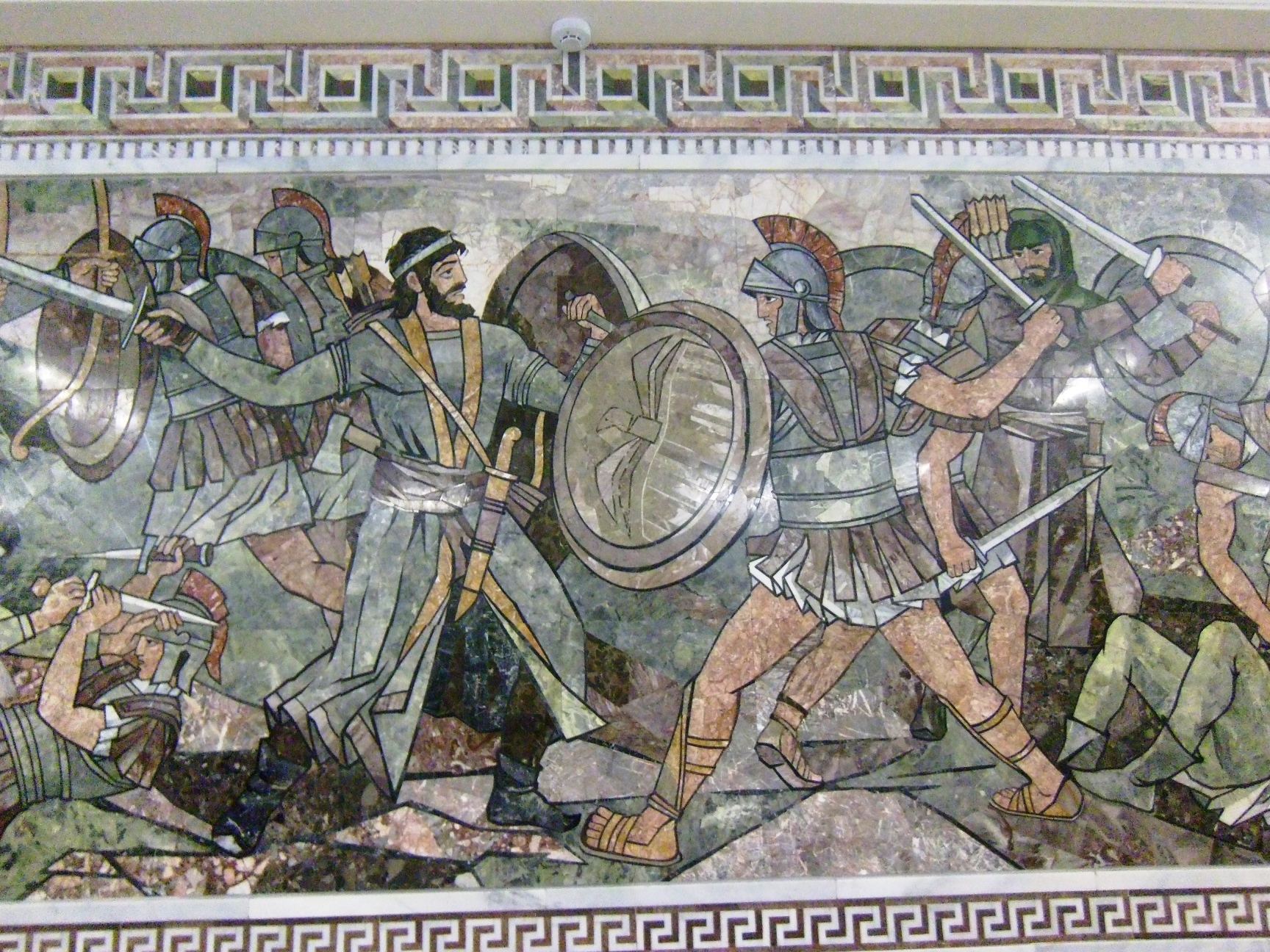
Siege of Cyropolis
Alexander the Great conquered most of the known world without suffering a serious wound. Then he came to Cyropolis. In 329 BCE, pushing into the Central Asian region of Sogdiana, Alexander targeted seven fortified towns that resisted Macedonian rule. Cyropolis was the largest, the best defended, and home to what ancient sources called the finest fighters in the region. Alexander took the first five towns in two days. Cyropolis took longer -- and it hit back. While leading a commando squad through a dried-up water channel beneath the city walls, Alexander was struck in the head and neck by a stone. His general Craterus was wounded by an arrow. The city fell, but it cost Alexander something rare: his own blood.
Seven Towns in the Dust
Alexander's campaign through Sogdiana was not a grand set-piece battle but a grinding pacification operation. Seven towns held out against Macedonian authority, and Alexander decided to eliminate them systematically. He began at Gazza and worked outward, sending his general Craterus ahead to Cyropolis with specific instructions: surround the city, dig a ditch, raise a stockade, and assemble siege engines. The purpose was twofold -- to prepare for the main assault and to pin down the Cyropolis garrison so it could not reinforce the smaller towns. Five of the seven fell in just two days. Many of the inhabitants were killed. The speed was deliberate. Alexander wanted the defenders of Cyropolis to see their neighbors fall and know what was coming.
Under the Walls
Cyropolis was not like the others. It had the largest population, the strongest fortifications, and a garrison of approximately 15,000 fighting men, according to the ancient historian Arrian. Alexander brought up his siege engines and began battering the defenses. But while the bombardment drew the defenders' attention to the walls, Alexander noticed something they had overlooked: a dried-up watercourse that ran beneath the city's fortifications. He ordered a select group of soldiers to crawl through the channel -- and joined them personally. It was the kind of calculated recklessness that defined Alexander's generalship. He did not merely command risk; he shared it. Once inside, his troops rushed to the gates and threw them open for the main assault force waiting outside.
The Stone That Found a King
When the defenders realized their city had been breached from within, they did not surrender. They counterattacked with fury. The fighting inside Cyropolis was close, chaotic, and violent. Alexander was struck by a stone that hit him in the head and neck -- a blow severe enough to be recorded by multiple ancient historians, which suggests it was more than a glancing impact. Craterus took an arrow wound. The Macedonians pressed forward regardless, and the initial defense collapsed. Arrian records that approximately 8,000 of the 15,000 defenders were killed in the first phase of fighting alone. The survivors retreated to the town's central fortress and held out for one more day before surrendering, driven to capitulation not by Macedonian arms but by the absence of water.
Conflicting Accounts
What happened after the fall of Cyropolis depends on which ancient source you trust. Arrian, drawing on the memoirs of Ptolemy -- one of Alexander's generals and later the founder of Egypt's Ptolemaic dynasty -- records that the city surrendered and that Alexander distributed the captured men among his army, ordering them kept in chains until he departed the country. No rebel, Ptolemy reported, was to be left behind. Aristobulus of Cassandreia told a different version: the city was stormed, and the inhabitants were massacred. The contradiction is telling. Ancient histories were often written to serve the reputations of the men who lived them, and the gap between "surrendered" and "massacred" speaks to the brutal realities that polished narratives preferred to obscure.
What Cyropolis Cost
Alexander recovered from his wound and continued his campaigns, eventually pushing beyond Sogdiana to the edges of India before his army refused to march farther. But Cyropolis left its mark. The siege demonstrated that Central Asian resistance was fiercer and more costly than the pitched battles Alexander had won against the Persian Empire's conventional armies. These were garrison towns, defended by local fighters who knew their terrain and had nothing to fall back on. Alexander adapted -- the watercourse infiltration was tactically brilliant -- but the stone that struck his head was a reminder that adaptation has limits. Cyropolis entered the historical record as one of the moments when Alexander's conquest felt less like destiny and more like a contest that could have gone either way.
From the Air
The exact location of ancient Cyropolis is debated by historians. Most scholars place it in modern Tajikistan -- near Istaravshan (ancient Ura-Tyube) or near Kurkath on the Syr Darya -- not in Afghanistan. The coordinates used here are approximate and represent the broader Sogdiana campaign region rather than a confirmed site. The surrounding terrain is the northern Afghan-Tajik plain with mountains to the south. Mazar-e Sharif International Airport (OAMS) is the nearest major airfield, approximately 25 km to the east. Best viewed at 5,000-10,000 feet AGL. The flat terrain and agricultural fields are characteristic of the ancient Sogdian-Bactrian borderlands.