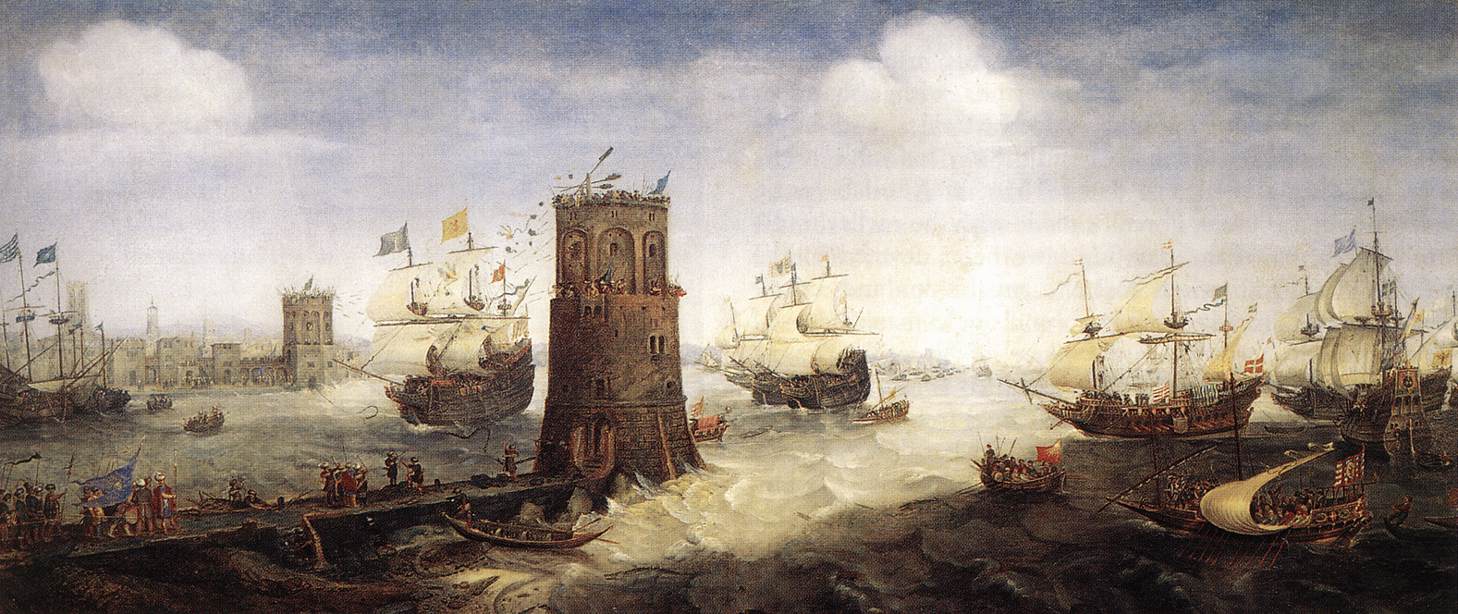
Siege of Damietta (1218-1219)
Two ships lashed together, four masts rising from the joined decks, a siege tower swaying above the waterline -- this improvised contraption, dreamed up by the chronicler Oliver of Paderborn, captured a fortified tower that months of conventional assault could not take. The Fifth Crusade's attempt on Damietta in 1218 was less a grand military campaign than a grinding experiment in desperation, where European knights, Egyptian defenders, the Nile itself, and feuding Crusader leaders all collided at the muddy delta where Egypt meets the Mediterranean.
A Pincer That Never Closed
The strategy sounded elegant on parchment. Crusader forces would seize Damietta at the mouth of the Nile, then use the wealthy port as a launching point for a two-pronged attack on Jerusalem -- one army pushing south from Acre, the other striking northeast from Egypt through Suez. Control of Damietta would finance the campaign and neutralize the Ayyubid fleet. In March 1218, Crusader ships set sail for Acre, and by late May the assault force -- Knights Templar, Knights Hospitaller, Frisian and Italian fleets, and contingents from across Europe -- was converging on the delta. The first ships arrived on May 27, though storms delayed the main commanders. On May 29, under the temporary command of Simon III, Count of Saarbrucken, the Crusaders established a beachhead "without any loss of blood." It was the last thing that came easily.
Invention Born of Failure
Assaults on the chain tower guarding the river approach began on June 24, 1218, and they failed repeatedly. The tower controlled a chain that blocked ships from sailing upriver, and without taking it, the Crusaders could not reach the city itself. Conventional siege methods proved useless against a tower surrounded by water. So the Crusaders improvised. They bound two ships together for stability, erected four masts and sailyards as a framework, and built a siege tower and scaling ladder on top. The whole structure was then covered in animal skins to deflect fire and arrows. On August 24, this ungainly engine was maneuvered against the tower. By the next day, the garrison surrendered. It was a genuine innovation in naval siege warfare -- but the victory only opened the door to a longer, grimmer fight for the city beyond.
The Crusade Devours Itself
Winter arrived. So did disease, supply shortages, and a leadership crisis that would prove as damaging as any Egyptian counterattack. In September 1218, Cardinal Pelagius, Bishop of Albano and papal legate, arrived at the Crusader camp and immediately challenged the authority of John of Brienne, King of Jerusalem. Pelagius argued that as the Church's representative, he outranked any secular commander. The resulting power struggle split the army into factions at precisely the moment when unity mattered most. Months of siege ground on through 1219 as the Ayyubid sultan al-Kamil defended the city and the Nile's seasonal flooding turned the delta into a swamp that neither side could master. The Crusaders eventually took Damietta, but the fractured command that won the city would lose it. By July 1221, the same internal divisions and an ill-conceived advance up the Nile led to catastrophe. The Crusaders surrendered Damietta and evacuated Egypt entirely.
Where the Nile Meets the Sea
Damietta's geography made it both prize and trap. Sitting at one of the Nile's mouths where the great river fans into the Mediterranean, the city commanded trade routes connecting Egypt to the wider Mediterranean world. For the Crusaders, it promised wealth, grain, and a strategic foothold in Egypt. For the Ayyubids, it was an irreplaceable gateway. The delta landscape itself shaped the siege -- marshy, flat, veined with waterways that turned to flood channels when the Nile rose. A generation later, in 1249, King Louis IX of France would return to this same spot during the Seventh Crusade, drawn by the same strategic logic and defeated by the same unforgiving terrain. Damietta taught the Crusaders a lesson they kept refusing to learn: Egypt's river was a more formidable defender than any fortress.
From the Air
Located at 31.42N, 31.82E on the Nile Delta coast of Egypt. From the air, the delta fans out visibly where the Nile meets the Mediterranean. The nearest major airport is Cairo International (HECA), approximately 180 km to the south. At lower altitudes, the flat delta terrain and network of waterways are clearly visible. Best viewed at 5,000-10,000 feet for the full delta context.