Siege of Dunkirk (1793)
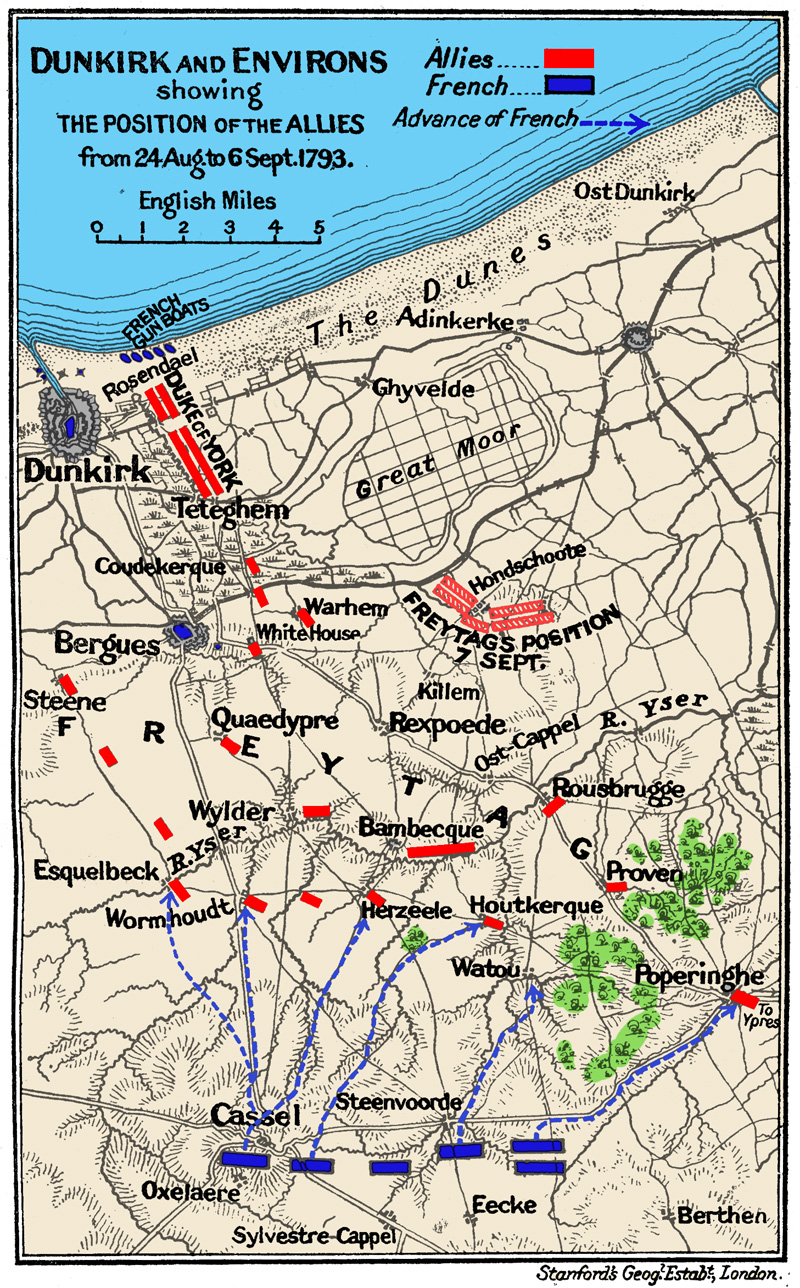
The siege guns were supposed to arrive at Nieuport on 26 August 1793. Instead, French gunboats turned up and started shelling the British right flank without anything to shoot back with. On 27 August, ships finally appeared - carrying the gunners but not their cannons. On 30 August, Admiral John MacBride arrived to command the naval coordination, again without any fleet. The whole farce had been Henry Dundas's idea, a war minister 600 miles away in Whitehall who wanted Dunkirk for diplomatic leverage and as a future British base. The Duke of York had been ordered to take a fortified port without artillery, with rivers that could be flooded against him, and without the men to surround it. He never had a chance.
A Cabinet Decision
The siege of 1793 was conceived not by generals but by Pitt's government - chiefly by Henry Dundas, Secretary of State for War. Dundas reasoned that whoever held Dunkirk at the eventual peace would hold a card worth playing, and a Channel port in British hands would be useful for any future Continental adventure. The Austrians wanted the British corps further south, joining the main coalition advance toward Paris. They were overruled. Prince Frederick, the King's second son, was ordered to march northwest from Menin with 22,000 men and take the port, while Field Marshal Freytag's 14,500 Hanoverians and Hessians spread out in a cordon to cover his open left flank. It was the wrong objective in the wrong direction with the wrong tools.
The Sluices Open
York drove the French defenders back into Dunkirk on 22 August, capturing eleven guns and clearing the Rosendaël suburb in a costly assault on the 24th that killed the Austrian Feldmarschall-Leutnant d'Alton. But the commander inside the walls, Joseph Souham, knew exactly what to do. He opened the town sluices, and within days the British trenches filled with two feet of water and the surrounding fields turned to swamp. An eyewitness wrote that the ground became 'a perfect swamp'. Then came the fever - a sickness the troops called Dunkirk Fever that carried men off faster than French muskets. Souham had a more decisive friend: in Paris, Lazare Carnot of the Committee of Public Safety realised that humiliating Britain at Dunkirk would be a national prize, and ordered 40,000 men from other fronts to converge on the besiegers.
Promises Not Kept
York spent the last days of August watching reinforcements arrive without the equipment they were supposed to bring. He pleaded with London. He cannibalized a frigate at Furnes for whatever guns could be floated up the canal. The Royal Navy, which had been promised, simply was not there. The civilian witness writing to the Public Advertiser claimed the town would have surrendered outright on the first day had naval bombardment arrived as planned, were it not for the Paris Commissioners who shot any officer who spoke of giving up. We will never know whether that was true. What we do know is that around York's army, the French were no longer 5,000 men but thirty thousand - some of them, controversially, paroled prisoners from Valenciennes who had sworn not to fight.
Retreat by Candlelight
On 6 September the French struck Freytag's covering corps at Hondschoote, and over three days drove it back. On the same morning the Dunkirk garrison sortied against York's right flank: the 14th Foot lost nine officers out of eleven and 253 men. On 8 September a Council of War decided the siege was over. Souham had wrecked the canal so the captured 24-pounder naval guns could not be towed; they were spiked and abandoned where they sat. At eleven that evening York's army began marching in the dark toward Veurne, baggage tumbling off carts into ditches. They reached safety, but they left behind 32 guns and the satisfaction of every officer who had warned the cabinet that this was the wrong war.
The Reckoning
MacBride's fleet finally appeared off Nieuport on 11 September, three weeks late. Total Coalition losses across the operation came to about 2,000 killed and wounded plus thousands more to sickness - one Guards officer estimated 10,000 men in all. An officer wrote to the Morning Chronicle two days after Hondschoote that every man who had died should be 'set down to the score of the ministers, who have sacrificed their duty to the holiday mummery of camps or to the amusements of partridge shooting'. The historian Digby Smith would later call Dunkirk a missed opportunity. The Duke of York, the king's son, spent the rest of his life being teased about a small hill at Cassel and a nursery rhyme about marching men up and down. He had earned better.
From the Air
Coordinates 51.04 N, 2.38 E. The 1793 siege ranged across a triangle of Dunkirk, Bergues 8 km south, and Hondschoote 18 km southeast. From altitude you can trace the canals of French Flanders that still mark the flooded approaches Souham used to ruin the British trenches. Nearest airports: Calais-Dunkerque (LFAC), Ostend-Bruges (EBOS). The flat polder country can produce sudden coastal mist.