Siege of Dunkirk (1944-1945)
On 9 May 1945, a day after the rest of Nazi Germany had laid down arms, Admiral Friedrich Frisius walked out of Dunkirk to formally surrender his fortress. Across the table sat Brigadier General Alois Liska of the 1st Czechoslovak Armoured Brigade - exiled soldiers of a country that had ceased to exist in 1938, finally accepting the capitulation of the regime that had erased their homeland. While Soviet troops took photographs in the Reichstag and Eisenhower drafted communiques in Reims, more than 10,000 German troops at Dunkirk had simply continued the war for eight months past any military logic. They were, by a single day, the last German pocket on European soil to formally surrender.
The Port That Wasn't Worth It
The math was unsentimental. After D-Day, Field Marshal Montgomery's 21st Army Group needed ports to feed an army racing toward Germany. The Canadian First Army on his left flank had orders to clear the Channel ports - Le Havre, Boulogne, Calais, Dunkirk - one by one. But in mid-September 1944, Eisenhower told Montgomery that Antwerp's vast undamaged docks mattered more than any of them. Montgomery rewrote his orders: 'Early use of Antwerp so urgent that I am prepared to give up operations against Calais and Dunkirk... Dunkirk will be left to be dealt with later; for the present it will be merely masked.' Resources shifted south to clear the Scheldt estuary. Dunkirk would be ringed, watched, and ignored.
Nibbling the Perimeter
Before the masking decision, the Canadians had tried the direct approach. The 5th Canadian Infantry Brigade took Bourbourg on 7-8 September. The Calgary Highlanders attacked Loon-Plage against opposition so heavy that each company was reduced to fewer than thirty men - the village fell on 9 September only when the Germans withdrew. Over the following ten days, Canadian units chewed through the German outer ring at Mardyck, Spycker, Bergues, and Bray-Dunes. The Belgian Resistance's Witte Brigade helped clear De Panne and Nieuwpoort east of the city. Then came the order to stop. The 2nd Canadian Division pulled out on 16 September, replaced briefly by Royal Marines Commandos, then by the 51st Highland Division. None of them were trying to win Dunkirk anymore - just to keep the Germans inside it.
A Czechoslovak Brigade Comes Home
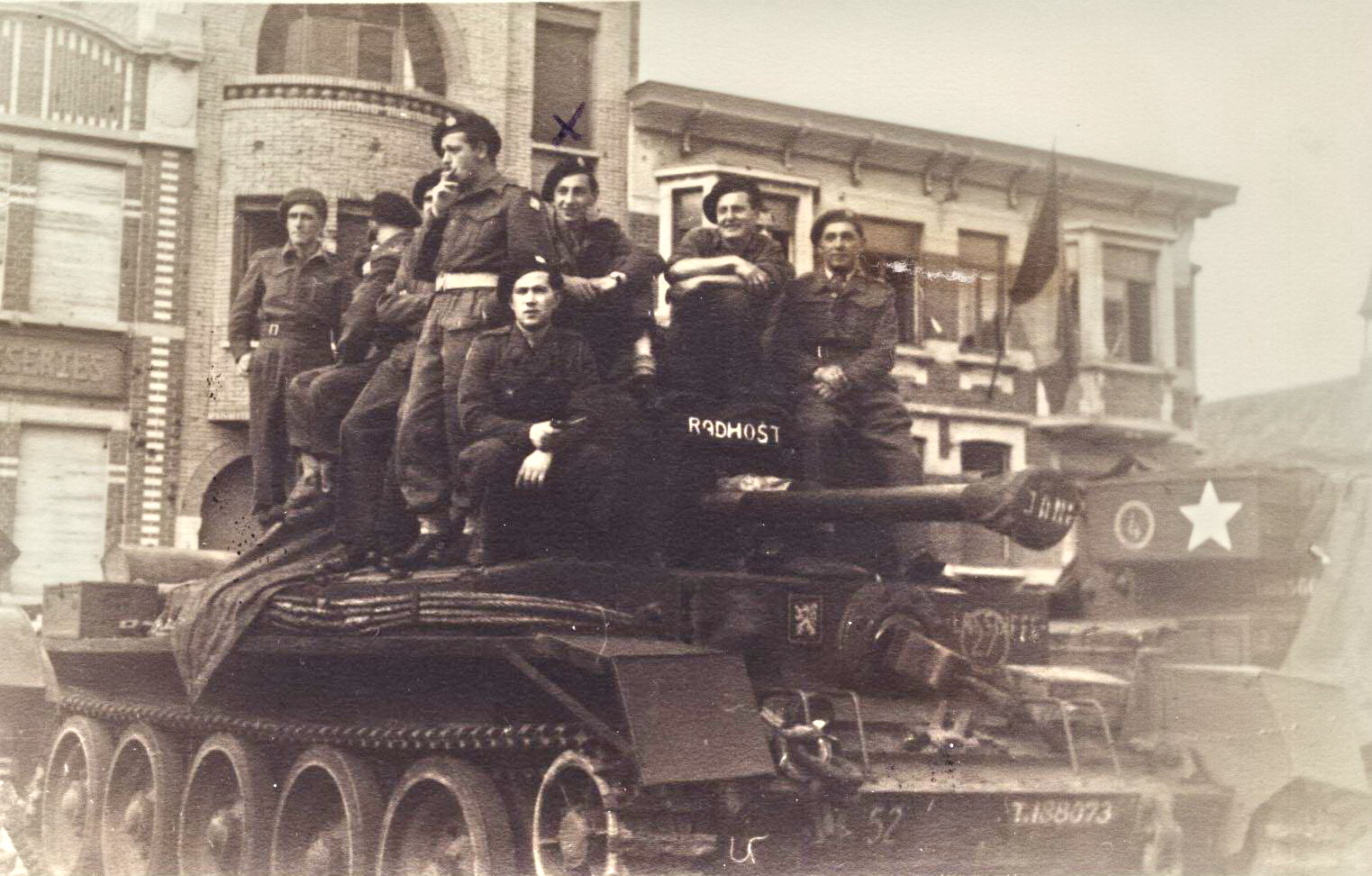
On 9 October the 1st Czechoslovak Armoured Brigade arrived to take over the siege. They were a remarkable formation - men who had fled Czechoslovakia after the Munich Agreement and the German occupation, who had fought in France in 1940, then in North Africa, then waited in Britain for the chance to fight their way back toward Prague. Now they sat in Flanders watching a German garrison instead. The 2,000-strong Waffen-SS detachment inside Dunkirk and the remnants of five infantry divisions had been mauled in Normandy before retreating into the fortress. Admiral Frisius commanded a motley of Kriegsmarine sailors, Luftwaffe ground crew, fortress troops, and dedicated SS - over 10,000 men in total. They sortied. The Czechoslovaks shelled. Allied propaganda leaflets fluttered into the streets, addressed 'An die deutschen Truppen in Dunkirchen' - to the German troops in Dunkirk.
The Last Pocket
Through autumn rain and winter cold and the Ardennes counteroffensive far to the east, Dunkirk simply held. Air supply drops still occasionally got through. E-boats slipped along the coast at night. The garrison was the most resilient of all the Channel fortress commands - even the Royal Marines had been dissuaded from a full assault. By April 1945, with Berlin encircled and the Reich collapsing, Frisius was still issuing orders. Then came 7 May at Reims and 8 May in Berlin. The war in Europe ended. But Dunkirk was a separate command, with its own admiral, awaiting its own instructions. The instructions came the next day. Frisius drove out under flag of truce and signed unconditional surrender to General Liska on the morning of 9 May 1945.
What Remained
The fortress had cost the Allies very little after the masking decision - the gamble on Antwerp had paid for itself many times over. Dunkirk itself was wrecked, its docks systematically demolished by the Germans during the siege, the harbour useless for the very purpose that had made it strategic in 1940 and 1944. The Czechoslovaks rolled into a ruined town and then, in a final cruelty of geopolitics, went home to a Czechoslovakia about to slip behind the Iron Curtain. Many of them would be persecuted by the communist government for having fought with the Western Allies. Today a quiet monument outside the harbour remembers them - the brigade that took the last surrender of Nazi Germany on the western front, in a war that for them had begun seven years earlier with the loss of their own country.
From the Air
Coordinates 51.04 N, 2.38 E. The 1944-45 perimeter ran from Mardyck and Loon-Plage west of the city through Bergues 8 km south to Bray-Dunes and De Panne on the Belgian frontier - a roughly 30 km arc. Nearest airports: Calais-Dunkerque (LFAC), Lille-Lesquin (LFQQ) 70 km inland, Ostend-Bruges (EBOS). Coastal flying conditions can deteriorate quickly with onshore winds and sea fog.