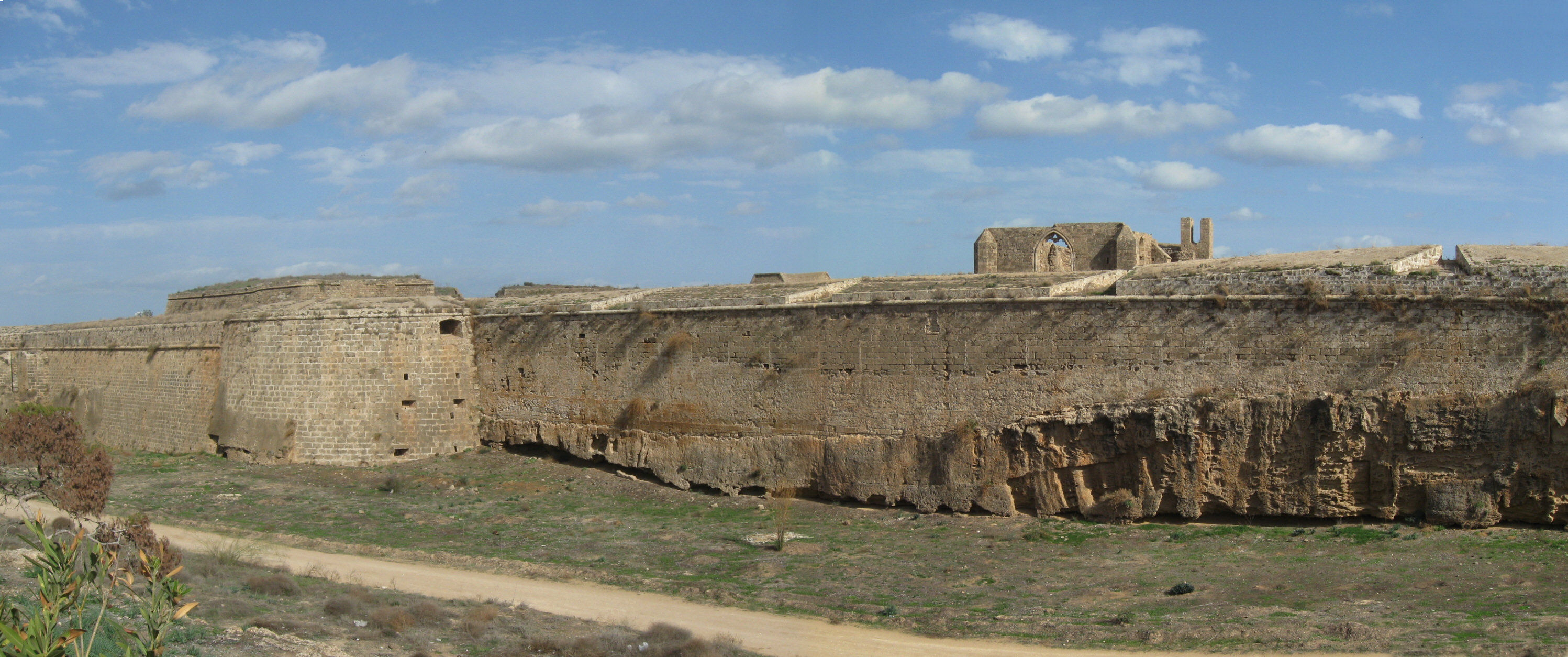
Siege of Famagusta
The surrender ceremony was supposed to end the bloodshed. On August 5, 1571, Venetian commander Marcantonio Bragadin walked into the tent of Ottoman general Lala Kara Mustafa Pasha to hand over the keys to Famagusta, the last Christian-held city on Cyprus. The terms had been generous -- safe passage to Crete for all Westerners, a two-year grace period for the Greek population to decide their future. For three days the evacuation had proceeded smoothly. Then, without clear provocation, everything changed.
In the Wolf's Mouth
Cyprus had been under Venetian rule since 1489, a wealthy island whose cotton and sugar trades enriched the Republic and whose location commanded the sea routes of the Levant. But its geography was also its curse. Surrounded on all sides by Ottoman territory, Cyprus sat isolated, hundreds of miles from Venice. One contemporary historian wrote that the island lay "in the wolf's mouth," and the metaphor proved grimly accurate. Venice fortified what it could during the 1560s, hiring the military engineer Sforza Pallavicini to upgrade the defenses of Cyprus, Crete, and Corfu. Foundries and gunpowder mills were built to make the islands self-sufficient. It was not enough. When the Ottoman invasion force -- between 350 and 400 ships carrying as many as 150,000 men -- set sail on June 27, 1570, the island's fate was largely sealed. Nicosia, the capital, fell quickly. Its incomplete Venetian walls offered little resistance, and the Ottoman army massacred as many as 20,000 of its garrison and citizens.
Eleven Months Against the Tide
Famagusta was different. Its fortifications were stronger, its commander resolute. Bragadin led the defense alongside Lorenzo Tiepolo, Captain of Paphos, and General Astorre Baglioni, the last governor of Venetian Cyprus. Together they commanded roughly 8,500 defenders with 90 artillery pieces -- a force dwarfed by the Ottoman siege army, which Venetian chroniclers claimed numbered 250,000 with 1,500 cannons, though these figures are likely exaggerated. What is not exaggerated is the duration and ferocity of the siege. For eleven months the Ottoman artillery pounded Famagusta's walls while tunnelers burrowed beneath them. The besiegers filled the space between the plain and the wall tops with packed earth, creating ramps for assault. In July 1571, they finally breached the fortifications and fought their way into the citadel, only to be thrown back at staggering cost. Ottoman casualties over five major assaults reportedly reached 52,000, including the son of the Ottoman commander. By August, Bragadin's garrison had been reduced to 900 men -- wounded, starving, out of ammunition, and with no relief fleet in sight.
A Betrayal Written on Skin
Bragadin requested terms on August 1. Mustafa Pasha agreed to remarkably generous conditions: safe passage, Greek self-determination, orderly evacuation. For three days, it worked. Then at the formal surrender ceremony, Mustafa's demeanor shifted. He accused Bragadin of murdering Turkish prisoners and hiding munitions. When Bragadin denied it, Mustafa drew a knife and cut off his right ear, then ordered guards to remove the other ear and his nose. What followed was calculated cruelty. Bragadin was imprisoned for two weeks while his wounds festered. He was dragged around the city walls carrying sacks of earth and stone. He was hoisted from a ship's yardarm for sailors to mock. Finally, in the main square of Famagusta, he was tied naked to a column and flayed alive, praying the Miserere as the executioners worked. His skin was stuffed with straw, dressed in his military insignia, and paraded through the streets on an ox. Together with the severed heads of his generals, the macabre trophy was sent to Constantinople as a gift for Sultan Selim II.
The Gift Famagusta Gave
Bragadin's suffering was not meaningless. The eleven months his garrison held Famagusta consumed Ottoman resources and manpower on a scale that altered the strategic balance of the Mediterranean. While Mustafa Pasha's army bled outside Famagusta's walls, Pope Pius V was cobbling together the Holy League from reluctant Christian states -- a coalition that might never have formed without the time Bragadin's defense bought. When news of his death reached Venice, the Republic's grief hardened into fury. Venetian seamen in the Holy League fleet fought at Lepanto on October 7, 1571, with a ferocity that contemporaries attributed directly to the desire to avenge Bragadin. The Battle of Lepanto became the first major Ottoman naval defeat, breaking the myth of Turkish invincibility at sea. Historians still debate why Venice never sent a relief fleet from Crete, just days away. Some believe Venetian strategists deliberately sacrificed Famagusta, hoarding their forces for the showdown they knew was coming.
Walls That Still Remember
Today Famagusta's Venetian walls still stand in what is now northern Cyprus, their massive stone blocks pitted with the scars of Ottoman cannon fire. The Martinengo Bastion, the strongest point in the fortifications, remains one of the finest examples of Renaissance military architecture in the eastern Mediterranean. Bragadin himself made a final journey home centuries after his death -- Venetian merchants eventually recovered his stolen skin from Constantinople's arsenal, and it was returned to Venice, where it rests in a niche behind the Church of Santi Giovanni e Paolo. From the air, the outline of the old walled city is unmistakable: a rough polygon jutting into the harbor, surrounded by the sprawl of modern Gazimagusa. The fortifications that held for eleven months are still the most prominent feature of the landscape, a stone testament to a defense that changed the course of Mediterranean history.
From the Air
Located at 35.12N, 33.95E on the eastern coast of Cyprus. The Venetian walled city is clearly visible from altitude, jutting into Famagusta harbor. Nearest airports: LCEN (Ercan International, 30nm west) and LCLK (Larnaca International, 35nm southwest). Best viewed at 3,000-5,000 feet for wall detail. The Martinengo Bastion is identifiable at the northwest corner of the fortifications.