Siege of Fort Pulaski: The Day Brick Walls Became Obsolete
"You might as well bombard the Rocky Mountains." That was the U.S. Chief of Engineers, Colonel Joseph Gilbert Totten, describing the futility of attacking Fort Pulaski before the Civil War. The fort's seven-and-a-half-foot solid brick walls, reinforced with masonry piers and surrounded by alligator-infested marshes, had been engineered to be impervious. Robert E. Lee himself, who had helped construct the fort as a young Army engineer, surveyed its defenses and told the garrison commander that enemy shells might make things warm but could not breach the walls at such distance. On April 10, 1862, thirty-six Union guns opened fire from Tybee Island. Thirty hours later, rifled shells had punched through the southeast corner and were striking the powder magazine containing twenty tons of gunpowder. Colonel Charles Olmstead surrendered. The age of masonry fortification was over.
A Fortress Named for a Polish Hero
Fort Pulaski sits on Cockspur Island, Georgia, near the mouth of the Savannah River, commanding the seaward approaches to one of the South's most important cities. Named for Casimir Pulaski, the Polish cavalry officer who died fighting in the American Revolution, the fort was a "Third System" coastal defense, part of a nationwide chain of fortifications authorized under the James Madison administration. Construction began in 1830 and finished in 1845. The fort replaced two earlier defenses on the site, including a colonial-era British fort torn down during the Revolution and a first American fort swept away by an 1804 hurricane. Sixteen days before Georgia seceded from the Union on January 19, 1861, volunteer militia seized Fort Pulaski from the federal government. Confederate forces immediately began repairing and upgrading its armament.
Lee's Layered Defense
When Robert E. Lee assumed command of the Department of South Carolina, Georgia and Florida in November 1861, he brought intimate knowledge of the terrain and tides around Fort Pulaski. He established a defense in depth: Old Fort Jackson was armed and strengthened as an interior barrier three miles below Savannah. Batteries were placed at Causton's Bluff and Elba Island to block river approaches. Ships were sunk in the channels as obstructions. Commodore Josiah Tattnall's gunboats patrolled the river. Lee's system was designed to keep the Union from reaching Savannah even if Pulaski fell. The garrison under Colonel Olmstead had been provisioned with six months of food and armed with 48 cannons, including ten columbiads and five mortars. Lee was confident the river could not be forced.
Night Work on Tybee Island
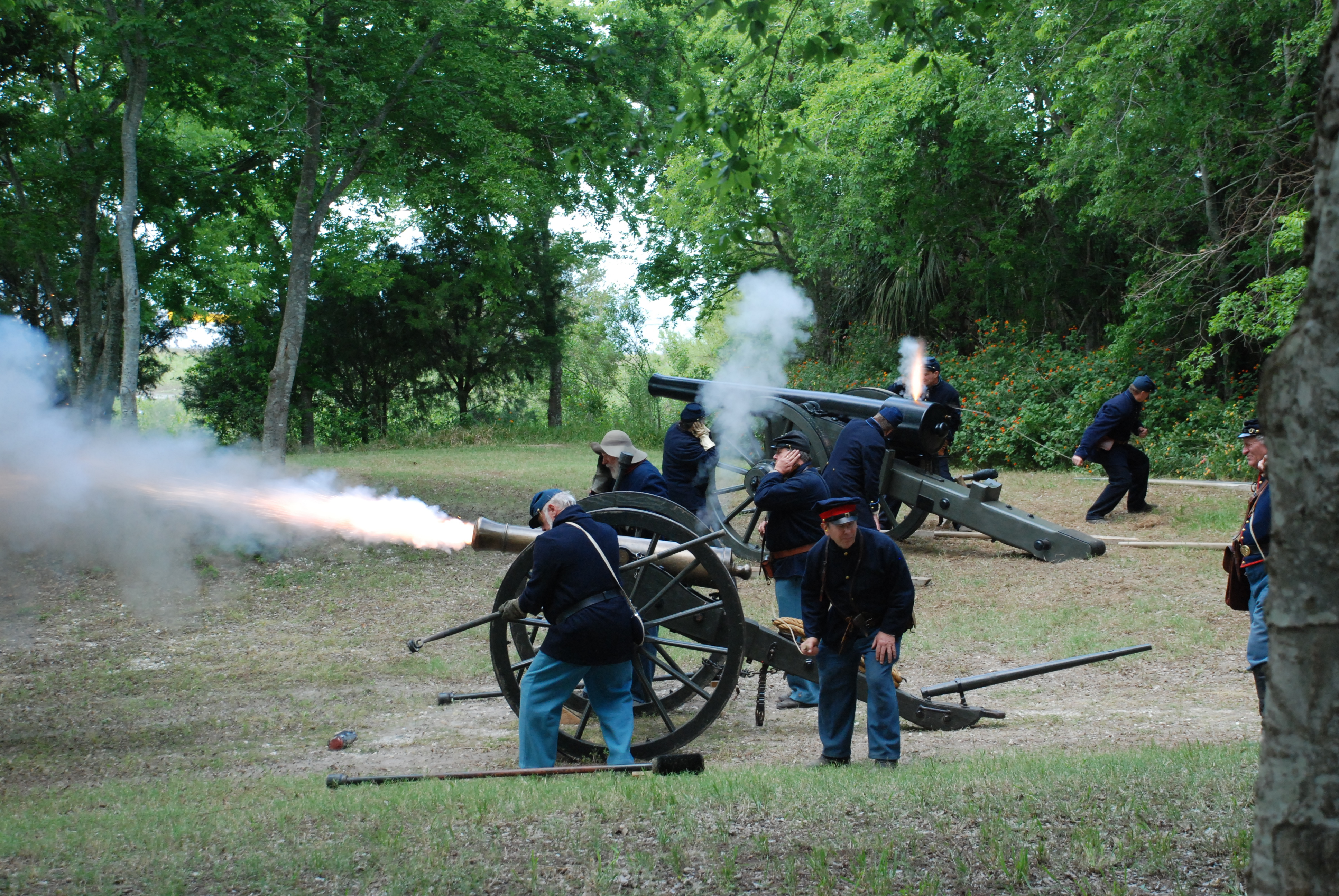
The Union advance began in November 1861 when Flag Officer Samuel Du Pont's gunboats seized the abandoned Tybee Island lighthouse. Captain Quincy Gillmore proposed an unconventional plan: reduce the fort with rifled guns, a new technology most commanders dismissed. His superior approved the plan but doubted the rifles would do more than "shake the walls in a random manner." Landing the siege guns was brutal work. Artillery pieces were rafted to shore at high tide, then dragged up the beach by hand at low tide. Two hundred and fifty men were needed to move a single 13-inch mortar. Fort Pulaski's gunners forced all construction to proceed by night, with camouflage applied each morning. Engineers laid nearly a mile of corduroy road through swamp. After a month, thirty-six guns were in position along a two-and-a-half-mile front.
Thirty Hours of Fire
On April 10, Major General David Hunter demanded "immediate surrender and restoration of Fort Pulaski." Olmstead replied: "I am here to defend the fort, not to surrender it." The bombardment began at eight in the morning. The Parrott rifles and James rifles proved devastatingly accurate, concentrating fire on the fort's southeast corner. Confederate gunnery was described by the Federals as firing with "great precision, not only at our batteries, but even at the individual persons passing between them." As the day wore on, the fort's guns were dismounted or destroyed one by one. By nightfall, the southeast wall was breached. The next morning, Union fire enlarged the gap until shells were passing through the fort and striking the powder magazine. Olmstead surrendered at 2:30 p.m. on April 11. The 10,000-man assault force waiting on Tybee Island was never needed.
The End of an Era
The fall of Fort Pulaski closed Savannah as a Confederate port and extended the Union blockade down the Atlantic coast. But its significance reached far beyond one city. The siege proved that rifled artillery could destroy masonry fortifications at distances previously considered safe, making every brick-and-stone coastal fort in the world instantly obsolete. Military engineers had to rethink everything. The Confederates learned the lesson immediately, incorporating the experience into the defenses of Charleston, where earthworks replaced masonry and repeated Union assaults failed from 1862 through 1865. The Union, ironically, did not fully absorb its own lesson until the second attack on Fort Fisher in January 1865, when Admiral Porter finally adopted Gillmore's targeted gunnery tactics. Fort Pulaski is today a National Monument, its breached walls preserved as testimony to the moment technology outran engineering.
From the Air
Located at 32.027N, 80.891W on Cockspur Island at the mouth of the Savannah River. The pentagonal fort is clearly visible from altitude, sitting on a low island surrounded by salt marsh. Tybee Island and its lighthouse are immediately to the east; Hilton Head Island, South Carolina is visible to the northeast. The Savannah River channels pass on either side. Nearest airport is Savannah/Hilton Head International (KSAV), approximately 14 nautical miles to the west-northwest. Best viewed at 2,000-3,000 feet AGL. At lower altitudes, the breach in the southeast wall is still visible. The surrounding marshes and waterways that defined the siege's logistics are dramatically apparent from the air.