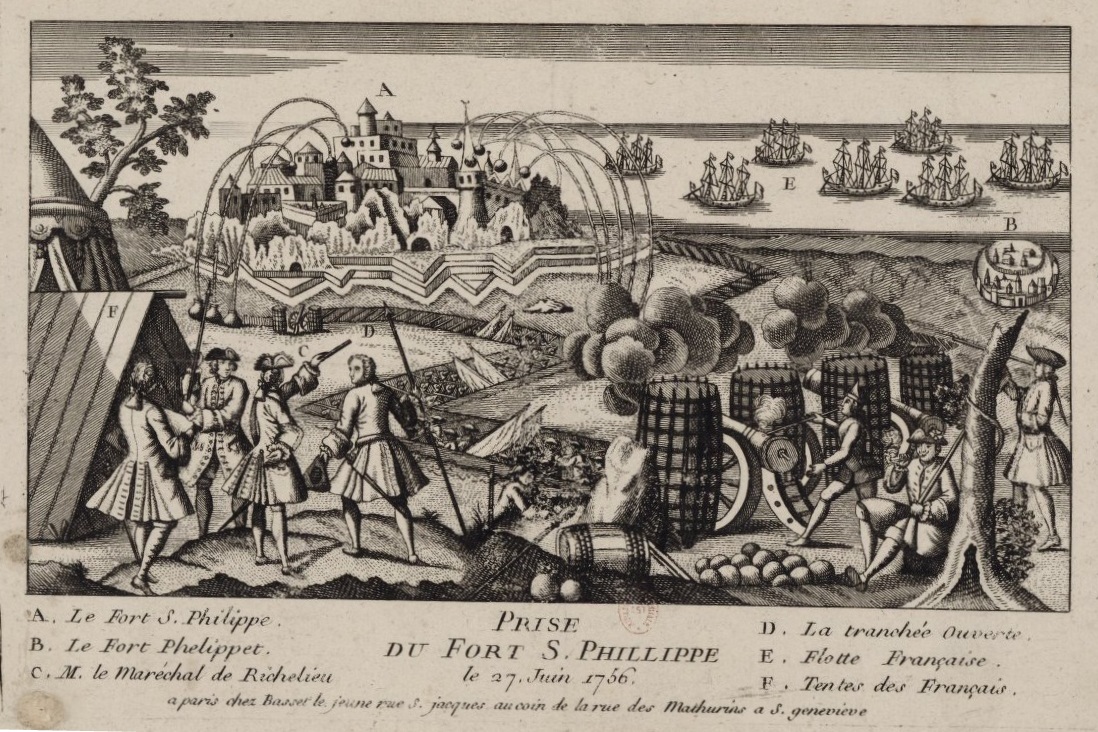
Siege of Fort St Philip (1756)
The English, Voltaire wrote, "shoot an admiral from time to time, to encourage the others." He was talking about John Byng, executed in March 1757 for failing to relieve Fort St. Philip on Menorca -- a fortress whose fall the previous summer had triggered one of the great scandals of 18th-century British military history. The siege lasted seventy days. Its consequences lasted far longer.
An Island Already Lost
By the time the French arrived in April 1756, Menorca was a fortress in name only. Britain had held the island since 1708, receiving it formally under the Treaty of Utrecht in 1714, and had treated it with the neglect that comes from assuming a possession is secure. A parliamentary investigation later cataloged the decay: crumbling walls, rotten gun platforms, and over thirty-five senior officers absent from their posts, including the governor of Fort St. Philip and the colonels of all four garrison regiments. The man left holding it together was William Blakeney, the lieutenant governor -- eighty years old, plagued by what his contemporaries called alcoholism, and possessed of a distinguished career that had not prepared him for what was coming. The French knew all of this. They hoped that capturing the island would persuade Ferdinand VI of Spain to join their side in the looming war. It did not, but they took the island anyway.
Seventy Days
The Duke de Richelieu sailed from Marseille on April 10 with 16,000 troops and seventeen warships. By April 18 he had landed on Menorca and occupied most of the island. The bombardment of Fort St. Philip began on May 8. Blakeney had used the warning time to strengthen his fortifications, but the garrison was burdened with over 800 non-combatants -- women and children whose presence meant supplies would run out fast. The critical moment came on May 20, when a Royal Navy squadron under Admiral Byng arrived from Gibraltar and fought an inconclusive engagement known as the Battle of Minorca. Byng withdrew. The garrison fought on alone for another five weeks before Blakeney surrendered on June 29, two days after the French captured several key outworks.
The Cost of Failure
The butcher's bill told different stories depending on which side you counted. The British garrison lost 59 killed and 149 wounded. French casualties were staggering by comparison: roughly 1,600 dead and 2,000 wounded, a testament to the ferocity of the defense even under desperate conditions. Blakeney surrendered on terms, and the surviving garrison -- 4,378 soldiers and civilians -- were transported to Gibraltar on French ships. Back in Britain, the aftermath was savage. Byng was court-martialed for failing to do his utmost and executed by firing squad in March 1757, despite pleas for mercy. Thomas Fowke, the Governor of Gibraltar, was found guilty of not sending reinforcements early enough and was dismissed. Blakeney, meanwhile, was lionized by the press as a hero. His colleagues were less impressed: his chief engineer, William Cunninghame, considered the surrender premature and cataloged numerous failures in the defense.
Traded Like Currency
Menorca became a bargaining chip. France appointed Hyacinthe Gaetan de Lannion as governor and held the island until the Treaty of Paris in 1763, when Britain traded Guadeloupe to get it back. The exchange speaks volumes about 18th-century imperial priorities -- a Caribbean sugar island weighed against a Mediterranean naval base, and the Mediterranean won. But Britain's hold remained tenuous. Spain recaptured Menorca in 1781 during the Anglo-Spanish War, and it was formally returned to Spanish sovereignty in the Treaty of Paris of 1783. Fort St. Philip, the fortress that had resisted for seventy days, was eventually demolished -- its stones scattered, its story absorbed into the long contest for control of one of the Mediterranean's most fought-over islands.
From the Air
Located at 39.87N, 4.31E at the entrance to Mahon harbor on the eastern coast of Menorca. The ruins of Fort St. Philip are on the southern shore of the harbor mouth, opposite the later Mola Fortress. Nearest airport is Menorca Airport (LEMH), approximately 5 km southwest. Approach from the east for a dramatic view of the narrow harbor entrance where the 1756 battle was contested.