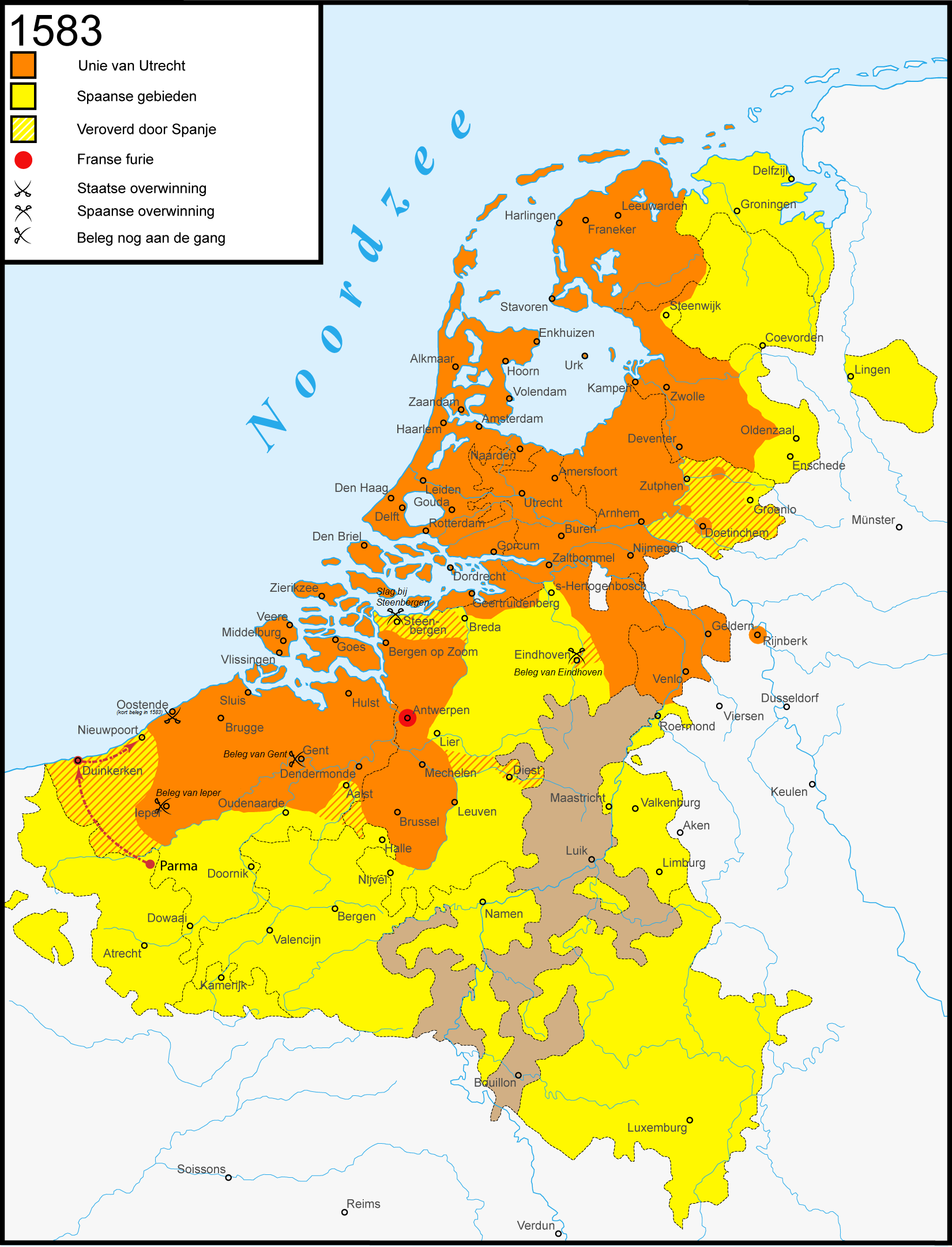
Siege of Ghent (1583-1584)
By the summer of 1584, the food in Ghent was running out, and so was William of Orange. The prince had been assassinated on 10 July in Delft, leaving the Dutch Revolt without its central political figure. Two months later, on 17 September 1584, the gates of Ghent opened to the army of Alessandro Farnese, Duke of Parma, and seven years of the Calvinist Republic of Ghent ended. Within a few years, fifteen thousand people - artisans, weavers, merchants, preachers, families - would leave the city for the Protestant north, taking with them the skills and the capital that had made Flemish Ghent prosperous for centuries. The economic gravity of the Low Countries shifted permanently to Amsterdam.
A Republic Born in October
On 28 October 1577, radical Protestants seized power in Ghent and declared an end to Spanish royal authority. The new regime, soon called the Calvinist Republic of Ghent, set itself up as the leading force in Flanders' resistance to the Habsburg crown. It controlled most of the surrounding County of Flanders. It coordinated with the parallel Calvinist Republic of Antwerp. For a few years, it looked as if a Protestant Low Countries might emerge in the south as well as the north. But the republic was riven from the start by two factions. Jan van Hembyze, a radical and an intolerant Calvinist, wanted to push as hard as possible. Francois van der Kethulle, lord of Ryhove, an Orangist loyal to William the Silent's more moderate line, wanted to keep the broader coalition intact.
Hembyze, Twice
In 1579, Hembyze tried to ban Ryhove from the city. Ryhove, with William of Orange's help, had Hembyze removed instead. For four years Ryhove ran a relatively moderate Ghent that coordinated with Antwerp and the States of Brabant. Then in January 1583, Francis, Duke of Anjou - the French prince the rebels had brought in as a nominal sovereign - tried a violent coup against his own allies in what became known as the French Fury. Ryhove and his moderate allies kept trying to repair the relationship. The city lost patience. On 14 August 1583, Hembyze was recalled. He arrived in Ghent on 24 October and established a dictatorship. Ryhove was expelled, retreated to Dendermonde, and began blockading the supplies from Antwerp into Ghent to bring his rival down.
Farnese Closes the Net
While the Calvinist republic ate itself, Alessandro Farnese, the Spanish governor-general, methodically encircled it. Farnese was patient, talented, and ruthless in the way professional commanders of his era admired. Sas van Gent fell in October 1583. The Waasland region fell in November. On 3 November, the starving English garrison at Aalst - in Dutch rebel service - was bribed into surrender in exchange for food and overdue pay. Ypres surrendered on 7 April 1584 after a siege. Hembyze and the preacher Pieter Datheen tried to open secret negotiations with Farnese on 5 March, but the talks were exposed; Datheen was imprisoned. Dendermonde fell on 17 August 1584, and Ryhove escaped to England. Ghent was now alone.
The City Surrenders
On 17 September 1584, Ghent opened its gates. The terms Farnese offered were not as harsh as some Spanish commanders had imposed elsewhere - he was a soldier who understood that political settlements outlast battlefield victories. Catholicism was restored as the official religion. The Calvinist republic ended. But the soft terms came with one provision that emptied the city of its productive heart - those who would not return to the Catholic faith had a window to leave. About fifteen thousand inhabitants, including thousands of Calvinists, primarily migrated north to Holland. Weavers carried the Flemish textile trade to Leiden. Diamond cutters and merchants carried their networks to Amsterdam. By 1600, Ghent's population, which had stood at roughly 50,000 before the revolt, had collapsed.
Where the Center of Gravity Moved
The fall of Ghent ended the city's role as the political and cultural lead of the Dutch Revolt. The center of gravity moved to Antwerp, and then - after Antwerp itself fell to Farnese in 1585 - to the County of Holland. Almost all of Flanders was reconquered for the Spanish crown. Maurice of Nassau campaigned south fifteen years later, reached as far as Nieuwpoort in 1600, won a tactical battle, and discovered that the Flemish population would not rise to support him. The Siege of Ostend ended in 1604 with the last major Flemish coastal city back in Spanish hands. When the Peace of Munster was signed in 1648, only a narrow northern coastal strip - Staats-Vlaanderen, today's Zeelandic Flanders - remained Dutch. It is still the only piece of the old County of Flanders with a substantial Protestant population, an echo across four centuries of one September day in 1584.
From the Air
The siege center was Ghent itself, at roughly 51.05 degrees north, 3.72 degrees east in East Flanders, Belgium. Approach from the south with the Belfry of Ghent, Saint Nicholas Church, and Saint Bavo's Cathedral aligned in the city's medieval triple-tower silhouette. Farnese's encircling lines wrapped the city to the north, east, and west, taking advantage of the Schipdonk and Lieve canal systems. Nearest airport is Brussels (EBBR) about 50 km southeast; alternates Antwerp (EBAW) and Kortrijk-Wevelgem (EBKT). The flat Flemish polder country offers good visibility on clear days; autumn and winter often bring stratus and ground fog over the canals.