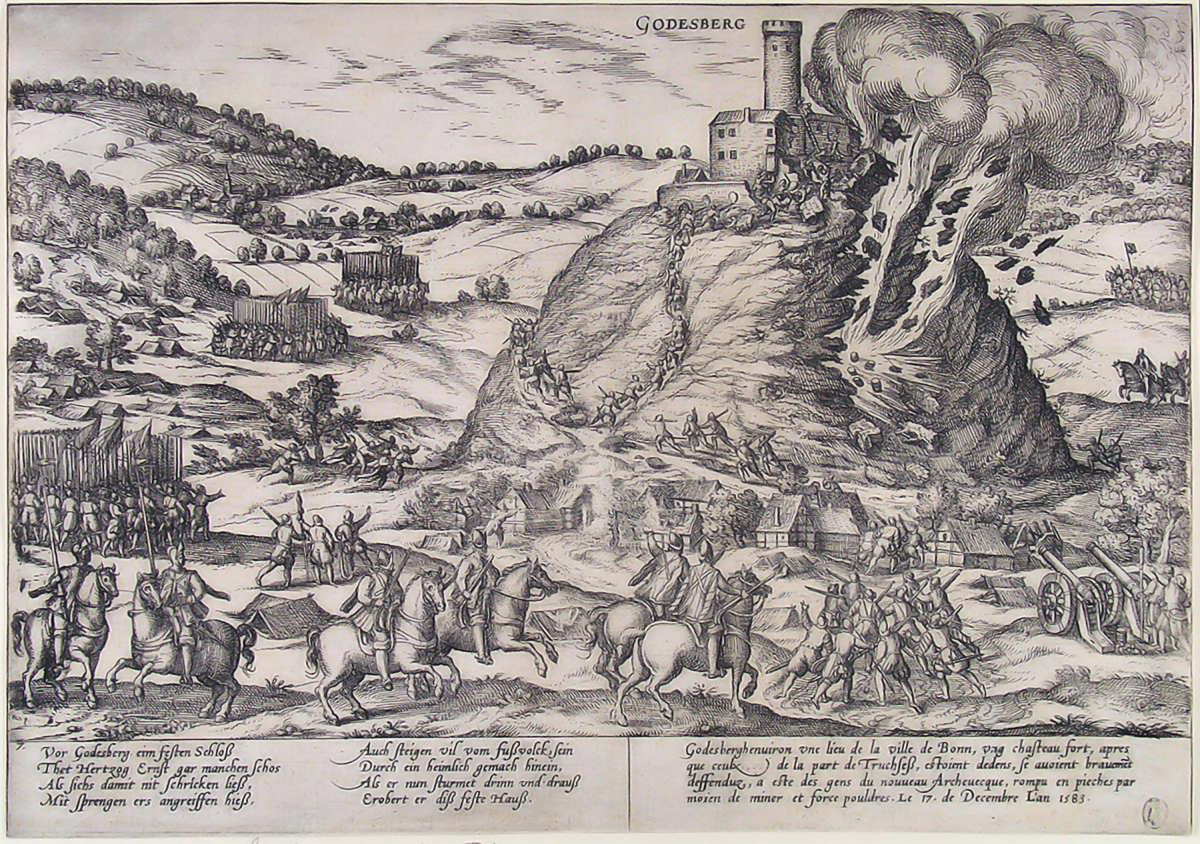
Siege of Godesberg
On 17 December 1583, after the cannonade had failed and the breaches had been judged unstormable, Bavarian sappers detonated 1,500 pounds of black powder under the basalt foundation of the Godesburg. Half the castle vanished into the sky in a single crack. The mountain shook. Smoke rolled down the Rhine valley toward Bonn. And then the strangest thing happened, which is that the surviving garrison did not surrender. They climbed onto the rubble and kept shooting. The Bavarian assault columns waiting in the saps below stumbled into a wall of their own debris and stopped. The castle had been destroyed and the siege was still not over. What finally let the attackers inside was something no military manual mentions: the latrine system.
A Bishop with a Wife
The Cologne War of 1583-1589 began with a wedding. Gebhard, Truchsess of Waldburg, was Archbishop-Elector of Cologne, one of the seven men who chose Holy Roman emperors. He was also, by late 1582, a quiet Calvinist, and on 2 February 1583 he married Agnes of Mansfeld-Eisleben. The Pope excommunicated him in April 1583. The Cologne cathedral chapter elected a Catholic replacement, Ernest of Bavaria of the House of Wittelsbach, and within months a local marital dispute had pulled in papal mercenaries, Spanish gold, the Duchy of Bavaria, the Electorate of the Palatinate, and eventually Henry III of France and Elizabeth I of England. The whole of central Europe was watching to see whether an elector could change his religion and keep his job. Gebhard was betting that he could. The Godesburg was supposed to keep that bet alive.
The Mountain Fortress
The Godesburg sat on a volcanic cone four hundred feet above the Rhine, seven kilometers south of Bonn. Its walls were thick and round in the medieval style, partly upgraded with Italian-inspired refinements, though the geometry of the mountain refused the star-shaped trace italienne. The approach road switchbacked under the castle wall, where defenders could fire down at any column toiling upward. Battering rams were useless on the turns. Artillery aimed from the valley floor had to fight gravity. By 1583, the Godesburg was the favorite seat of the Cologne electors, a strongbox for archives and valuables, and a popular reputation as nearly impregnable. Around 180 people were inside when Ferdinand of Bavaria, Ernest's brother, arrived on 18 November with four hundred foot soldiers, five squadrons of cavalry, and half a dozen culverins. Among the defenders was Lieutenant Colonel Felix Buchner, Captain Eduard Sudermann of Cologne, a garrison of Dutch troops, and several prisoners held in the dungeons, including the auxiliary bishop of Hildesheim and a captured commander from Florence.
Ten Days of Useless Fire
Ferdinand asked for surrender on the first day. The defenders replied that they had sworn to Gebhard and would die for him, which was the sort of answer Ferdinand had expected. He set three cannons at the foot of the mountain and opened fire. For ten days the cannonade accomplished almost nothing. Several thousand pounds of powder was burned against the walls and the angles were wrong. On 28 November Ferdinand moved his guns uphill into a hillside vineyard west of the castle and within hours had breached the outer ward. He sent three Italian engineers forward to examine the damage. They came back under fire and told him plainly that storming the breach would cost too many lives. The defenders held every elevated angle. So Ferdinand turned to sappers, and the sappers turned to local peasants whom he conscripted to dig. Many of the conscripts died under fire from the castle walls. By 6 December the tunnel had reached the southeastern face. By 16 December the gallery was packed with 1,500 pounds of powder. Meanwhile Gebhard, hiding in the north, wrote a desperate letter to the Archbishop of Canterbury begging for English money. None came.
The Crack
On 17 December, Ferdinand sent his trumpeter one last time. The defenders answered that they did not know the meaning of the word surrender. Ferdinand ordered four hundred men into the saps. The mine fired with what every chronicle calls a dreadful crack. Pieces of tower and wall pinwheeled into the sky. Nearly half the Godesburg collapsed in seconds. The four hundred assault troops surged out of the saps toward the breach, expecting to walk into a ruined fortress, and instead found their path blocked by mountains of their own rubble. The surviving defenders climbed onto the wreckage and started firing. What finally cracked the defense was small and human and grim. Some of the Bavarians worked their way around the eastern face and discovered a route into the inner courtyard through the castle's latrine drains, an opening too obscure to have been adequately guarded. Once attackers were inside the walls, the fight became a slaughter.
The Bargain at the Keep
Buchner and a few survivors retreated into the keep, which had ridden out the explosion. He pulled the prisoners out of the dungeon and stood them at the keep's door. Either Ferdinand spared his life, his wife's life, and Sudermann's life, or the prisoners would be killed. Ferdinand agreed. The Abbot of Heisterbach, one of the hostages, is said to have asked personally that Buchner be spared on the grounds that Buchner had treated him well during his captivity. The three were brought out alive, with considerable difficulty given the temper of the besieging troops. Inside the castle, 178 people had died: garrison soldiers, peasant servants, women, children, and the auxiliary bishop of Hildesheim who had died of illness in his cell shortly before the storm. They were buried in two mass graves whose locations were forgotten within a generation. The foundation stone, a slab of black marble inscribed with the date 1210, was dug out of the rubble and carried to Munich as a trophy. It is back in Bonn now, at the Rheinisches Landesmuseum.
What the Crack Changed
Bonn fell to the Bavarians on 28 January 1584. Gebhard's cause unraveled over the next six years until Ernest of Bavaria stood uncontested as Archbishop-Elector in 1589, the first Wittelsbach to hold the seat. The family kept it for most of two centuries. The Counter-Reformation got a foothold in the lower Rhine that it never lost. The principle of ecclesiastical reservation, that a converted prelate had to resign rather than carry his lands into a new faith, survived the test. And the German wars of religion acquired a precedent for foreign mercenaries deciding domestic disputes - Italians, Spaniards, Walloons, Scots, all paid by foreign treasuries - a precedent that would explode forty years later into the Thirty Years' War. The Godesburg's keep, the cylindrical tower that the explosion had failed to destroy, still stands on the cone south of Bonn. The 1959 hotel and restaurant built into the ruin is run by the city of Bad Godesberg. The latrine drain is no longer in service.
From the Air
Coordinates: 50.6833, 7.1500. The Godesburg cone sits prominently on the west bank of the Rhine, about 7 km south of Bonn city center. The hill rises sharply about 400 feet from the river plain - a clear volcanic plug visible from cruising altitude in clear weather. Nearest major airport: Cologne Bonn (EDDK), 14 nm north. Watch for Rhine valley haze and the EDDK Class C/D shelf. Best visual viewing altitude 2,500-4,000 feet on a south-to-north Rhine transit.