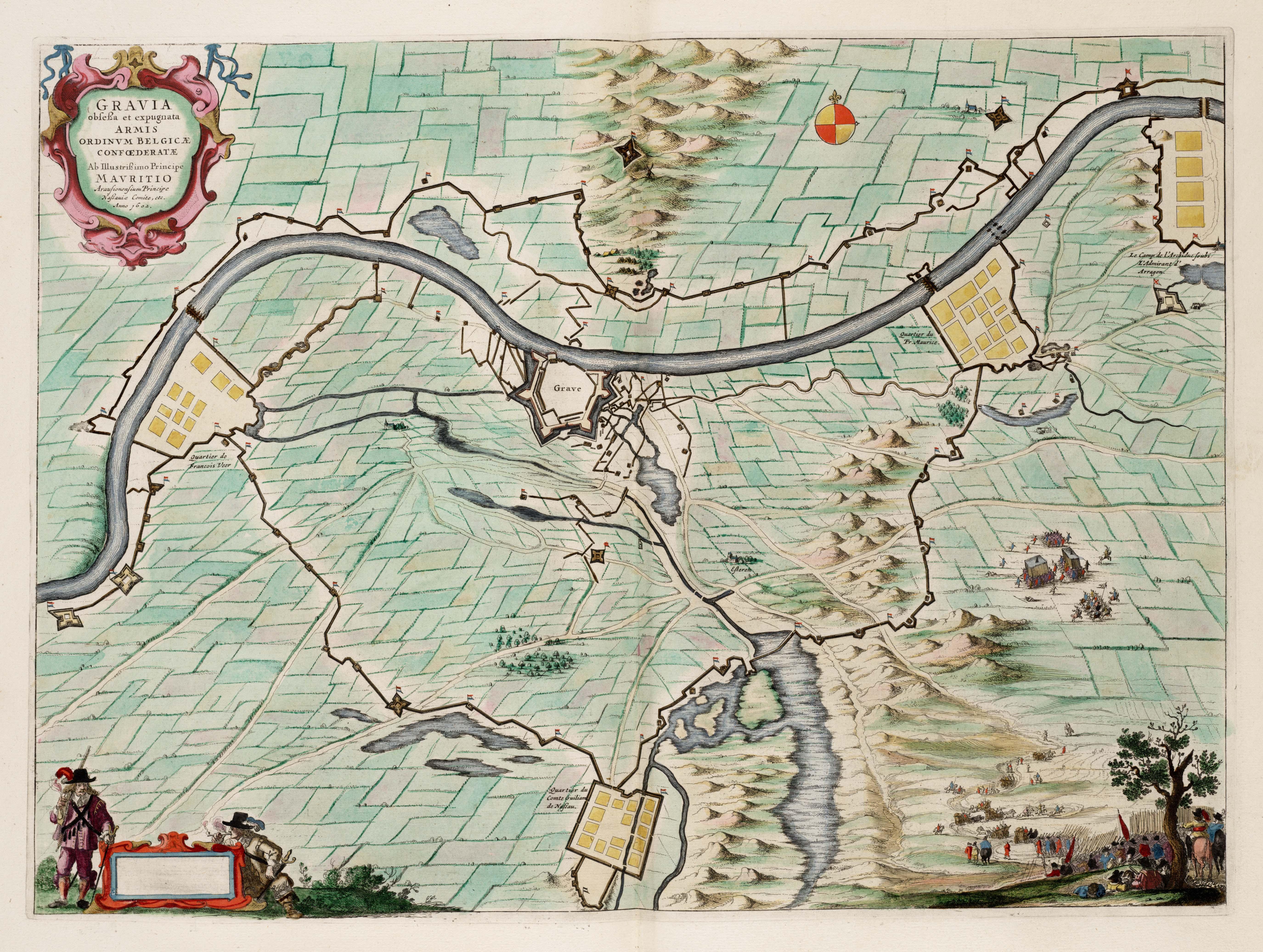
Siege of Grave (1602)
On a summer day in 1602, somewhere in the English trenches outside Grave, Sir Francis Vere was inspecting his lines when the Spanish garrison launched a sudden sally. The fighting was sharp. The Spaniards were driven back, but in the middle of it a musket ball struck Vere in the face, passed beneath his eye, and lodged in his skull. The most respected English soldier of his generation, the man who had held Ostend through the previous January's catastrophic assault, was carried unconscious from the field. The Earl of Leicester sailed across the North Sea in case Vere died and the queen needed someone to take command. Queen Elizabeth I, watching from London, declined the offer. In the meantime, an eighteen-year-old named Frederick Henry of Nassau, half-brother to the army's commander, stepped into the English line. The siege would have to be finished without Vere.
Why Grave Mattered
Grave sits at a bend in the Meuse in what is now Noord-Brabant, and in 1602 it was a Spanish-held fortress town inside what the Dutch insisted was their own republic. The Eighty Years' War had been grinding on for three decades by then, and Prince Maurice of Orange had been methodically taking back the Spanish garrisons left behind in the United Provinces. In July 1601 he had captured Rheinberg, an important Spanish stronghold on the Rhine. The plan for 1602 was to keep going, taking advantage of the fact that the Spanish army of Flanders was tied down by its own grinding siege of Ostend, the Dutch coastal city held by Sir Francis Vere and a mixed garrison that had bled the besiegers brutally that January. With Albert of Austria's forces fixed on the coast, Maurice could move inland. Grave, blocking river traffic on the Meuse, was the next obvious target.
Twenty Thousand Men Cross Two Rivers
The Dutch government decided Vere was wasted in Ostend's ditches and ordered him into the field with Maurice. He left in March 1602 with eight thousand English troops, many of them veterans of the previous winter's fighting at Ostend, and joined Maurice's army at the Hague. The combined force numbered nearly twenty thousand men. They crossed the Waal at Nijmegen, the Maas at Mook, and pushed south into Brabant. Grave's defenders, about 1,500 Spanish and Italian soldiers under Don Antonio Gonzalez, had been steadily improving their fortifications and now faced a besieging army more than ten times their size. Frontal assault was out of the question once Maurice's engineers had ringed the city with their own field works. The Spanish in Grave settled in to wait two months for relief.
The Relief That Couldn't Get Through
Help, when it came, came from Venlo upstream. Francisco de Mendoza arrived in late July with a Spanish relief force and tried to break through to Grave. He discovered, the hard way, just how large the Dutch and English besieging army really was. The leading element of the Spanish column ran into prepared positions and was thrown back with significant loss. The garrison inside Grave, hearing that Mendoza was close, launched repeated sallies to support a breakthrough that never came. The sallies wasted men and supplies they could not spare. Ambrosio Spinola, the rising Genoese commander who would later become the most feared Spanish general of the war, was operating with Mendoza but could not change the arithmetic. The relief failed. The mutiny that followed in the Spanish ranks, after the defeat, was severe enough that historians count it among the major mutinies of the war.
When the Meuse Rose
The siege almost ended in Maurice's failure for a reason that had nothing to do with Spanish arms. In early September the heavy autumn rains arrived, and the Meuse began to rise. It rose so fast that Maurice's trench lines started to flood, and he genuinely considered raising the siege and pulling his army back across the river before it was too late. He made one last call for the garrison to surrender. By extraordinary luck, the Grave defenders had reached the end of their own supplies at almost exactly the same moment. On 20 September 1602, after two months and two days under siege, Don Antonio Gonzalez accepted Maurice's terms and handed over the city. Grave would stay in Dutch hands for the rest of the Eighty Years' War, garrisoned largely by English troops until the Peace of Munster ended the conflict in 1648.
What Happened to the People in It
Francis Vere survived his head wound, which was a small miracle of early modern surgery, and lived another seven years. His brother Horace Vere, who had stepped up at Grave when Francis fell, would go on to become one of the most senior English generals of the Stuart period. Frederick Henry of Nassau, the teenager who took over the English trenches when Vere went down, would inherit command of the Dutch army on the death of his older brother Maurice in 1625 and become one of the most successful field commanders the Republic ever produced. The five hundred or so Spanish and Italian soldiers who marched out of Grave on 20 September were, by the conventions of the war, allowed to leave with their lives and weapons. They returned to a Spanish army in mutiny over its own pay and a strategic position that had just been made measurably worse. The town of Grave, once they had left it, became a Dutch garrison town and stayed one for the next two and a half centuries.
From the Air
The historic town of Grave sits at approximately 51.76 degrees north, 5.74 degrees east, on the south bank of the Meuse in Noord-Brabant a few kilometers downstream from Ravenstein and a similar distance upstream from Nijmegen. From altitude the old fortified town is identifiable as a small dense cluster on a curve of the river, with traces of the star-shaped Vauban-era fortifications still visible in the surrounding land use. The A50 motorway crosses the Meuse just east of the old town. Nearest airports are Eindhoven (EHEH) about 45 km south, Weeze (EDLV) about 45 km east across the German border, and Dusseldorf (EDDL) further southeast. The Meuse remains a major inland waterway and is a useful linear reference for navigation across Brabant.