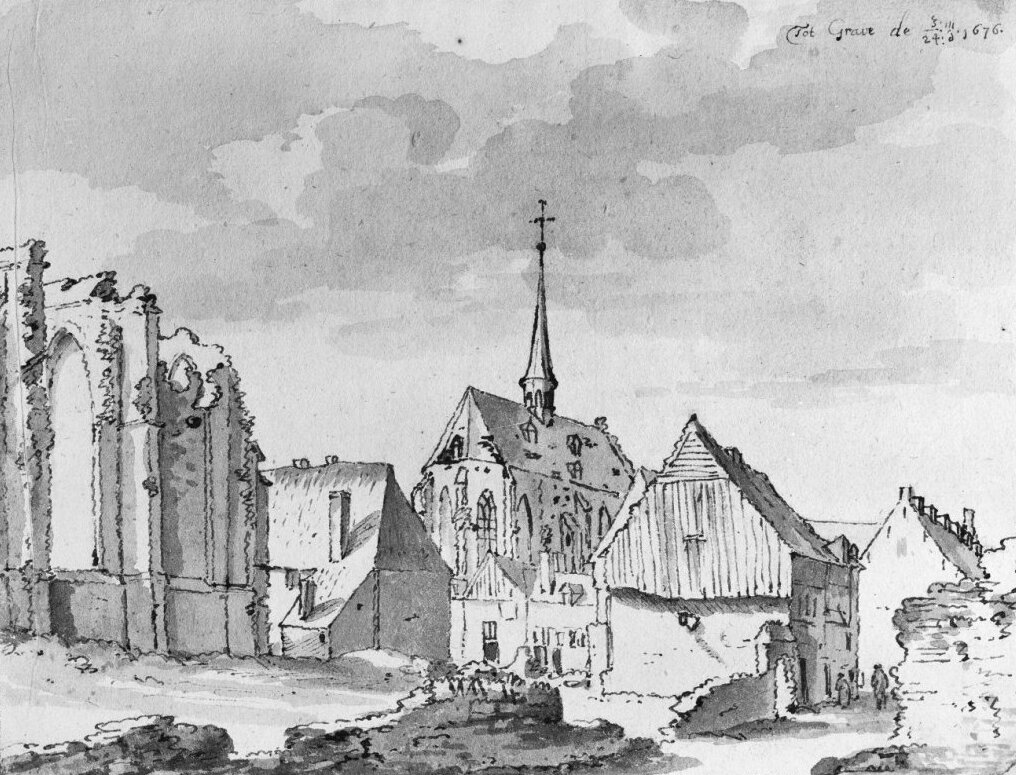
Siege of Grave (1674)
More than 100,000 cannonballs and 3,000 bombs fell on a town that covered only a few dozen hectares. Grave was not a city. It was a knot of brick and earth against a bend of the Meuse - and for three months in 1674, two armies poured iron into it until the church towers cracked and the streets disappeared under rubble. The French commander inside, Noel Bouton de Chamilly, refused to surrender. The Dutch commander outside was 71 years old and would not listen to advice. Then a 23-year-old prince showed up with 10,000 fresh troops and a personal grudge against Louis XIV.
How a Small Town Became the Last French Outpost
The Franco-Dutch War had begun two years earlier as a French lightning strike. In the spring of 1672, Louis XIV's armies overran most of the Dutch Republic in weeks. Grave, sitting on the Meuse in what is now North Brabant, fell to Turenne's troops on 5 July without much of a fight. The advance only stopped when the Dutch opened their dikes and turned Holland into a shallow sea - the famous Water Line. Then the calendar turned against the French. Spain, the Holy Roman Empire, and Lorraine joined the war. By 1674, French armies had been pulled out of one Dutch town after another. Only two remained: Maastricht to the south, and Grave on its quiet bend of the Meuse, cut off and surrounded by enemy country.
The Hedgehog and the General Who Would Not Listen
Chamilly turned Grave into what contemporaries called a hedgehog fortress, all spines and angles. When Lieutenant-general Carl von Rabenhaupt's Dutch army finally arrived on 25 July, the trenches would not advance. French gunners knew their ranges. The Meuse itself was an obstacle. The Dutch tried diverting the river Raam to drain the moat - it helped, then a French sortie pushed them back. Menno van Coehoorn, the most celebrated fortress engineer in the Dutch Republic, rode out to advise the besieger. Rabenhaupt, 71 years old and stubborn, ignored him. The summer dragged into autumn. Bombs fell. The walls of Grave still stood.
William of Orange Arrives in a Bad Mood
Two hundred kilometres to the southwest, William III of Orange had just fought the bloody, inconclusive Battle of Seneffe against Conde. His Austrian co-commander de Souches had sabotaged the campaign with obstructionism. William stripped him of command and, frustrated, took 10,000 troops and rode to Grave instead. He set up headquarters in Wychen Castle and assumed the siege. Inside the walls, Chamilly was apparently flattered - the famous prince had come personally to break him - and he resolved to be worthy of the opponent. He was. William's reinforcements achieved no more than Rabenhaupt's old guns had. The fortress, by now half rubble, would not yield.
An Honourable Ending in a Ruined Town
It was Louis XIV himself who broke the stalemate. From Versailles, the Sun King wrote to Chamilly: the position made no strategic sense any more, abandon it. After a brief truce and negotiation, Chamilly capitulated on 27 October on generous terms. William, who had come to respect the man across the wall, let the garrison march out with the honours of war - colours flying, drums beating, weapons shouldered. The day after the surrender, William attended a thanksgiving service in St Elizabeth's church, sitting in his battle-stained uniform while his court preacher, also booted and spurred, gave the sermon. The civilian casualties inside Grave were never counted. The suffering, the chroniclers wrote, was indescribable.
What the Rubble Meant
Measured against the grand allied plan of 1674 - 120,000 soldiers, three war fronts, the liberation of the Spanish Netherlands - capturing one small ruined town on the Meuse was a meagre return. Yet it mattered. With Grave's fall, every patch of the Dutch Republic except Maastricht was back in Dutch hands. More than that, the siege marked the moment when the war stopped being a French sprint and became a grinding stalemate of attrition. Armies were getting bigger, casualties higher, and neither side was tired enough yet to make peace. For William of Orange, still only 23, Grave was a lesson in the patience and brutality of siege warfare - lessons he would carry to Ireland, to the Boyne, and eventually to the English throne.
From the Air
Grave sits at 51.76 N, 5.74 E, where the Meuse makes a slow southern bend in North Brabant. From altitude in clear weather the star-shaped fortifications are still readable in the modern street pattern. The town lies roughly 12 km southwest of Nijmegen and 20 km northeast of Eindhoven. Nearest airport is Eindhoven (EHEH); Nijmegen-Volkel military airfield (EHVK) is closer but restricted.