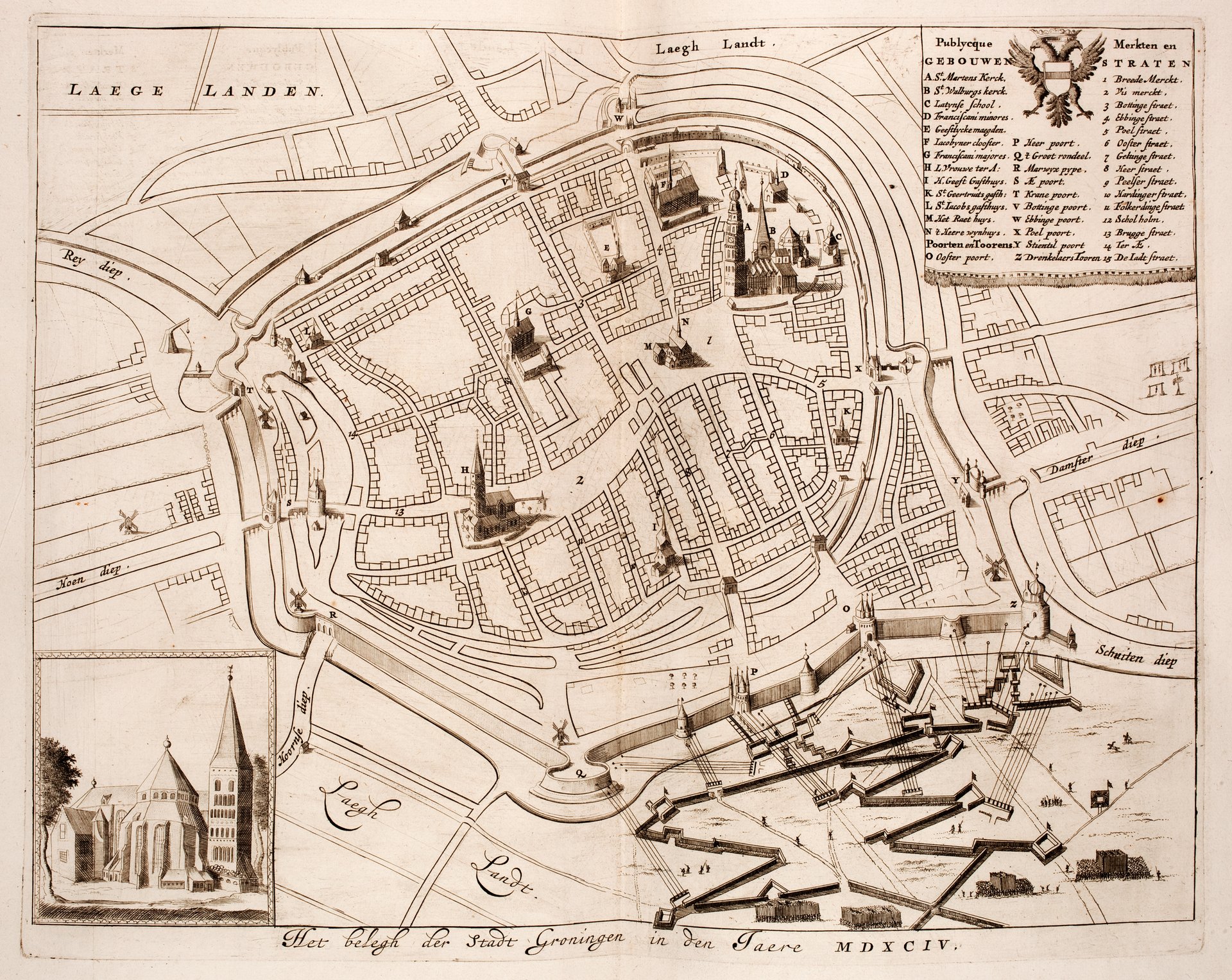
Siege of Groningen (1594)
Fourteen years earlier, a count had sold the city for ten thousand crowns. In March 1580 George de Lalaing, Count of Rennenberg, took the money, arrested Groningen's principal citizens, and opened the gates to the Spanish. For the young Dutch Republic this was a wound in the north that refused to close, and the name of the betrayer became a byword for what could happen when fortified towns were left to their stadtholders. By May 1594, when Prince Maurice of Orange finally appeared before the walls with a Dutch and English army, what was at stake was not just a city. It was whether the Republic would have a northern border at all.
Squeezing the Strongest Town in the North
Maurice did not march on Groningen first. He spent five years tightening a noose. Delfzijl, the city's transit port to the sea, fell. Steenwijk and Coevorden went next. William Louis, the Dutch commander in the region, took the peat bogs east of Groningen, then Winschoten and Slochteren, cutting the city off from the German states. A new Spanish hill fort under construction outside the walls was seized before it could be finished. By the time the Anglo-Dutch force arrived on 22 May 1594 and began opening trenches against the south side, Groningen was already an island. Nearly half of Maurice's army were English and Scots - twelve English companies and ten Scots under Sir Francis Vere, reinforced by another eight that Queen Elizabeth I had grudgingly released.
A City With Divided Hearts
Groningen's walls bristled with artillery, but its people did not all want the same thing. Inside the city, the poor were deeply attached to the Catholic faith; the burghers, watching their trade strangled by blockade, saw their future with the Republic. Mayor Alberto Jarges and the Frisian Catholic garrison of four hundred had been stiffened by another six hundred Spanish and Flemish troops slipped in through the Poelepoort under Jarich van Liauckema. That gave the defenders nearly a thousand men - enough to make a fight of it, not enough to hold forever. Maurice diverted the surrounding waters into small purpose-built canals to float his siege guns into position. The few outlying sconces had already been abandoned. Only the bastion at Aduarderzijl required a storm by William Louis's men.
The Relief That Never Came
Far to the south, the Count of Fuentes was supposed to be assembling a Spanish army to break the siege. He never got close. His troops mutinied in the ranks, his march was harassed by Dutch cavalry, and disease and desertion chewed through what remained. The relief column melted before it could move. By mid-June, the besiegers' cannon were concentrated on the Oosterpoort, and Dutch and English engineers were tunnelling mines beneath the great ravelin in front of the bastion. Word of the mines spread through the city. The burghers wanted to negotiate; Jarges and Liauckema, knowing Spain executed garrisons that surrendered easily, ordered the fight to continue. Fighting broke out among the citizens themselves before the city finally agreed to terms on 22 July.
The Reformation, in One Capitulation
The Pensionary Johan van Oldenbarnevelt had earlier been willing to leave Groningen a free city with religious freedom for Catholics. The military, suspicious of another Rennenberg, had refused. The capitulation that ended the siege threw out the older deal entirely. Monks and priests departed - many of them refugees who had fled to Groningen from the southern Netherlands, now refugees a second time. The city council was emptied of Catholics. Catholic worship was banned outright. Property of the Roman Church was confiscated. A medal was struck for the new council, for the members of the States Assembly, and for the officers of the army. Groningen merged with the surrounding Ommelanden but would not become a province in its own right until 1795.
What the Capture Changed
The fall of Groningen pushed the last Spanish forces out of the northern provinces and shifted the balance even further north - into the German county of East Friesland, where Calvinist Emden was facing a Lutheran count. The States-General garrisoned Emden and forced Count Edzard II to recognise the Republic diplomatically in the Treaty of Delfzijl the following year. Francisco Verdugo, the Spanish commander twice defeated in this campaign, was recalled. Maurice paused, then turned his army toward the Rhine to try for Twente. That next campaign would fail at Groenlo - but in the north, the work was done.
From the Air
The 1594 siege lines lay around the historic centre of Groningen at roughly 53.22 degrees north, 6.55 degrees east. From a cruising altitude of 3,000 to 5,000 feet, the old city core is recognisable as a denser, irregular pattern surrounded by the green ring of the former defensive works (now parks). The Oosterpoort area, focus of the besiegers' cannon, sits east of the centre. Groningen Airport Eelde (EHGG), about 12 km south, is the nearest controlled field.