Siege of Guînes (1352)
On a winter night early in January 1352, an English freelance soldier named John of Doncaster led a small band over a moat, up a wall, past sleeping French sentries, and into the keep of one of the strongest castles in northern France. He had been a prisoner here. He had been forced to repair the very defences he was now scaling. He had reportedly studied them, the chroniclers say, through an affair with a French washerwoman. By morning the castle of Guînes was English, the Hundred Years' War truce was finished, and the map around Calais was about to be redrawn for the next two centuries.
An Uneasy Truce, an Inviting Castle
Five years earlier, after the slaughter at Crécy in August 1346 and the eleven-month starvation siege of Calais that followed, the English king Edward III held the Channel port and the French crown was bankrupt and bleeding. The Truce of Calais, signed in September 1347, was supposed to stop the war for nine months. Like most truces in the long Anglo-French quarrel, it never quite ended; it just leaked. Naval clashes continued. Skirmishes flared in Gascony and Brittany. And six miles south of Calais sat the castle of Guînes, the strongest French fortification in a defensive ring meant to contain the English bridgehead. Owned by Raoul, Count of Eu, a French nobleman who had spent four years in English captivity, the castle had been quietly offered to Edward in lieu of his enormous ransom. Then the new French king, John II, had Raoul executed for treason rather than let the transfer happen. Guînes stayed French. For about a year.
Doncaster's Midnight Climb
Few medieval coups were quite so personal. John of Doncaster was, by his own admission, exiled from England for violent crimes and earning his keep in the Calais garrison. According to contemporary accounts, he had been a French prisoner at Guînes itself, worked as forced labour repairing the walls, and used the opportunity to memorise every weakness. One chronicler insists he learned the rest of what he needed through an affair with a washerwoman who came and went through the gates. Whatever the truth of that, what happened next is not in dispute. Doncaster's band crossed the moat, propped scaling ladders against the curtain wall, slipped over the top, knifed the sentries, broke into the keep, released English prisoners held inside, and seized the entire castle by sunrise. It was the kind of escalade you read about in chivalric romances. Except the soldiers were criminals and the prize was real.
A King Caught Between Two Bad Choices
Edward III, in London, found himself with a problem. Keeping Guînes meant tearing up a truce he was not ready to break. Returning it meant giving back a castle worth a campaign. He ordered the English occupants to hand it back. Then the English Parliament opened its session on 17 January, advisers made warmongering speeches, and the Commons approved three years of war taxes. With money in his pocket Edward changed his mind. The Captain of Calais received new orders: take Guînes in the king's name. John of Doncaster, the exiled criminal who had started it all with a midnight climb, was pardoned and rewarded. Across the Channel, the French commander who had failed to hold the castle, Hugues de Belconroy, was drawn and quartered for dereliction of duty at the insistence of Geoffrey de Charny, the very same officer who had recently failed his own attempt to retake Calais by bribery.
Two Months in the Marshes
By May, Charny was back with an army of 4,500 men, including 1,500 men-at-arms and a large force of Italian crossbowmen. Inside the castle, Thomas Hogshaw commanded just 115 English defenders. The land around Guînes worked against the besiegers; marshy ground and small waterways made approach from most directions impossible, and let the English supply the garrison by boat. Charny chose the only viable angle, the main entrance facing the town, defended by a barbican. He converted a nearby convent into a fortified gun platform, ringed it with a palisade, and set up catapults and cannons. Through June and into July, the historian Jonathan Sumption calls it savage and continual fighting. The English then ferried more than 6,000 reinforcements to Calais from England. In mid-July a fresh contingent slipped close in the dark and stormed the French camp at night. The palisade came down. Many Frenchmen died. The siege broke.
The Pale of Calais
Charny pulled back to Saint-Omer and disbanded his army. The French slighted a small new English tower at Frethun, three miles southwest of Calais, then retreated for good. The English spent the rest of 1352 consolidating: new towers, fortified bottlenecks across the marshes, a ring of defences around the port. From this campaign emerged what would be called the Pale of Calais, the small English-ruled enclave that survived in northern France for the next 206 years. France was eventually forced to garrison sixty fortified positions in an arc around it, at ruinous cost. Geoffrey de Charny himself died four years later at Poitiers, killed defending the French royal banner as King John II was captured. The Treaty of Brétigny in 1360 confirmed Guînes and its county as English territory. The castle was besieged again in 1436 and 1514, and held. It finally fell back to France in 1558, four years after Mary Tudor lost Calais itself. By then John of Doncaster's washerwoman, if she ever existed, was 200 years dead.
From the Air
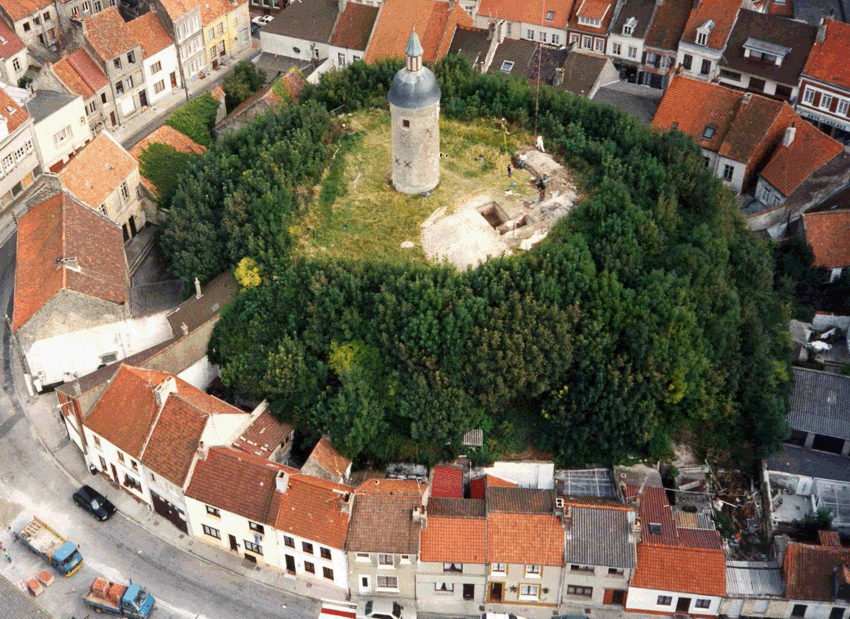
The Château de Guînes sits at 50.869°N, 1.869°E, about 10 km south of Calais and 4 km south of the Field of the Cloth of Gold site at Balinghem. The medieval motte and earthworks survive as a clock-tower park; the rectangular grid of the old town is still visible from the air. Calais-Dunkerque (LFAC) is 12 km north; Lille-Lesquin (LFQQ) is 95 km south-southeast. Best viewed at 2,000-3,500 feet on a clear day; low winter sun rakes across the surviving motte and gives the best definition. The marshes Charny found impassable have been drained for centuries, but the ground is still notably flat and damp.