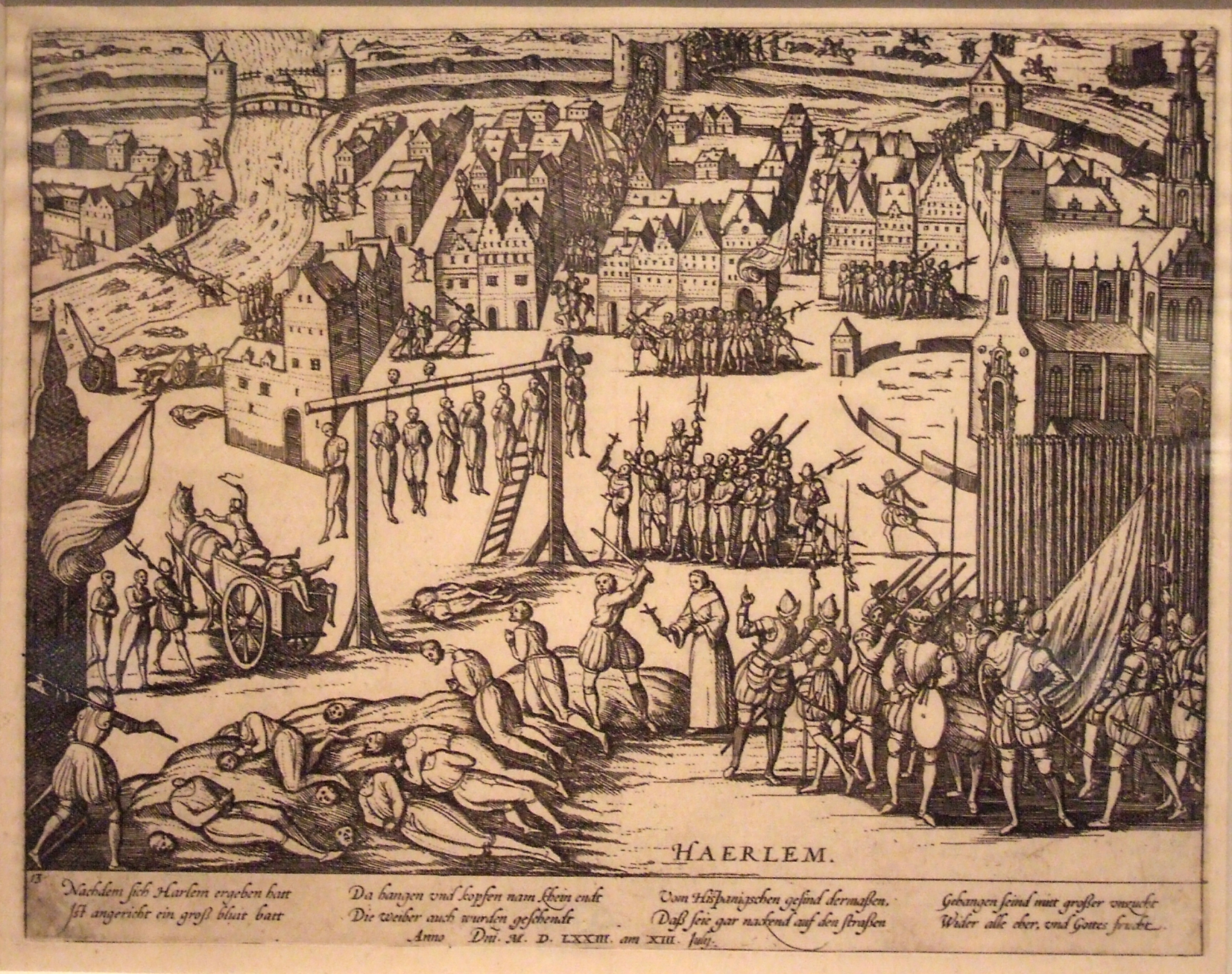
Siege of Haarlem
On 17 November 1572, the Spanish army murdered every citizen of Zutphen. Two weeks later, on 1 December, they did the same in Naarden. Word of these massacres reached Haarlem before the soldiers did. The city had been wavering for months between obedience to Philip II and revolution against him, but the news from Zutphen and Naarden ended the debate. When a delegation returned from Amsterdam having tried to negotiate, the new pro-Orange council convicted them as traitors. The Sint-Bavokerk was stripped of its Roman Catholic symbols the same day. The choice was made: resist, and probably die anyway, or surrender, and certainly die. Ten days later, on 11 December, the Spanish guns opened up.
A Winter That Wasn't Supposed to Happen
Medieval armies did not fight in winter. Don Fadrique, son of the Duke of Alva, kept his men in the field anyway, because Haarlem mattered. The city sat on the narrow neck of land between the Haarlemmermeer and the dunes, and whoever held it controlled access to the heart of Holland. Within the walls, the people of Haarlem dug in for a season nobody had planned for. The Spanish tunneled toward the ramparts to collapse them. The defenders dug counter-tunnels and blew the Spanish ones apart underground. On 19 December the besiegers fired 625 shots into a single stretch of wall between the Janspoort and the Catherijnebridge, and the defenders built a new wall behind it overnight. Two of the city gates collapsed entirely. Kenau Simonsdochter Hasselaer, a timber merchant and widow, organized the work of rebuilding what the cannon broke - a contribution that later folklore would inflate into the legend of three hundred women fighting at her side.
When the Lake Closed
For three months the people of Haarlem could still get food across the Haarlemmermeer, smuggled in by boat at night. That ended on 29 March 1573, when the army of Amsterdam - loyal to Spain - took the lake and closed the last route in. Hunger followed quickly. By late May the city was eating horses, dogs, and worse. On 27 May, in a moment of starving rage, the defenders dragged Spanish-loyal prisoners out of the jail and killed them. In early July, William of Orange assembled a relief force of five thousand soldiers near Leiden and marched. The Spanish ambushed them on the Manpad and cut them apart. The last hope was gone. Inside the walls, the people who had endured seven months of cold, bombardment, and starvation now had to choose how they wanted to die.
The Surrender That Wasn't
On 13 July 1573 the city opened its gates. Haarlem had agreed to pay 240,000 guilders to spare the citizens and the buildings from sack - a vast sum, raised from people who had eaten leather to survive. The written promises were honored only in narrow technical terms. Most ordinary residents were allowed to leave. The garrison was not. The English, French Huguenot, and other foreign soldiers who had defended the walls were executed almost to a man; only the Germans were spared. Forty burghers judged guilty of sedition were beheaded. When the Spanish ran out of ammunition, they switched methods: roughly 1,500 of the city's defenders were tied back to back in pairs and thrown alive into the Spaarne river. Governor Wigbolt Ripperda and his lieutenant were beheaded. Don Fadrique walked into the Sint-Bavokerk, the same church the defenders had stripped bare seven months earlier, and thanked God for his victory.
What the Defeat Bought
Haarlem lost. But the seven-month siege had cost the Spanish perhaps ten thousand soldiers and stripped away the myth that Alva's army could roll over the Low Countries unopposed. When Spanish forces moved on to Alkmaar a few months later, the citizens there fought back with a confidence Haarlem had purchased for them. Alkmaar held, and that victory marked the turning point of the Dutch Revolt. The Army of Flanders, unpaid and exhausted, mutinied repeatedly in the years that followed. Inside the Sint-Bavokerk today, carved into the stone, you can still read the words the survivors left behind: 'In dees grote nood, in ons uutereste ellent / Gaven wij de stadt op door hongers verbant / Niet dat hij se in creegh met stormender hant.' In our uttermost misery, forced by hunger, we gave up the city - not that he took her by storm. Alkmaar and Leiden celebrate their independence days every autumn. Haarlem, having lost, has never quite known what date to commemorate.
From the Air
Coordinates 52.383N, 4.633E, the historic center of Haarlem at the Sint-Bavokerk on the Grote Markt. The city lies 15 km west of Amsterdam Schiphol (EHAM) and 5 km inland from the North Sea coast at Zandvoort. Best viewed at 2,500-3,500 ft; the medieval street plan inside the old walls is still legible from the air, and the Spaarne river - where the defenders were drowned - curves through the center past the cathedral. The Haarlemmermeer that once cut off the city is long since drained and is now the polder containing Schiphol airport itself.