Siege of Jadotville
During the siege, the Irish radioed their headquarters: "We will hold out until our last bullet is spent. Could do with some whiskey." It was September 1961, and 156 soldiers of A Company, 35th Battalion of the Irish Army -- serving under the United Nations in the newly independent Congo -- were surrounded by between 3,000 and 5,000 Katangese gendarmes, Belgian settlers, and French, German, and Rhodesian mercenaries in the mining town of Jadotville. They held their perimeter for five days without losing a single soldier killed. Then they ran out of ammunition and water, and their commander, Commandant Pat Quinlan, surrendered. What followed was not gratitude but decades of institutional shame.
The Congo's Unraveling
The crisis that brought Irish soldiers to Jadotville had been building since the Congo's independence from Belgium in June 1960. The Belgian Congo's economy was controlled by powerful firms, above all the Union Miniere du Haut Katanga, and when independence came, Belgium supported the secession of the mineral-rich Katanga Province under Moise Tshombe to protect those economic interests. Prime Minister Patrice Lumumba and President Joseph Kasavubu appealed to the United Nations for help defending their sovereignty, and the UN Operation in the Congo -- ONUC -- deployed peacekeepers from Ireland, India, and Sweden, among others. But the situation in Katanga was tangled beyond easy resolution. Belgian soldiers had reinvented themselves as mercenaries commanding the Katangese gendarmerie, making them difficult to link to the Belgian state and harder still to remove.
Trapped at the End of a Road
A Company arrived in Jadotville on September 3, 1961, ordered there to protect civilians after the Belgian foreign minister reported that settlers feared for their safety. Two previous UN companies -- one Swedish, one Irish -- had already been withdrawn due to the hostility of the local white population. Quinlan recognized the danger immediately. By September 5, Katangese forces were building roadblocks on every road out of town. He requested extraction or reinforcement twice; both requests were denied. When ONUC launched Operation Morthor on September 13 -- an offensive aimed at arresting remaining mercenaries across Katanga -- the Katangese counterattacked the isolated Irish position. The attackers came in waves of roughly 600, supported by 81mm mortars, a French 75mm field gun, and a Fouga Magister jet armed with bombs and machine guns.
The Perimeter Holds
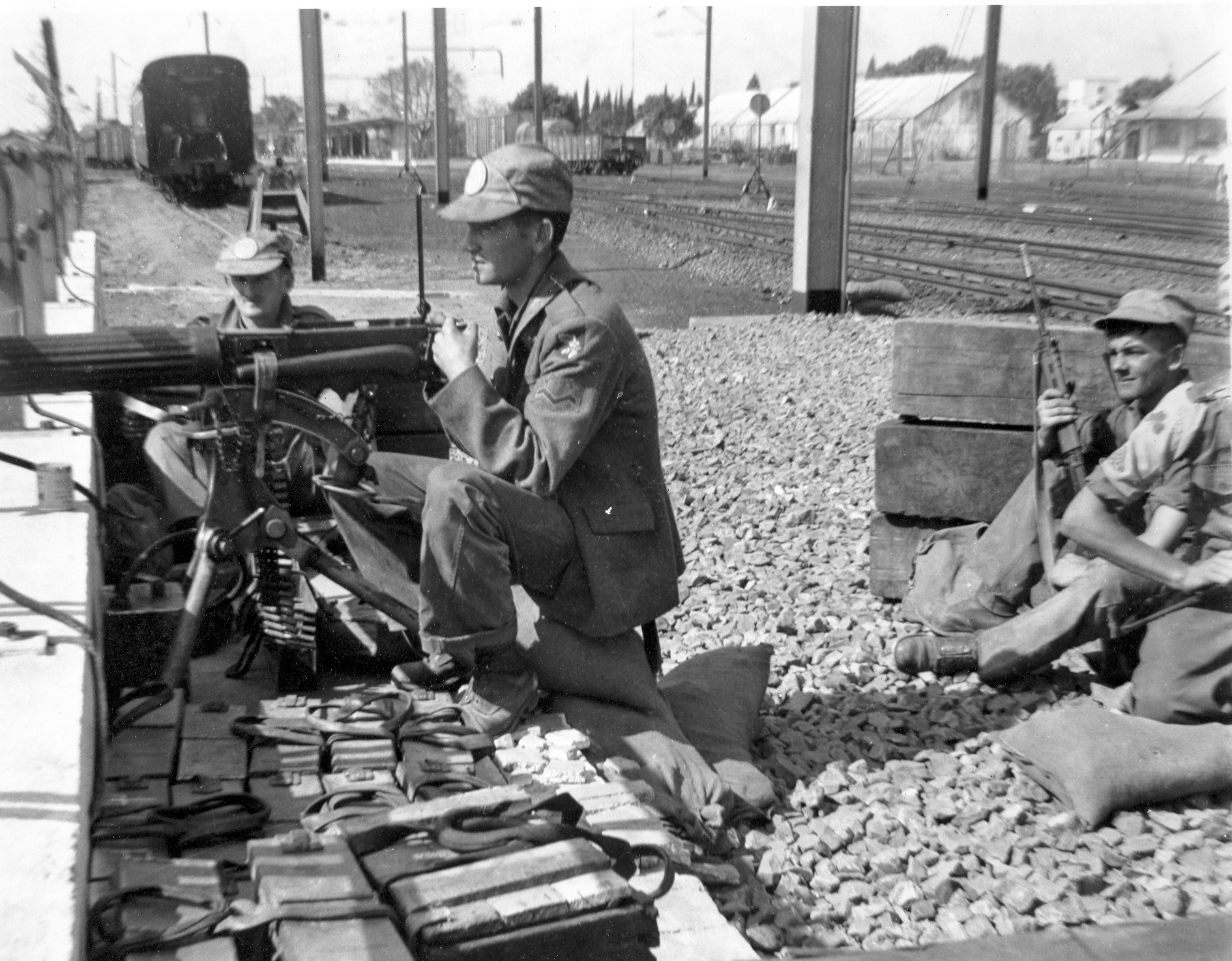
Quinlan's defense became a textbook example. His soldiers dug trenches and fought with Vickers machine guns, 60mm mortars, and two Irish-built Ford Mark VI armored cars that reportedly fired 15,000 rounds over four days. The Irish support platoon knocked out most Katangese mortar and artillery positions, including the 75mm gun, with counter-battery fire. Mercenary officers were observed shooting their own retreating gendarmes to stem the rout. A relief column of 500 Irish, Swedish, and Indian troops -- including Gurkhas from 1 Gorkha Rifles -- attempted to break through but was stopped at the Lufira Bridge, where Katangese forces brought sustained ground and air fire that killed at least five Indian soldiers and forced the column back. The Katangese blew the railway bridge to cut off further relief. After five days without resupply, with no water and no ammunition, Quinlan surrendered. His company was held as prisoners for a month before being released in a prisoner exchange on October 15.
Decades of Derision
Although A Company had tactically defeated a force twenty to thirty times its size, inflicting several hundred casualties while suffering none killed, the Irish Defence Forces did not acknowledge the battle. The term "Jadotville Jack" became a slur within the military. Quinlan recommended several of his men for the Military Medal for Gallantry, Ireland's highest award for valor. None received it. Some veterans reportedly took their own lives in later years. Quinlan died in 1997 with his reputation still under a cloud. It took John Gorman, a retired soldier who had been a seventeen-year-old private during the fight, years of campaigning to force a reckoning. In 2004, the Irish minister for defence ordered a full review. A Defence Forces inquiry cleared Quinlan and A Company of misconduct. A commemorative stone was erected at Custume Barracks in Athlone in 2005. In 2016, the Irish government awarded A Company a Presidential Unit Citation -- the first in the state's history. The following year, newly designed Siege of Jadotville Medals were presented in Athlone, more than half a century after the battle.
The Day Hammarskjold Died
On the same day that Quinlan surrendered to Katangese Minister Godefroid Munongo, UN Secretary-General Dag Hammarskjold was flying to peace talks with Tshombe. His plane crashed near Ndola, Northern Rhodesia, under circumstances that remain disputed decades later. Operation Morthor, the offensive that had triggered the siege, was widely criticized in the international press. British Prime Minister Harold Macmillan compared the UN peacekeepers to "the Red Army in blue berets." The Congo Crisis would grind on for years. For A Company, the war ended in December 1961, when they rotated home to Ireland after a six-month tour that had included not only the siege but further combat alongside Swedish UN troops. The 2016 Netflix film The Siege of Jadotville, starring Jamie Dornan, brought their story to a global audience -- a recognition that came generations late, but came at last.
From the Air
The siege took place near modern-day Likasi (formerly Jadotville) at approximately 10.98°S, 26.73°E in Haut-Katanga Province, DRC. The Lufira Bridge, where the relief column was stopped, lies on the highway between Likasi and Lubumbashi to the southeast. Likasi is a mid-sized city visible from altitude as an urban area amid savanna. The terrain is at approximately 1,300 m elevation. Lubumbashi International Airport (FZQA/FBM) is the nearest major airport, about 120 km to the southeast. The former NATO base at Kamina lies to the northwest. Best viewed at 5,000-8,000 ft AGL.