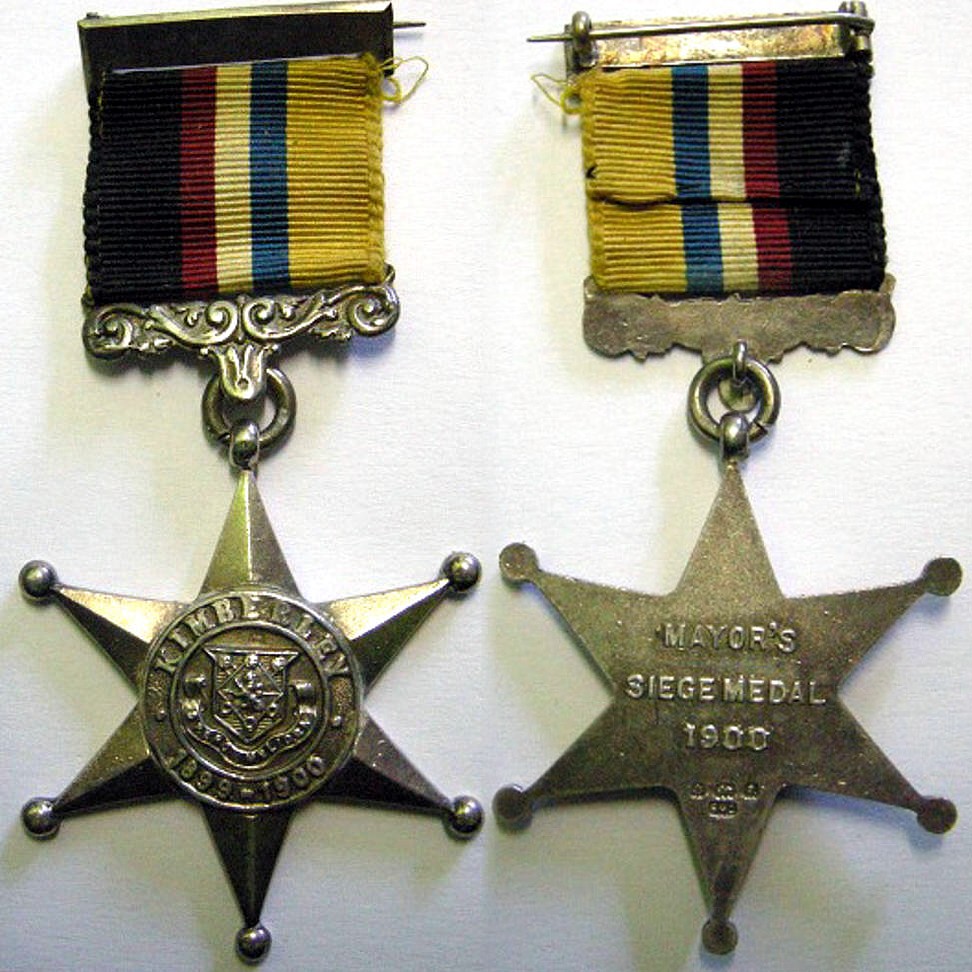
Siege of Kimberley
George Labram was an engineer, not a soldier. But in the besieged city of Kimberley, during the summer of 1899-1900, the distinction hardly mattered. Working in the De Beers workshops, Labram designed and built a rifled artillery piece from scratch -- a 100mm gun the defenders christened Long Cecil. It could hurl a 13-kilogram shell six thousand meters. Within weeks of its first firing, the Boers brought in a far heavier gun to silence it. On 9 February 1900, a shell from that gun killed Labram in the Grand Hotel. His funeral, held after dark for safety, was interrupted by Boer shelling -- guided by a traitor inside the town who lit a flare to mark the procession.
The Diamond Trap
Kimberley in October 1899 was the second-largest city in the Cape Colony and the source of 90 percent of the world's diamonds. Its population of 40,000 lived just a few kilometres from the borders of two hostile Boer republics. When war broke out on 11 October, the town was almost completely unprepared. Colonel Robert Kekewich established a 22-kilometre defensive perimeter and set about organizing what resources he had. Those resources, however, mostly belonged to De Beers -- and therefore to Cecil Rhodes. Rhodes had moved into Kimberley just before the siege began, narrowly evading capture as the Boer ultimatum expired. His presence was deliberately provocative. By placing himself inside the besieged town, he raised the political stakes so high that the British government would be forced to divert military resources to relieve his mining operation. The strategy worked, but it came at a cost. Rhodes and Kekewich clashed constantly over the conduct of the defense, and Lord Methuen eventually sent word that Rhodes was to be removed from Kimberley the moment relief arrived.
Ingenuity Underground
The siege began in earnest on 6 November 1899, when Boer forces under Commandant Cornelius Wessels demanded surrender and began shelling the town. Their strategy was not to storm the defenses but to starve and bombard the garrison into capitulation. Kekewich's engineers answered with remarkable improvisation. Labram built an industrial refrigeration plant inside the Kimberley Mine to preserve cattle that would otherwise rot in the summer heat. His team manufactured an armoured train, fortifications, a watchtower, artillery shells, and finally Long Cecil itself. When the Boers introduced their devastating Long Tom gun on 7 February 1900 -- repaired after British saboteurs had disabled it at Ladysmith -- no place at ground level remained safe. Rhodes sent a message directing women and children to the De Beers mine shafts, where they could be lowered underground. The gun fired smokeless powder poorly, however, giving observers up to 17 seconds' warning before each impact.
The Hardest Toll
Rationing tightened as weeks became months. The garrison eventually resorted to horse meat. Vegetables were nearly impossible to grow without adequate water, and the scarcity fell hardest on Kimberley's most vulnerable: the 15,000-strong indigenous population and the migrant mine labourers trapped inside the perimeter. A local doctor advised eating aloe leaves to prevent scurvy, while Rhodes organized a soup kitchen. Twice, Boer forces drove groups of African labourers back into the town when defenders tried to send them home -- an apparent attempt to strain the food and water supply further. The siege's cruelties did not end when it was lifted. In January 1901, the British established a concentration camp at Kimberley for Boer civilian families. Its prisoners included men, women, and children from across the Cape Colony, the Free State, and the Transvaal, along with Black refugees. A memorial outside the Newton Dutch Reformed Church commemorates those who died there before the camp closed in January 1903.
A Cavalry Charge Through Crossfire
The first relief attempt, under Lord Methuen, stalled at the battles of Modder River and Magersfontein in December 1899 -- part of the string of disasters the British called Black Week. For two months, 10,000 British troops sat within 12 miles of Kimberley, unable to break through. In February 1900, Lord Roberts assembled a new force of over 40,000 men. He sent Lieutenant-General John French's cavalry on a flanking maneuver that covered 120 miles in four days at the height of the South African summer. On 15 February, French's exhausted troopers rode straight through Boer crossfire -- rifle shots from the river, artillery from the hills -- screened by the enormous dust cloud their horses kicked up. By evening they were inside Kimberley. Roughly 500 horses died or were broken during the ride. When French arrived, he went not to Kekewich, the garrison's military commander, but to Rhodes at the town's chief hotel.
What Remains
The Honoured Dead Memorial stands in Kimberley today, a sandstone monument commissioned by Rhodes and designed by Sir Herbert Baker. Twenty-seven soldiers are entombed within it, built from stone quarried in the Matopo Hills of what is now Zimbabwe. It bears an inscription by Rudyard Kipling. Long Cecil, the gun Labram built in the De Beers workshops, is mounted on the memorial's base, facing the Free State, surrounded by shells from the Boer Long Tom that killed its creator. The siege lasted 124 days and reshaped the course of the war. Public pressure to relieve Kimberley, Ladysmith, and Mafeking forced the British to abandon their original strategy of marching directly on the Boer capitals. The consequences of that detour played out at Paardeberg, where Cronje's retreating army was cornered within days of Kimberley's relief.
From the Air
Kimberley lies at 28.74S, 24.76E on the Northern Cape's flat, semi-arid plains. From the air, the Big Hole -- the massive open-pit diamond mine -- is the most distinctive landmark, visible even from high altitude as a dark void in the city grid. The Honoured Dead Memorial and the De Beers mining complex are nearby. The nearest major airport is Kimberley Airport (FAKM), about 7 km south of the city center. The Modder River, scene of the relief battles, lies roughly 30 km to the south. Best viewed at 5,000-8,000 ft AGL for the full urban context. The landscape is flat grassland with scattered kopjes, typical of the Northern Cape.