Siege of Kotte (1557-1558)
Fifty thousand soldiers descended on Sri Jayawardenapura Kotte in late 1557. They came in three waves -- the vanguard under Prince Tikiri Bandara leaving on November 10, the center under General Panapitiya Mudali on November 15, and King Mayadunne himself bringing the rearguard on November 30. Inside the capital of the Kotte Kingdom waited fewer than 500 Portuguese soldiers and about 9,000 Lascarins, defending a puppet king, a fracturing alliance, and a city whose own inhabitants were beginning to wonder which side they should be on.
Three Brothers and a Broken Kingdom
The siege was the climax of decades of civil war. In 1521, three sons of King Vijayabahu VII had murdered their father and divided his kingdom in the event called the Vijayaba Kollaya. The eldest, Buvanekabahu VII, held Kotte. The youngest, Mayadunne, took the inland Kingdom of Sitawaka and spent the next thirty years trying to reassemble what had been broken. After Buvanekabahu's death in 1551, the Portuguese installed his Catholic grandson Dharmapala on the Kotte throne -- a king who converted to Christianity in 1557 and became a vassal of the Portuguese crown. The conversion sparked open revolt among Kotte's Buddhist population. The Portuguese response was severe: they arrested and hanged numerous participants, including 30 Buddhist monks. Mayadunne saw his moment. He proclaimed himself the rightful heir and called on Kotte's people to join him. Many chieftains and their followers abandoned Dharmapala and marched to Sitawaka.
Fustas on the Lake
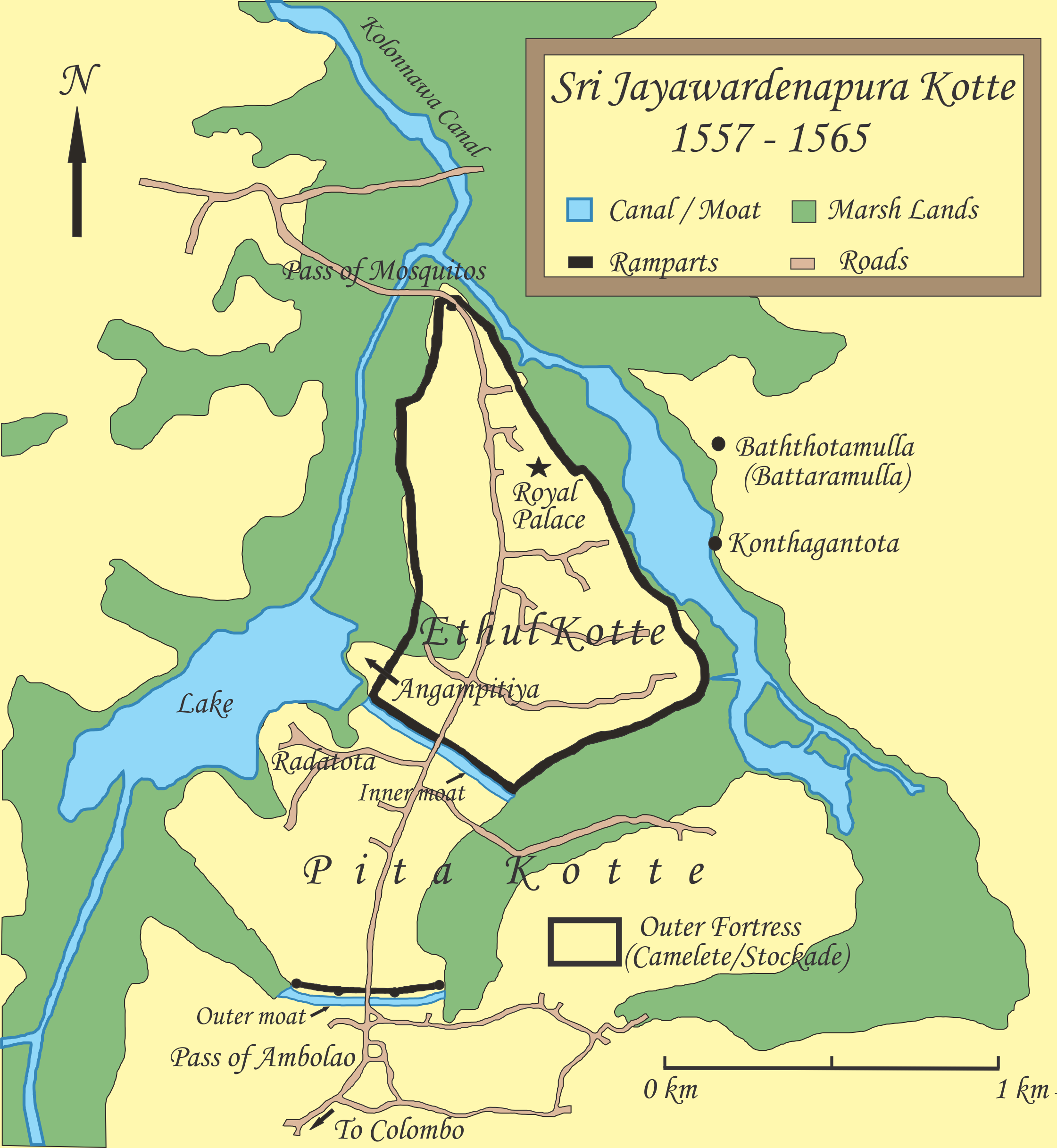
Captain-Major Afonso Pereira de Lacerda organized the defense with grim efficiency. He parceled out his thin forces across multiple positions: 20 Portuguese and 200 Lascarins at the Pass of Ambolao, 40 Portuguese and 400 Lascarins at the Pass of Mosquitos, and 80 Portuguese with 800 Lascarins manning the defenses of Pita Kotte. His most creative deployment was on the water -- 12 fustas, shallow-draft warships armed with falconet cannons, patrolling the lake and canals around the city. When Tikiri Bandara launched the first assault under cover of darkness, approaching the Ethul Kotte ramparts from the west, it was cannon fire from the fustas that scattered his forces. At dawn, a counterattack led by Francisco Barreto with 8,000 Lascarins and 80 Portuguese nearly killed Tikiri Bandara himself, though they were forced to withdraw when the daring captain Rui Dias Pereira took a fatal arrow to the neck.
The Battle by the Lake
On August 20, 1558 -- the feast day of Saint Bernard -- Afonso Pereira launched a major sortie. Three hundred Portuguese and 9,000 Lascarins sallied out in three formations. The initial assault went well: grapeshot from two falconets tore into Sitawakan musket men, and the advance guard withdrew. But success bred overconfidence. The Portuguese vanguard and center charged after the retreating enemy, breaking their own formation and opening a gap with the rearguard. Tikiri Bandara's men swarmed into that gap. Panapitiya Mudali arrived with reinforcements and attacked the isolated rearguard under Diogo de Melo Coutinho. What followed was a chaotic, desperate fight. Diogo de Melo killed Panapitiya Mudali in close combat, but 3,000 Lascarins who chased the fleeing enemy ran straight into an ambush set by King Mayadunne. The survivors limped back to Kotte under covering fire from the fustas, whose grapeshot fell indiscriminately on Sitawakan and Lascarin fighters alike.
A Debt Between Rivals
The failed sortie poisoned morale inside Kotte. Portuguese captains mutinied against Afonso Pereira's leadership, and when investigators identified the ringleader, they found it was Diogo de Melo Coutinho -- the very man who had saved the army at the lake. Rather than punish the hero, Afonso Pereira confronted him publicly with words that ended the crisis: "Diogo de Melo, I own I owe you my life, and since you have given it to me and saved me from so many enemies, don't be the occasion of my losing it." The appeal worked. Meanwhile, news of the siege reached Mannar, where Captain Jorge de Melo gathered every soldier he could find and marched to Kotte. His relief force broke through Sitawakan lines and entered the city, giving the defenders enough strength to hold.
The Beginning of the End for Kotte
By November 1558, reinforced and regrouped, Afonso Pereira led 370 Portuguese and 7,000 Lascarins against the Pass of Ambolao. This time the attack succeeded, and Mayadunne withdrew his army. The Portuguese celebrated with a religious procession through Kotte, carrying the standards of Saints Francis, James, and Bernard. But the victory was hollow. Afonso Pereira fell severely ill with malaria, and his replacement -- the veteran Jorge de Menezes, known as Baroche -- marched out in 1559 to capture the Mapitigama stockade, a campaign that ended in the catastrophic Portuguese defeat at the Battle of Mulleriyawa. Within seven years of the siege's end, the Portuguese had abandoned Kotte entirely, retreating to their fort at Colombo. The capital Mayadunne had besieged for twelve months was left empty -- not conquered, but simply given up.
From the Air
Located at 6.91N, 79.89E at Sri Jayawardenapura Kotte, now Sri Lanka's legislative capital and a suburb of Colombo. The old city occupied a defensible position surrounded by lakes and marshes -- the Diyawanna Oya lake, now home to the Sri Lankan Parliament building, was part of these original water defenses. Nearest airports: Bandaranaike International (VCBI) 28 km north, Colombo Ratmalana (VCCC) 8 km southwest. Best viewed at 3,000-5,000 ft AGL. The Parliament island in Diyawanna Oya is a strong visual landmark.