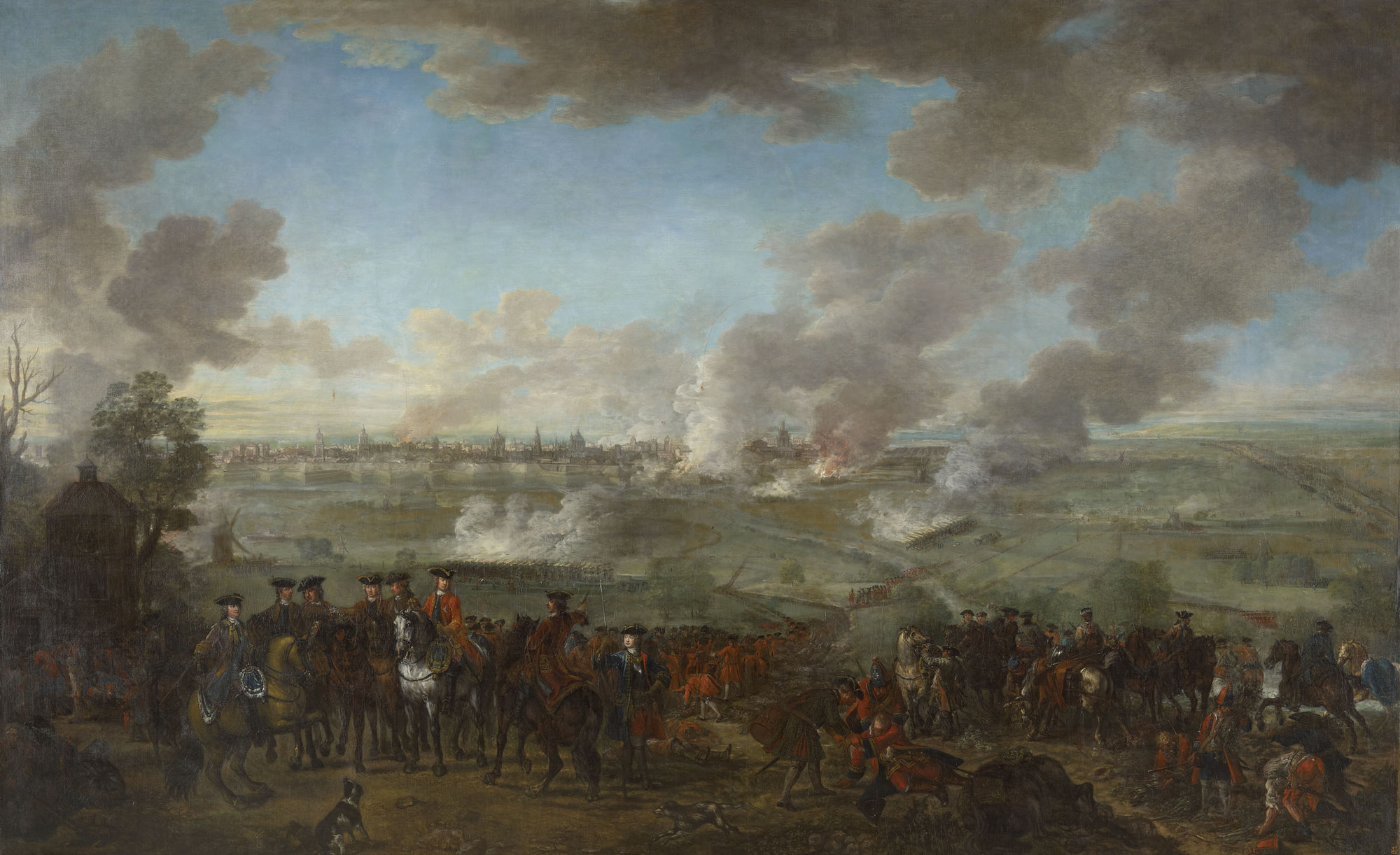
Siege of Lille (1708)
On the night of 29 September 1708, a French cavalry column rode out of the darkness toward the Allied siege lines at Lille. Each of the two thousand horsemen carried a fifty-pound sack of gunpowder slung across his saddle, and a musket. They were disguised as Allied troops. The leading regiments passed the sentries without challenge. By the time the Allies realised what was happening, five regiments were already inside the cordon and riding hard for the city walls. The skirmish that followed was short and catastrophic — Allied grenades detonated two of the powder bags, killing horses and men in a single white flash — but about fifteen hundred French cavalry made it through with fifty thousand pounds of gunpowder strapped to their backs. It was the most audacious resupply of the entire war. And it bought the French garrison only six more weeks.
The Two Eyes of France
After the Allied victory at Oudenaarde on 11 July 1708, Prince Eugene of Savoy argued that the next prize had to be Lille. He called Lille and Tournai the "two eyes of France" — the two fortified cities controlling the headwater approaches to the northern French plain, the Lys flowing through one and the Scheldt through the other. Louis XIV had captured Lille in 1667 and handed it to his greatest engineer, Sébastien Le Prestre de Vauban, who had spent the next thirty years turning it into what most contemporaries considered the strongest fortress in Europe: fifteen bastions, four hornworks, ravelins on every face, a separate pentagonal citadel to the north-west, and inundations that could flood a third of the perimeter. The garrison was 16,000 men under Marshal Louis-François de Boufflers. The civilian population — 60,000 — was largely pro-French. To begin a siege, the Allies first had to move their guns 120 kilometres overland with 16,000 draft horses and several thousand wagons. The convoy did not start east until early August.
Eugene and Marlborough Divided
Eugene took the siege itself with 40,000 men, surrounding the city on 13 August. The Duke of Marlborough, with over 60,000, held the covering army against the French field forces — 100,000 men under the Duke of Vendôme, the Duke of Burgundy, and the Duke of Berwick. Within three weeks, both sides were running into trouble. The Allies bombarded from too great a distance and used too much ammunition. An assault on the counterscarp on 7 September lost nearly 3,000 men for ground that patient sapping could have taken in a week. Eugene was wounded on 21 September. Marlborough took over the siege. By late September, half the Allied engineers were dead, ammunition was running out, the depots at Menen and Oudenaarde were empty, and the Dutch deputies were openly debating whether to abandon the operation. The siege was saved by a single decision: Eugene insisted that the supply line be shifted to Ostend on the Channel coast and a convoy fight its way through.
Wijnendale and the Convoy
On 28 September 1708, near the village of Wijnendale in West Flanders, the French general La Mothe intercepted that convoy with 22,000 men. Defending it was an Anglo-Dutch force of 7,500 under Major General John Richmond Webb. Webb arranged his infantry in dense lines among the hedges and woods on either side of the road and forced the much larger French force into a frontal funnel. La Mothe's troops attacked uphill into massed musketry, took heavy losses across several hours, and finally pulled back. The convoy went through unmolested and reached Lille with ammunition and food for the besiegers. Wijnendale was the unsung battle of the Spanish Succession — Webb became briefly famous for it, then disputed for years afterwards over the official dispatches, then largely forgotten. Without him, the siege fails and the war turns. With him, the trenches advanced again.
Boufflers Marches Out
On 22 October Boufflers surrendered the city under favourable terms — he was allowed to send his wounded, his sick, and the soldiers' wives and children to Douai — and pulled the remaining 8,000 men of his garrison back into the citadel. Henry de Nassau, Lord of Ouwerkerk, the 67-year-old Dutch commander, had died of exhaustion four days earlier and never saw the surrender. The Allies entered the city at a cost of 12,000 casualties; Lille had been the costliest siege of the war. The citadel held another forty-six days. On 9 December, with the great frost of 1709 just weeks away, Boufflers surrendered the citadel and marched his garrison out with the full honours of war — drums beating, colours flying, every soldier in his place. Louis XIV decorated him for the defence. Northern Flanders had fallen, the road into France was open, and the war ground on for six more years. The fortifications Vauban had built were repaired and re-armed. Lille would be French again by the Treaty of Utrecht in 1713.
From the Air
50.6372°N, 3.0633°E. The 1708 siege lines have largely disappeared under modern Lille, but the geometry survives in the city's street plan: the bastioned pentagonal Citadel of Vauban ("Queen of Citadels") stands intact 1.5 km north-west of the centre, ringed by the green wedge of the Bois de Boulogne where the wet moats and glacis used to be. From above, the citadel is unmistakable — a five-pointed star of grass and stone at the edge of the medieval city, with the Esplanade running south-east from it. Recommended viewing altitude 2,500–4,000 ft AGL for the full historical layout. Nearest airports: Lille-Lesquin (LFQQ) 5 nm south; Brussels (EBBR) 50 nm east; Charles de Gaulle (LFPG) 100 nm south. The flat Flanders plain has few obstructions but is often hazy — winter mornings give the cleanest light over the citadel earthworks.