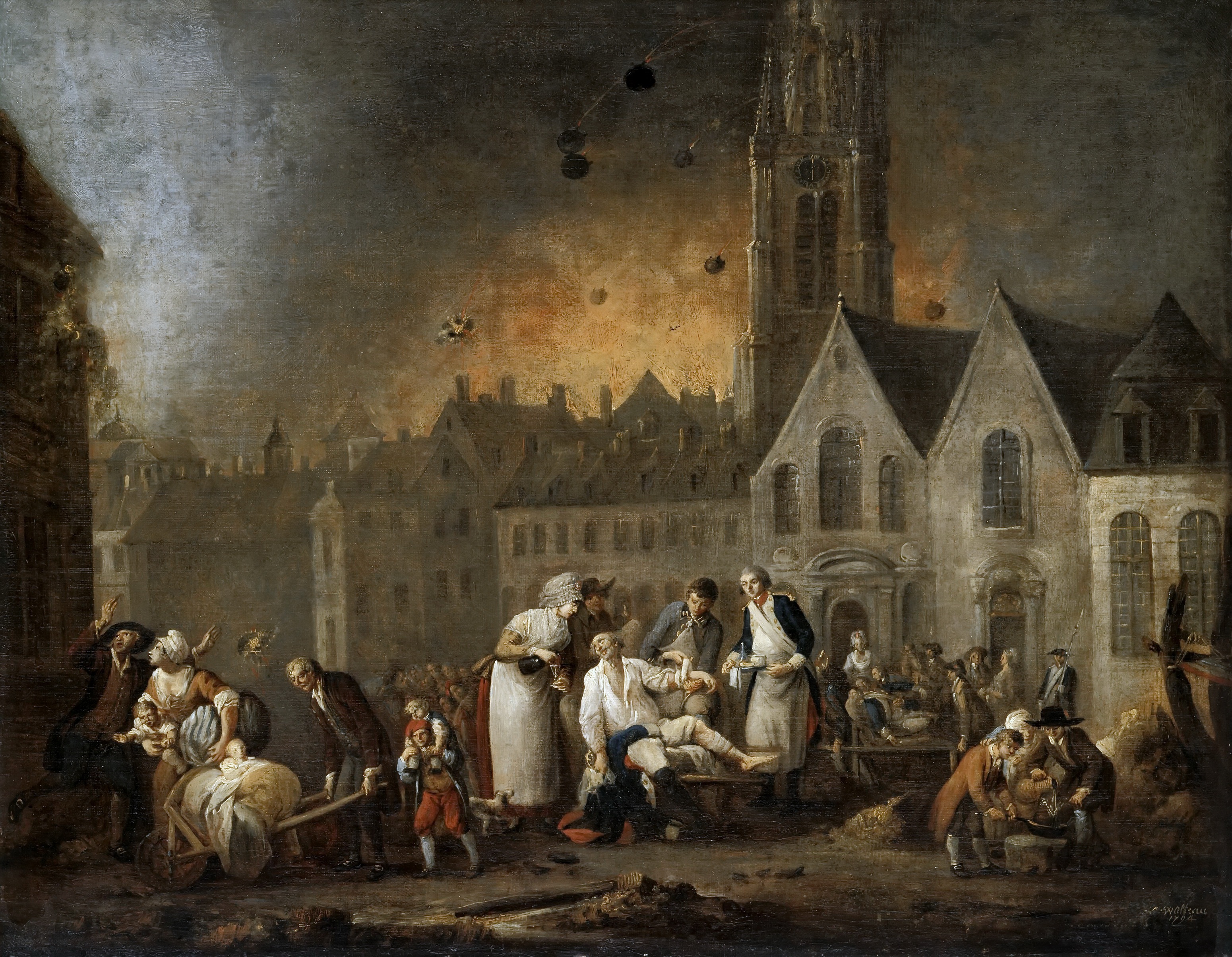
Siege of Lille (1792)
On the third of October 1792, a Lille militia captain named Charlemagne Ovigneur kept loading and firing his gun on the city walls while smoke rolled up from his own street. His house was burning. His wife was inside, giving birth. He did not leave the gun. He did not, as far as the records suggest, even pause for very long. The Austrian batteries on the Tournai road were firing red-hot shot into the city at a rate the defenders had never seen, but the citizen captain stayed where he was. The story of Ovigneur — and of the bucket brigades of laundresses and bakers and weavers and children running water through the burning streets behind him — was the story that turned the eight-day Austrian bombardment of Lille into a national myth of the young French Republic. The Austrians fired sixty thousand rounds. The city did not surrender.
The Worst Autumn
The Revolution was eight days from declaring a republic when the siege began. Louis XVI was in prison. The Tuileries had fallen on 10 August. The Prussian Duke of Brunswick was marching on Paris with forty-two thousand men and a manifesto promising to put the royal family back on the throne by force. On 20 September, in a rainstorm in Champagne, the makeshift French army stopped him at Valmy. News of Valmy had not yet reached Flanders when, on 25 September, the Austrian commander Albert of Saxe-Teschen — husband of the empress Maria Christina — set out from Tournai with around fourteen thousand men and fifty guns and laid siege to Lille. The intent was to draw French strength north and away from Brunswick. Brunswick was already retreating. Saxe-Teschen did not yet know.
A City Designed to Hold
Vauban had rebuilt Lille for exactly this kind of moment. After the city's first siege in 1667, he had given it sixteen bastions, four hornworks, two flooded ditches around the citadel, and walls that had cost a million and a half florins. A century later much of his work was still in place, and the city was one of the most powerful of the so-called barrier fortresses guarding France's northern frontier. The garrison commander, Jean-Baptiste André Ruault de La Bonnerie, had three thousand regular infantry. Reinforcements quickly raised the number to ten thousand and then twenty-five thousand, because Saxe-Teschen's force was too small to actually surround the city — the French could march troops in along the southern roads at will. The Austrian siege, in retrospect, had little chance of taking such a fortress. But it had a real chance of burning it down.
Hot Shot
On 29 September the Austrian batteries opened fire. The doctrine was simple: heat the iron shot red, lob it over the walls, and let it start fires in the wooden interiors of the city. Lille was a town of narrow streets, half-timbered houses, weavers' workshops full of fibre and oil. A single shot could touch off a block. The bucket brigades that ran the water through the streets were almost entirely civilian — men, women, and children from the same Catholic working-class neighbourhoods where the fires were starting. Citizen guards on the walls fired back. Ovigneur fired back. By the morning of 4 October, Saxe-Teschen's wife Maria Christina had arrived at the camp and the bombardment was redoubled in her honour. By that evening, Saxe-Teschen had finally received news that Brunswick had withdrawn from France and that increasing numbers of French reinforcements were arriving outside Lille. The siege had become pointless and dangerous. He began to evacuate his batteries on 6 October.
The Numbers
When the Austrian guns ceased firing on 8 October, they had thrown sixty thousand shells and round shot at the city. About twenty siege cannons had burst or worn out from sustained firing. The Austrians' own casualties were modest — forty-three dead, a hundred and sixty-one wounded — but the damage to Lille was enormous: one observer reported that a quarter of the city's houses had burned. The political commissioners claimed five hundred destroyed and another two thousand damaged; the Church of Saint-Étienne was wrecked. French military losses came to perhaps two hundred. As the Austrians withdrew, the citizens of Lille poured out of the gates and tore up the abandoned siege works in fury. Many men in surrounding towns took the news of the city's defiance as the reason to enlist. The siege became, almost immediately, an instrument of revolutionary propaganda.
The Column and the Goddess
In the Grand-Place of modern Lille stands a column. On top is a bronze figure: a woman in flowing dress, holding a boutefeu — a cannon-lighting stick — in one hand and gesturing with the other toward the defiant inscription on the column's base. She is the Goddess of Lille — La Déesse — commissioned to commemorate the siege and finally erected in 1845, more than half a century after the bombardment. The figure was modelled by the sculptor Théophile Bra. She is said to embody the spirit of the bucket brigades and the citizen gunners; her face is, in the popular telling, the face of the unnamed women of the working-class quarters who carried water under fire. Beneath her in the square, sometimes, on the anniversary, schoolchildren read from the Wikipedia-famous lists of those who fought: Ruault, Ovigneur, the Chevalier de Saint-Georges (a Black officer of the volunteer Légion franche de cavalerie des Américains et du Midi, often described as the first all-non-white military unit in Europe, though only one of its seven companies was actually composed of men of colour), and Thomas-Alexandre Dumas — the son of an enslaved Saint-Domingue woman and a French nobleman — who would later become a general of the Revolution and the father of the novelist who wrote The Three Musketeers.
From the Air
Located at 50.637 degrees north, 3.063 degrees east, in central Lille, France. The Austrian batteries lay east of the city along the road to Tournai. Vauban's Citadelle de Lille — the great star fort that anchored the defence — is northwest of the old town. Nearest major airport is Lille (LFQQ) about 7 km south; Brussels (EBBR) about 110 km east. The star outline of the citadel and the dense old town inside the former walls are both clearly visible from the air.