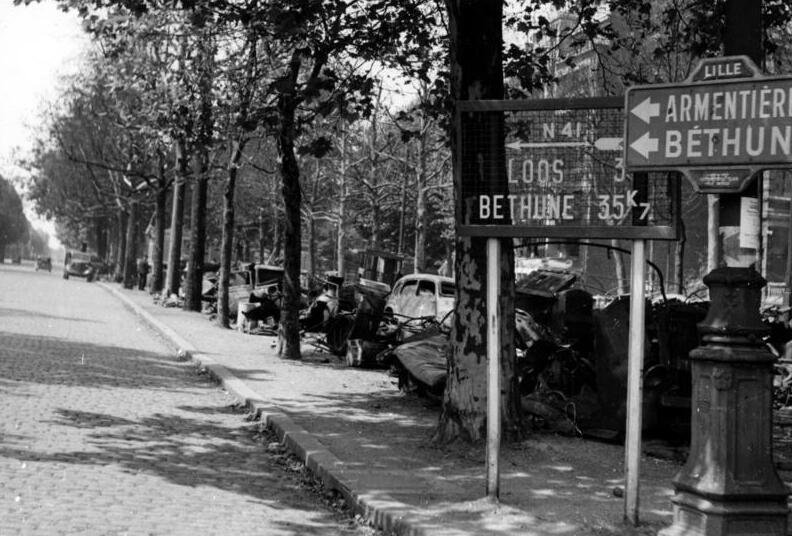
Siege of Lille (1940)
On 31 May 1940, as German troops stood at attention along the Grand'Place of Lille, the remnants of the French First Army marched out of the city with the full honours of war. Their commander, Général de corps d'armée Jean-Baptiste Molinié, had surrendered just after midnight. His men had been encircled for four days, low on ammunition, low on food, fighting house-to-house in the suburbs against four German infantry divisions and three panzer divisions. The German commander who returned their honours was General Alfred Wäger, who would be reprimanded by his superiors for the gesture. The drums beating in the square belonged to one of only two French garrisons in the two world wars whose surrender was honoured this way. Sixty miles to the north-west, on the same hours, the last boats were pulling away from the beaches of Dunkirk.
The Pocket Closes
On 27 May 1940 the German breakthrough at La Bassée Canal sealed the Allied trap. The 1st Panzer Division was already at Gravelines on the Channel; the 7th Panzer Division had rushed the gap and joined the X Armeekorps coming from the east. Walther von Reichenau's 6th Army closed the eastern jaw. Inside the pocket around Lille were five French infantry divisions — about 40,000 men of IV Corps under André Boris and V Corps under Darius Bloch (the soldier later known as Darius Paul Dassault, brother of the aircraft designer Marcel Dassault). The III Corps of the First Army managed to retreat to the Lys with the British Expeditionary Force. Everyone else was caught. Molinié's troops were exhausted, many of them refugees from the long retreat from the Belgian border; civilians from villages further south crowded the streets of Lille along with them.
The Captured Map
On 28 May a French patrol captured Generalleutnant Fritz Kühne, commander of the German 253rd Infantry Division, and recovered documents showing the exact positions of the German cordon. Molinié used the map to plan a westward breakout toward the Lys. The 2nd North African Infantry Division under Major-General Pierre Dame tried to cross the Deûle at the Sequedin bridge south of Lomme. The 5th North African Infantry Division under Major-General Augustin Agliany pushed for the Moulin Rouge bridge on the Santes road, south of Haubourdin. Both attempts ran into prepared German defences. The next morning, 29 May, two French tanks and two companies of infantry got across a mined bridge before being forced back. By that evening the 15th Motorised Infantry Division — under brigadier Alphonse Juin, who would become a Marshal of France after the war — had surrendered. House-to-house fighting in the suburbs intensified.
The Honours of War
By the night of 31 May, Molinié had no realistic options. His men were out of ammunition, food was running low, and German troops were filtering through the lines among the civilian refugees. He and Colonel Aizier negotiated a surrender; hostilities ended at midnight. The French troops marched into the Grand'Place to lay down their arms — the square that Louis XIV had once planned to crown with his statue — a short walk from Saint-André church on rue Royale, where Charles de Gaulle had been baptised in 1890. The German commander Alfred Wäger ordered his own troops to stand to attention as the French paraded past. The defenders were granted the honours of war: drums, colours, formal salute. Wäger was reprimanded by the German high command for offering this kind of respect to a defeated enemy. He never withdrew it.
What Lille Bought
Operation Dynamo — the evacuation of Allied troops from Dunkirk — had been running for almost a week by the time Lille surrendered. The four days the French First Army held the pocket diverted about seven German divisions away from the Channel coast at the most critical phase of the embarkation. Winston Churchill, writing in 1949 in The Second World War, called the defence of Lille a "splendid contribution" that delayed the German advance for four days. William L. Shirer, writing twenty years later, was more specific: the stand at Lille, he wrote, allowed the beleaguered Anglo-French forces at the port to hold out for an additional two to three days and save at least 100,000 more troops. The defenders of Lille were the only French garrison accorded the honours of war during the entire 1940 campaign. With the defenders of Fort Vaux at Verdun in 1916, they were one of only two French garrisons given that distinction by Germany across both world wars. The men who marched out of the Grand'Place went into prisoner-of-war camps. Most of them spent the next five years in captivity. The army they had bought time for fought on from beaches and London and eventually, under their own General de Gaulle, came back.
From the Air
50.6333°N, 3.0667°E. The 1940 fighting wrapped around the suburbs of Lille on the west — Lomme, Sequedin, Haubourdin, Santes — with the Deûle river marking the line of the final breakout attempts. From above, the modern industrial sprawl west of central Lille covers most of the old fighting ground; the Grand'Place where Molinié surrendered is the small rectangular paving in the centre, immediately north of the Belfry of Lille (104 m, easiest landmark). Dunkirk lies 45 nm to the north-west on the Channel coast — the geography that made Lille's stand matter is best appreciated by following the road and rail corridor north from the city. Recommended viewing altitude 2,500–4,000 ft AGL. Nearest airports: Lille-Lesquin (LFQQ) 5 nm south; Brussels (EBBR) 50 nm east; Dunkirk-Mardyck (LFAK) 40 nm north-west.