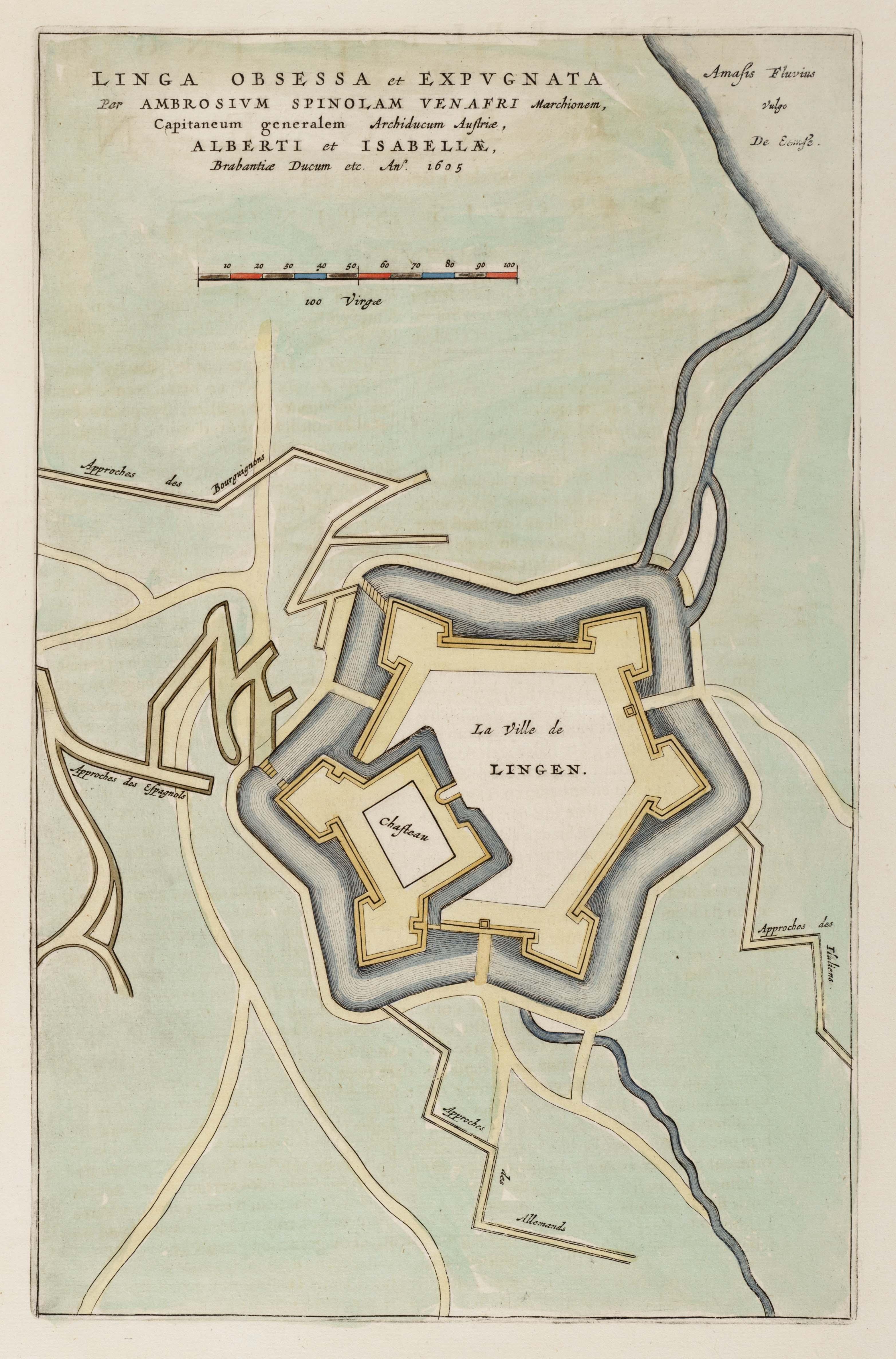
Siege of Lingen (1605)
Captain Maerten Cobben kept counting the days. One, two, three - the Spanish artillery worked the walls of Lingen while his garrison watched the horizon for Maurice of Orange and the relief column that everyone said would come. Four, five, six - the relief column did not come. By the ninth day, on 19 August 1605, Cobben understood what the Dutch headquarters in The Hague had already accepted: Lingen was not worth the army it would take to save it. He surrendered the town to Ambrogio Spinola, and a small Westphalian outpost on the Ems passed from the United Provinces back to Spain.
Spinola's Quiet Triumph
The siege of Lingen never produced a famous painting or a celebrated song. It was the kind of operation that the Eighty Years' War produced by the dozen: a fortified town on a river, a competent commander outside the walls, a garrison inside doing the arithmetic of bread and powder. What made August 1605 unusual was the man directing the Spanish guns. Ambrogio Spinola, the Genoese banker turned general, had spent the previous three years grinding through the siege of Ostend - a campaign so ruinous it almost broke both sides. Lingen was Spinola's victory lap, the proof that Ostend had not exhausted him. After taking the town he kept moving, picking off Mülheim an der Ruhr and Wachtendonk before winter quarters in November.
The Calculation in The Hague
Prince Maurice of Orange had been planning to lay siege to Antwerp when the reports of Spinola's march reached him. He abandoned Antwerp instantly. The States-General ordered him to the Rhine with everything he could carry: sixty-one infantry companies, six of cavalry, leaving only fifty companies behind to guard Ijzendijke. Maurice reached Deventer on 10 August - the same day Spinola's army arrived at Lingen, two days' march to the east. He posted garrisons through Deventer, Zutphen, and Zwolle to hold what he could. Maurice had a choice: race east to relieve Lingen, or hold his army intact for the bigger battles certain to come. He held his army. Cobben and his men were left to their nine days.
A Town That Kept Changing Hands
Lingen sits on the western bank of the Ems where the river bends north toward the sea, deep in what is now the Emsland district of Lower Saxony. The town had been Spanish before the Dutch took it in 1597, and now in 1605 it became Spanish again. It would change hands twice more before the Eighty Years' War finally ended in 1648. To a modern reader the parade of surrenders looks pointless, but for the people of Lingen each transition meant new garrison troops billeted in their homes, new oaths required at the town hall, new currencies and new churches favored by whoever held the keys. The siege itself was brief by the standards of the war - nine days, no famine, no plague - but it slotted Lingen into a different kingdom for another generation.
The Peace That Followed
Spinola's 1605 campaign was the high-water mark of a Spanish revival that Madrid could not pay for. Four years after Lingen surrendered, exhausted treasuries on both sides forced the Twelve Years' Truce of 1609. The war that resumed in 1621 dragged on until the Peace of Westphalia in 1648 finally recognized the independent Dutch Republic. Lingen ended up Dutch again under that settlement, then passed to Prussia in 1702, then to Hanover, then back to Prussia, and so down through the centuries of German history. The 1605 siege left almost no physical trace in the modern town. What remains is the date on a list, and the name of a captain who held out for nine days because he had been ordered to.
From the Air
Lingen sits at 52.52 N, 7.32 E in the Emsland district of Lower Saxony, on the west bank of the Ems River. The nearest major airport is Münster Osnabrück (EDDG), about 70 km south. From a recommended viewing altitude of 4,000-6,000 feet the river bend that defined the town's defenses is clearly visible, with the Dortmund-Ems Canal running parallel to the older river course. Weather in this part of the North German Plain is typically overcast; clear summer mornings give the best visibility.