Siege of Madrid
The slogan was painted on walls, printed on posters, shouted from barricades: No pasaran -- they shall not pass. From October 1936 to March 1939, Madrid endured one of the longest sieges of the 20th century, holding out against Francisco Franco's Nationalist armies while much of Spain fell around it. The city's resistance became the rallying point for the entire Republican cause, and the highest military honors the Republic could bestow were named after its capital. When Madrid finally fell on March 28, 1939, the war was already lost everywhere else. The city had outlasted everything except defeat itself.
The Coup that Failed in the Capital
Madrid was supposed to fall quickly. When the military uprising began on July 17-18, 1936, the conspirators expected the capital's garrison to seize key points and deliver the city to the rebel cause within hours. Instead, the coup collapsed in Madrid. The bulk of the security forces -- Assault Guards, Civil Guards, and loyal army units -- remained faithful to the elected government. Workers' militias, hastily armed with rifles distributed from government arsenals, surrounded the Montaña Barracks where rebel officers had concentrated, and after a violent two-day siege, the barracks fell on July 20. General Joaquin Fanjul, who led the rebellion inside, was captured and later executed. With Madrid secured, the Republican government began organizing the defense of a city that would spend the next two and a half years under threat.
November 1936: The Battle for the City
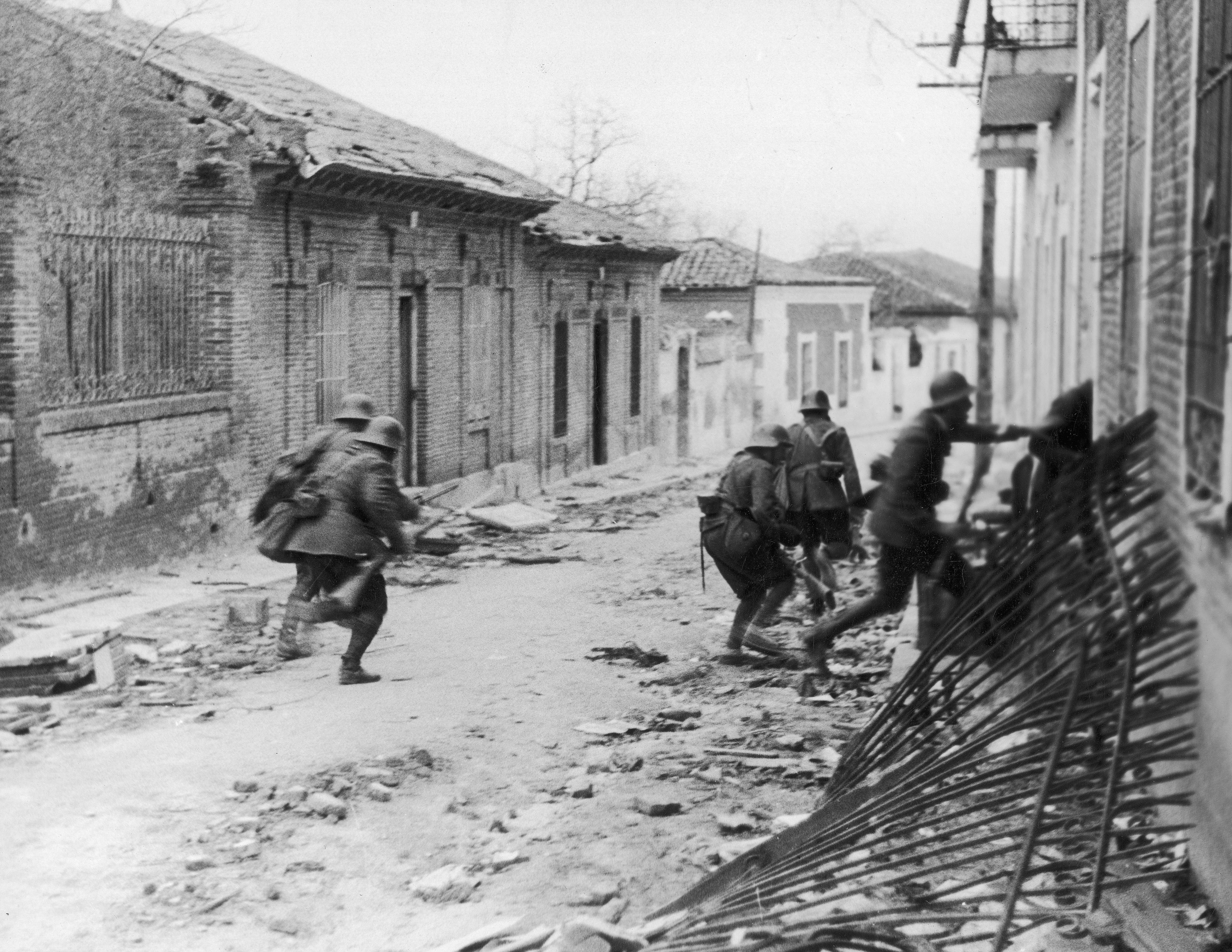
By autumn, Franco's Army of Africa had pushed north from Seville through Extremadura, taking Badajoz, Toledo, and reaching the outskirts of Madrid. On November 7, 1936, Nationalist columns under General Jose Enrique Varela attacked the city directly, crossing the Casa de Campo park and advancing into the University City district. What followed was some of the most ferocious urban combat in European history before Stalingrad. Republican militia, reinforced by the newly arrived International Brigades -- volunteers from dozens of countries -- fought room to room through university lecture halls and laboratories. The government evacuated to Valencia, but the people of Madrid stayed. General Jose Miaja and his chief of staff, Lieutenant Colonel Vicente Rojo, organized the defense with a combination of professional planning and popular fury. The Nationalists penetrated deep into University City but could not break through to the city center. By late November, the direct assault had stalled.
The Long Strangulation
Unable to take Madrid by storm, Franco shifted strategy to encirclement and attrition. The Battle of Jarama in February 1937 aimed to cut the Valencia road, Madrid's lifeline to the southeast. The Battle of Guadalajara in March 1937, where Italian Corpo Truppe Volontarie joined the Nationalist effort, attempted to complete the encirclement from the northeast -- and ended in one of the Republic's few clear victories, with Italian troops routed in snowstorms and mud. But the city still suffered. Nationalist artillery bombarded residential neighborhoods from the heights of the Casa de Campo. German and Italian aircraft conducted bombing raids that killed hundreds of civilians, making Madrid one of the first European cities subjected to sustained aerial bombardment of its population. Food grew scarce, fuel ran short, and the population endured winters without adequate heating. The phrase 'Madrid is the front' was literal -- trenches ran through city parks, sandbags lined apartment windows, and shell craters pocked the Gran Via.
Surrender Without a Savior
By early 1939, the Republic was crumbling. Catalonia had fallen, the government had fled to France, and Madrid stood isolated. On March 5, Colonel Segismundo Casado launched an anti-communist coup against the Republican government's remaining authority in Madrid, hoping to negotiate a peace with Franco. Instead, fighting broke out between Republican factions in the city streets -- communists against Casado's supporters -- a civil war within the civil war. The internal fighting lasted several days before Casado's forces prevailed. His negotiations with Franco produced nothing: the Nationalists demanded unconditional surrender. On March 28, 1939, Nationalist troops entered Madrid without significant resistance. The soldiers who had defended the city for 900 days had no strength or purpose left. The siege was over, and with it the Spanish Republic. Franco's dictatorship would last another thirty-six years.
What the Stones Remember
Modern Madrid carries the siege in its bones, even if most visitors never notice. Bullet holes are still visible on some facades in the University City area. The Parque del Oeste, rebuilt after the war, covers ground that was once a cratered no-man's-land. The Telefonica Building on Gran Via, the tallest structure in the city during the war, served as an artillery observation point and bore the nickname 'the telephone exchange of death' for the shells that regularly struck it. The two highest military decorations of the Republic -- the Laureate Plate of Madrid and the Madrid Distinction -- survived only in memory after Franco's victory erased the Republic's honors. But the phrase No pasaran endured, borrowed by resistance movements worldwide, its origin in Madrid's impossible stand becoming a universal shorthand for defiance against overwhelming force.
From the Air
Located at 40.430N, 3.715W. The siege extended across western and northwestern Madrid, with the heaviest fighting in the University City district (Ciudad Universitaria) and the Casa de Campo park, both visible from the air as large green areas west of the city center. The front line roughly followed the Manzanares River. Recommended viewing altitude 3,000-6,000 ft AGL. Nearest airport: Madrid-Barajas (LEMD), approximately 14 km northeast. The Telefonica Building on Gran Via and the Royal Palace mark key reference points.