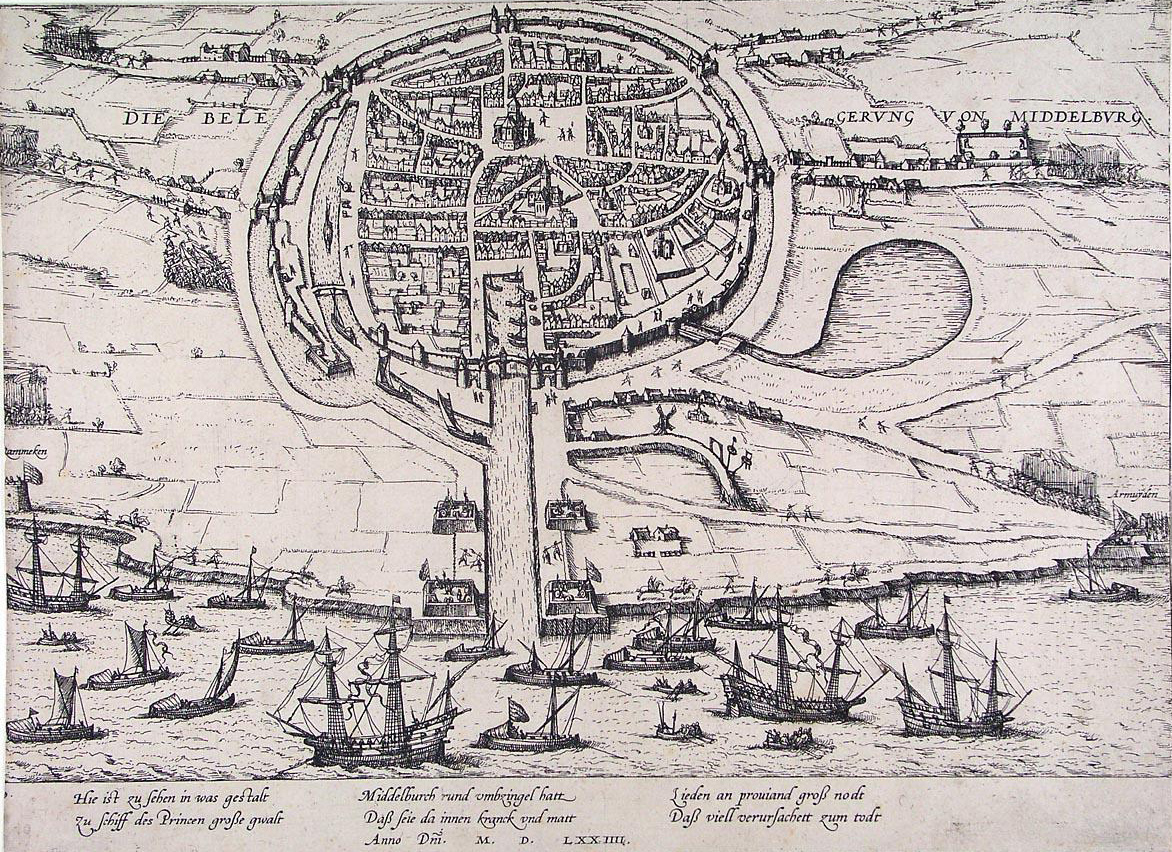
Siege of Middelburg (1572-1574)
By the bitter winter of 1573, the people of Middelburg who were judged 'of little use' - paupers, the dying, the sick - were being put outside the gates so the food inside could last a little longer for the rest. The Spanish soldiers of the garrison were starving too. Their commander, Cristóbal de Mondragón, had been ordered to hold the city for Philip II of Spain at any cost, and for fifteen months he did. Outside the walls, the Dutch rebel army of William of Orange - reinforced by English regiments paid for by Elizabeth I - tightened its noose. The siege of Middelburg (1572-1574) was not a battle anyone wanted. It was a slow, grinding contest of supply lines and willpower that ended only when news arrived that the last Spanish fleet trying to relieve the city had been smashed at sea. Mondragón surrendered with honour. The Catholic Habsburg world lost its last foothold on the island of Walcheren. The Dutch Revolt had a foundational victory.
Why Walcheren Caught Fire
Philip II of Spain had inherited the Seventeen Provinces of the Low Countries from his father Charles V, and his rule had quickly soured. By 1568 his Duke of Alba was governor-general - a hard-line Castilian general whose 'Council of Troubles' executed Protestants and dissident nobles in such numbers that even the Catholic gentry of the Netherlands began to fear him. William of Orange, stadtholder of Holland, Zeeland, and Utrecht, fled into exile and began organising resistance. The spark came in April 1572 when the Watergeuzen - the Sea Beggars, a fleet of Dutch privateers - captured the small port of Brielle on the Meuse mouth. The shock of that loss touched off a chain reaction. Within weeks, town after town on the Walcheren and Beveland islands declared for the rebels. Flushing (Vlissingen) opened its gates. Arnemuiden and Veere followed. By midsummer only Middelburg, Arnemuiden, and Goes still flew Spanish flags. Middelburg was the prize: walled, prosperous, sitting at the very centre of the island, with a strong Spanish garrison and Catholic civic government.
Two Failed Assaults, Then a Real Siege
The first attempt on Middelburg came in late April 1572, when about 1,100 Dutch rebels under Jerome Tseraerts attacked the city. They were repulsed within a day and resorted to plundering the surrounding villages. In June a smaller force of perhaps a hundred rebels under Bernard Nicholas briefly broke through the outer defences, only to be driven out by a Spanish sortie. Through that summer and autumn the Spanish garrison remained well supplied. The real siege did not begin until 4 November 1572, when roughly 1,500 Dutch and English troops under Tseraerts - fresh from a failed siege of Goes - landed on Walcheren and dug in around the city. Their force included an English regiment under Thomas Morgan, a few Scottish companies, and a number of untrained English volunteers. Tseraerts was promised the Lieutenant-Governorship of Walcheren if he could take the city. The rebels seized the small castle of Westhoven east of the walls, plundered the abbey that stood beside it, set fire to what they could not carry away, and settled in for what turned out to be a fifteen-month grind.
Mondragón and Hunger
The Duke of Alba sent Cristóbal de Mondragón - one of the most respected Spanish field commanders in the Low Countries - to take overall command of Middelburg. Mondragón was a veteran of the Italian wars and the campaigns in Germany, in his sixties but still in the field. He arrived to find a city slowly closing in on itself. The previous governor of Walcheren, Antoine of Burgundy, stepped down to become mayor under Mondragón's military authority. A Spanish relief fleet that Antoine assembled at Breskens to break the siege from the sea was intercepted off Vlissingen by the rebel captain Lieven Keersmaker, who sank or captured five ships. Through the winter of 1572-1573 the food in Middelburg dwindled. The rebels took the small castle of Popkensburg just outside the northern walls in early 1573, tightening the perimeter. Civilians inside the walls suffered first; then soldiers; then everyone. In late July 1573, after his own failure to relieve Haarlem, William of Orange personally took over command of the siege from Tseraerts. The relief that the Spanish garrison kept expecting did not come.
Honourable Surrender
What ended it was naval defeat. In late January 1574, a Spanish fleet sailing to break the siege was annihilated at the Battle of Reimerswaal in the Eastern Scheldt. When word reached Middelburg, Mondragón knew the garrison had no further hope. He opened negotiations with William of Orange. The terms were unusually generous for sixteenth-century warfare. The Spanish garrison would march out with honour, weapons in hand, drums beating, banners flying. William personally guaranteed that the city's Catholic clergy would not be harmed. Mondragón formally surrendered on 18 February 1574, and the Spanish column marched out of the gates of a city it had defended for over fifteen months. The guarantee about the clergy did not hold once the new Protestant authorities of Zeeland took over - the abbey was secularised, Catholicism was forbidden, and the canons were turned out. But the soldiers and their commander walked away alive. Mondragón would fight on in Spanish service for another twenty years, dying in 1596 at the age of ninety-two.
Why Middelburg Mattered
The fall of Middelburg cleared the last Spanish garrison from the island of Walcheren and gave the Dutch rebels unbroken control of the mouth of the Scheldt. From that base, the United Provinces could choke Antwerp's trade and grow their own merchant fleet in safety - an economic shift that, by the 1590s, would help launch the Dutch Golden Age. The siege also burnished William of Orange's reputation as a leader who could deliver military results and not just political theatre. For the Sea Beggars, the victory closed a campaign that had begun two years earlier at Brielle. For the Spanish, it was a confirmation that the religious-political-fiscal war they were trying to fight in the Low Countries was not winnable on Habsburg terms. The Eighty Years' War would grind on until 1648, but the Walcheren islands stayed Dutch, and the foundation stone of the future Dutch Republic had been laid in Middelburg's empty granaries.
From the Air
Coordinates 51.4997 N, 3.6136 E - the historic walled city of Middelburg on Walcheren, Zeeland, southwestern Netherlands. Recommended viewing altitude FL040-FL080. Visual landmarks: the diamond outline of the medieval old town with its concentric canals (still tracing the lines of the 16th-century fortifications), the Lange Jan church tower at the city's heart, the Westerschelde estuary to the south, and the North Sea coast 8 km west. The siege-era port of Vlissingen lies 7 km southwest; Veere (also captured by the Sea Beggars in 1572) lies 7 km northeast. Nearest airport: Midden-Zeeland (EHMZ) 7 km west; Antwerp (EBAW) 60 km southeast.