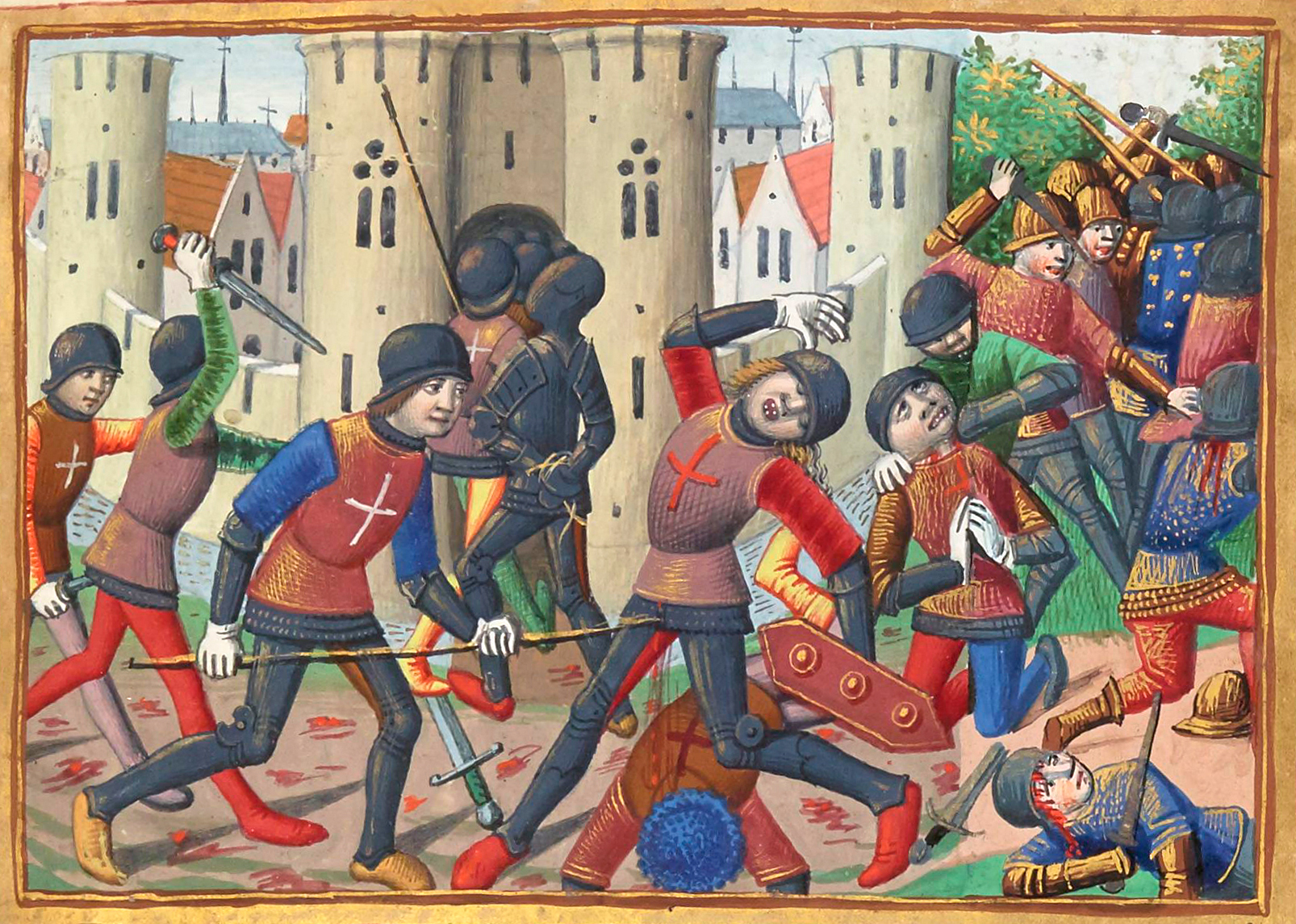
Siege of Montargis
The defenders of Montargis opened the sluice gates, and the Loire campaign of the Hundred Years' War began to turn before Joan of Arc ever lifted a sword. It was September 1427, and a French garrison perched on high ground between the Loing and Vernisson rivers had endured nearly two months of English bombardment. What happened next was not a feat of arms in the traditional sense but an act of hydraulic warfare, a calculated unleashing of water that swept away a bridge, divided an army, and handed France one of its first significant victories in a conflict that had been going badly for decades.
The Stronghold Between Rivers
Montargis occupied a natural defensive position that any medieval commander would envy. The town sat on elevated ground, flanked by the Loing and Vernisson rivers and threaded with canals that turned the surrounding terrain into a web of waterways. In June 1427, John of Lancaster, the Duke of Bedford and effective ruler of English-held France, ordered Richard Beauchamp, the Earl of Warwick, to take this stronghold. Warwick arrived with 3,000 men and artillery, laying siege on July 15. The garrison was sizeable, well supplied, and in no mood to surrender. For weeks, English cannons battered the fortifications, but the town's geography worked against the besiegers. The rivers and canals made it difficult to fully encircle the position, and the high ground gave the defenders an advantage that raw firepower could not easily overcome.
Water as a Weapon
By early September, the English had made little progress, and Dauphin Charles saw an opportunity. He dispatched a relief force of 1,600 men under two commanders who would soon become famous: Jean de Dunois, the Bastard of Orleans, and the fearsome captain known as La Hire. Dunois was methodical where La Hire was ferocious, and their plan required both qualities. Dunois sent word to the garrison, coordinating a precise sequence of events. His force appeared south of town, drawing English attention. As Warwick's troops moved to engage the relief force across a wooden bridge, the garrison inside Montargis acted. They opened the town's sluice gates. Water surged through the canals, sweeping the bridge away and cutting the English army cleanly in two. Suddenly Warwick's force was split on opposite sides of a flood, unable to support itself. Dunois struck from one direction while the garrison sallied from the other.
A Third of an Army Lost
The result was devastating for the English. Warwick lost a full third of his troops in the rout, along with all of his artillery and baggage. The survivors fled in disorder. For an army that had dominated northern France for years, the defeat at Montargis was a shock. The victory electrified French morale at a moment when confidence in the Dauphin's cause was dangerously low. Dunois, still in his mid-twenties, emerged as a military figure of the first rank. Two years later, he would be at Orleans when Joan of Arc arrived to lift that siege, and the two would fight together in the Loire Campaign that expelled the English from the valley. La Hire, too, would become one of Joan's closest battlefield companions. The partnership forged at Montargis proved durable. The siege demonstrated something the French had struggled to believe: that English armies could be beaten, that clever tactics could neutralize superior numbers, and that the rivers of France could be turned against those who tried to conquer her.
From the Air
Coordinates: 47.997N, 2.733E. Montargis is located at the confluence of the Loing and Vernisson rivers, about 110 km south of Paris. The river system and canal network are visible from altitude. Recommended viewing at 3,000-5,000 ft AGL. Nearest airport: Montargis-Vimory (LFEM).