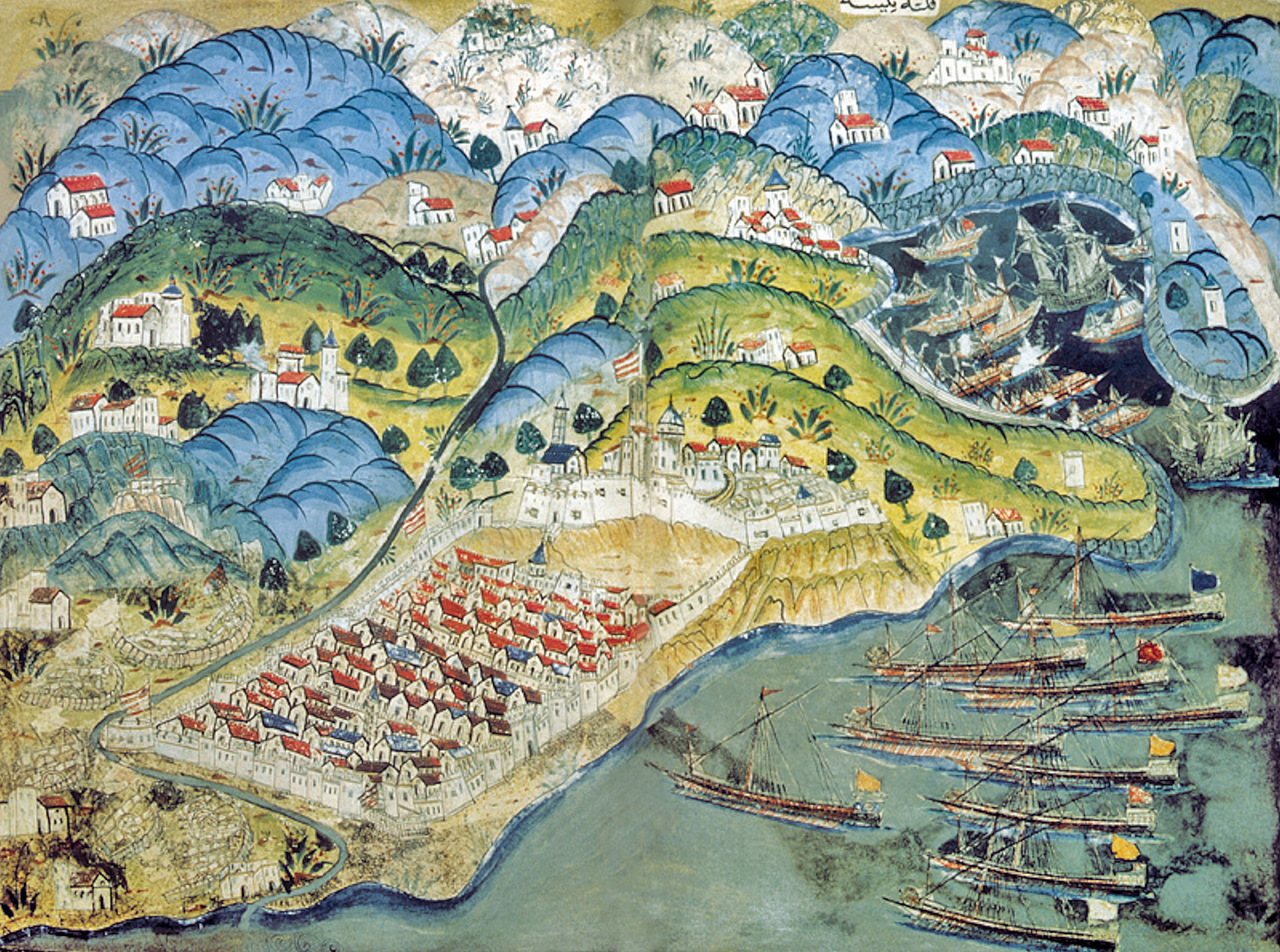
Siege of Nice
A cannonball from the Ottoman fleet is still embedded in a wall on the Rue Droite in Nice's old town. A plaque identifies it, noting that it dates from the siege of 1543, 'where Catherine Segurane, heroine of Nice, distinguished herself.' That a Turkish cannonball sits in a street in the south of France tells you something about how strange this siege was. The King of France and the Sultan of the Ottoman Empire -- the most powerful Christian and Muslim rulers of their age -- had joined forces to attack a city that belonged to neither of them.
An Alliance That Shocked Europe
The Franco-Ottoman alliance was one of the most audacious diplomatic arrangements of the 16th century. Francis I of France, locked in a long struggle with Holy Roman Emperor Charles V, needed naval power he did not possess. Suleiman the Magnificent needed a western ally to pressure the Habsburgs from two directions. Through the French ambassador to Constantinople, Antoine Escalin des Aimars -- known as Captain Polin -- the two rulers arranged for the Ottoman fleet to operate in the western Mediterranean alongside French forces. In mid-May 1543, the legendary admiral Hayreddin Barbarossa sailed from the Sea of Marmara with 110 galleys and 50 smaller vessels. He raided Sicily and southern Italy, anchored at the mouth of the Tiber opposite Rome, then sailed to Toulon and Marseille, where he was received with full military honors. European observers were horrified. A Christian king was welcoming the Ottoman fleet into the heart of Christendom.
Walls Breached, Citadel Held
Nice in 1543 belonged to the Duchy of Savoy, whose Duke Charles III had allied with the Habsburgs by marrying into the Portuguese royal family -- infuriating Francis I. The combined Franco-Ottoman fleet sailed from Marseille on August 5 and attacked Nice the following day. The defenders resisted fiercely, and it was during this fighting that the legend of Catherine Segurane was born -- a washerwoman said to have led the townspeople into battle, knocking down an Ottoman standard-bearer with her laundry paddle. The city surrendered on August 22, but the citadel -- the Chateau on the hill above -- held out, apparently because the French failed to supply sufficient gunpowder to their Ottoman allies. Barbarossa reportedly complained about the quality of French ships and the inadequacy of their supplies. The arrival of a relief fleet under the Genoese admiral Andrea Doria prompted the Ottoman withdrawal.
A Winter in Toulon
What happened next was perhaps more remarkable than the siege itself. Francis I offered Barbarossa the use of Toulon as a winter base, so that the Ottoman fleet could continue harassing Habsburg shipping. For six months, the Ottoman navy -- 110 galleys and 30,000 troops -- occupied a major French port. France provided approximately 10 million kilograms of bread to feed the Ottoman forces. From Toulon, Admiral Salah Rais raided Barcelona, Sanremo, and other Spanish and Italian coastal towns. The arrangement strained credulity across Europe. Other Christian powers denounced the alliance as treasonous to Christendom itself. Relations between the two allies were tense and suspicious throughout. A peace treaty was finally signed at Crepy in September 1544, and the Ottomans withdrew.
The Washerwoman and the Cannonball
Catherine Segurane's existence has never been definitively proven. Jean Badat, a historian who witnessed the siege firsthand, made no mention of her. The documented defense of Nice relied on the townspeople destroying a key bridge and the eventual arrival of Savoyard reinforcements. But the legend proved more durable than the facts. Louis Andrioli wrote an epic poem about her in 1808. A play followed in 1878. In 1923, a bas-relief monument was erected near the supposed site of her feat. Nice celebrates Catherine Segurane Day every November 25. The real legacy of the siege, though, is written in stone: the Fort du Mont Alban and the fortifications at Villefranche were built in its aftermath, hardening the coastline against future attacks. And that Turkish cannonball remains in its wall on the Rue Droite, a physical reminder that the Mediterranean world of the 16th century was far more interconnected -- and far stranger -- than most people imagine.
From the Air
Located at 43.70N, 7.27E in Nice's Vieux Nice (Old Town), which clusters at the base of Castle Hill (Colline du Chateau). The castle that withstood the siege no longer exists -- it was demolished in 1706 by Louis XIV -- but the hill remains a prominent landmark. Fort du Mont Alban, built after the siege, is visible on the hill east of the port of Villefranche. Nearest airport: Nice Cote d'Azur (LFMN). The old town, harbor, and surrounding fortifications are best viewed at 2,000-4,000 feet AGL.